Why Blend?
Single surfactants have limitations.
SLS is strong but harsh.
SLES is mild but needs foam help.
AOS is great in hard water but hard to thicken.
The solution: Blend them.
Combine surfactants to get the best of each.
The Science of Synergy
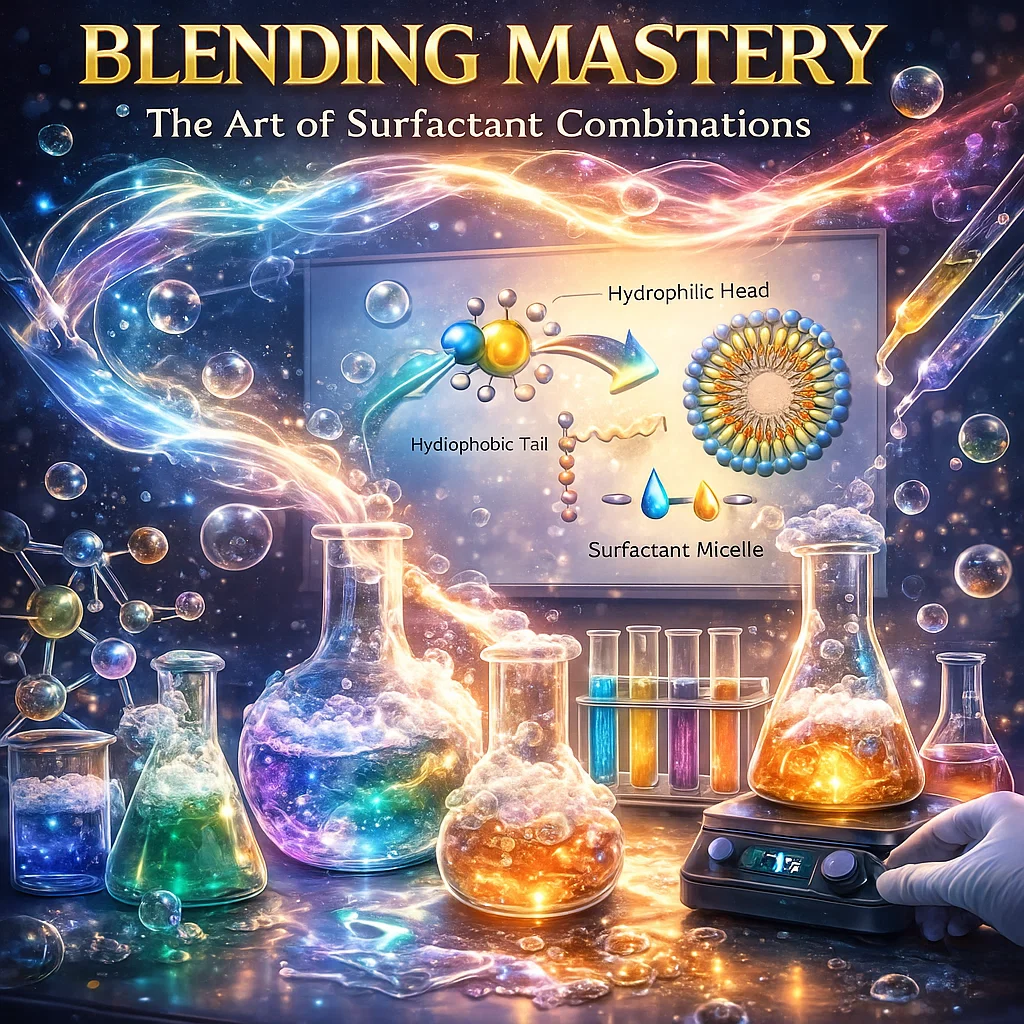
When surfactants mix, something interesting happens.
Their combined performance exceeds what each can do alone.
This is called synergy.
Example:
SLES alone: Good foam.
CAB alone: Mild, modest foam.
SLES + CAB: Excellent foam AND mild. Better than either alone.
Classic Combinations That Work
Combo 1: SLES + CAB (Betaine)
Use for: Shampoo, body wash, hand soap.
Ratio: 70-80% SLES, 20-30% CAB.
Result: Rich foam, mild, easy to thicken.
Combo 2: SLES + AOS
Use for: Dishwashing liquid, hard water areas.
Ratio: 60-70% SLES, 30-40% AOS.
Result: Works in hard water, good foam, stable.
Combo 3: SLES + AOS + CMEA
Use for: Premium dishwashing liquid.
Ratio: 50% SLES, 30% AOS, 10% CMEA.
Result: Maximum foam, creamy texture, cleans well.
Combo 4: SLES + LES (Lauryl Ether Sulfate, ammonium salt)
Use for: Extra mild products.
Ratio: 60% SLES, 40% AESA.
Result: Very gentle, for sensitive skin products.
How to Design Your Own Blend
Step 1: Define your goals.
What matters most?
- Foam volume?
- Foam stability?
- Cleaning power?
- Mildness?
- Cost?
- Thickening ease?
Rank them.
Step 2: Select primary surfactant.
This will be 50-70% of your blend.
Usually SLES for most applications.
Step 3: Select secondary surfactant(s).
This addresses what the primary lacks.
Need mildness? Add betaine.
Need hard water performance? Add AOS.
Need foam boost? Add CMEA.
Step 4: Test in small batches.
Make 500g samples.
Test foam, viscosity, stability.
Adjust ratios.
Step 5: Check cost.
Does the performance gain justify the extra cost?
Sometimes simpler is better.
Common Blending Mistakes
Mistake 1: Too many surfactants.
Three or four is usually enough.
Five or more creates complexity without benefit.
Mistake 2: Ignoring compatibility.
Some surfactants don’t mix well.
Anionic + cationic = usually bad. They neutralize each other.
Anionic + amphoteric = usually good.
Anionic + non-ionic = usually good.
Mistake 3: Wrong ratios.
Adding 1% of something rarely makes a difference.
Meaningful changes require meaningful amounts.
Minimum usually 10% of the blend.
Mistake 4: Not testing stability.
Blends can behave differently over time.
Always do accelerated stability tests.
Economic Blending
Sometimes blending is about cost, not performance.
Scenario:
AOS is expensive.
SLES is cheaper.
Customer needs hard water performance.
Strategy:
Use mostly SLES (cheaper).
Add just enough AOS to solve the hard water problem.
Maybe 70% SLES, 30% AOS.
Performance is good. Cost is controlled.
Documentation Matters
When you find a good blend, write it down.
Record:
- Exact percentages
- Order of mixing
- Mixing speed and time
- Temperature
- Final pH
- Final viscosity
- Stability results
Without records, you can’t repeat success.
The Bottom Line
Blending is where art meets science.
Single surfactants are tools.
Blends are solutions.
Learn to combine them well.
This skill separates beginners from experts.