The Mildness Challenge
SLS cleans great.
But it strips skin too harshly.
Customers complain:
- “My hands are dry.”
- “My scalp itches.”
- “This product is too strong.”
How do you keep cleaning power while reducing irritation?
Understanding Skin Irritation
Why do surfactants irritate skin?
They remove too much.
Your skin has natural oils. A protective barrier.
Strong surfactants strip away this barrier.
Result: Dry, tight, irritated skin.
They penetrate.
Some surfactant molecules can get into the skin.
This triggers inflammation.
Irritation scale (most to least):
SLS > SDS > SLES > AOS > CAB > Amino acid surfactants
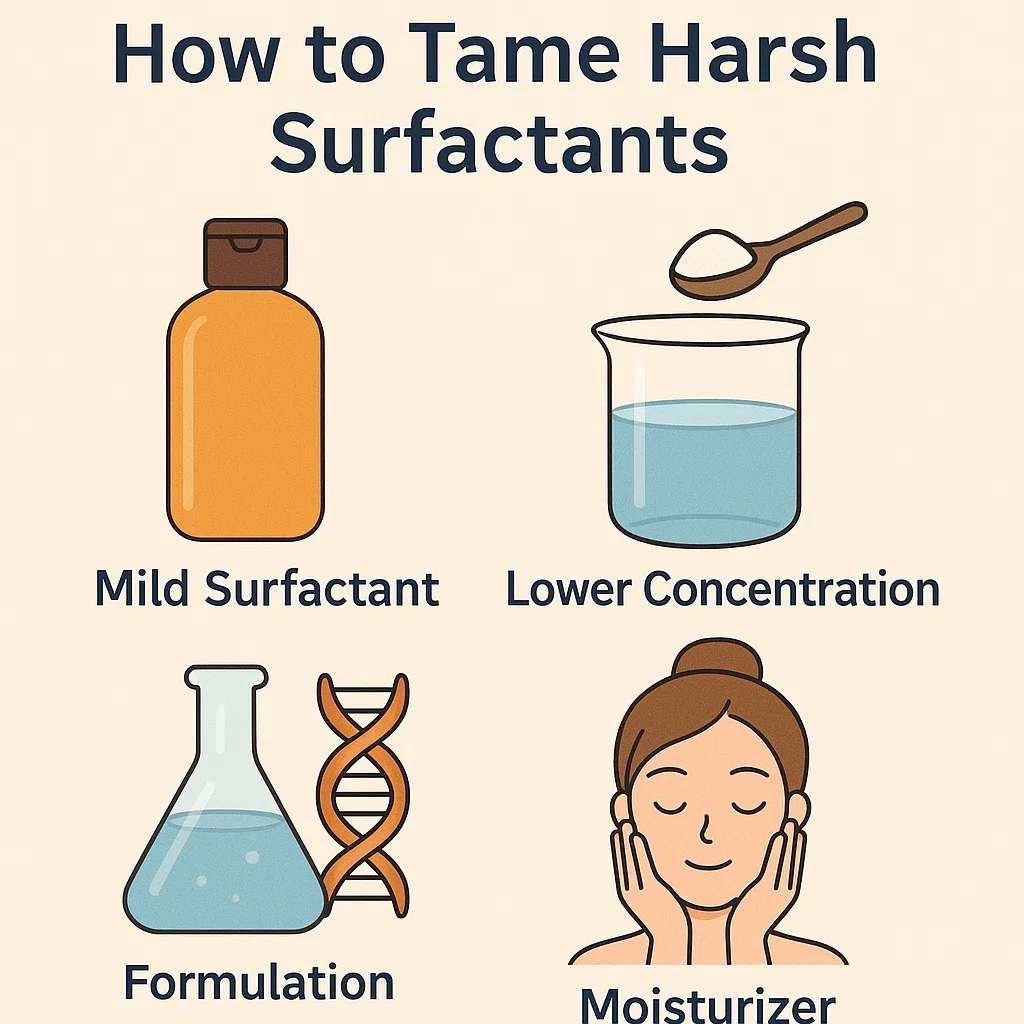
Strategy 1: Dilute with Water
The simplest approach.
Less surfactant = less irritation.
If you’re using 15% SLES, try 10%.
Product will be milder.
Trade-off: Also less foam and cleaning power.
Strategy 2: Blend with Mild Surfactants
This is the professional approach.
Don’t replace your surfactant. Add partners.
Best mild partners:
Amphoteric surfactants:
- CAB (Cocamidopropyl Betaine)
- CAPB (same thing, different name)
- Lauryl Betaine
These dramatically reduce irritation.
And they boost foam too. Win-win.
Non-ionic surfactants:
- Decyl Glucoside
- Lauryl Glucoside
- Cocamide DEA (less popular now)
Non-ionics are inherently gentle.
The Magic Ratio
How much mild surfactant to add?
General guideline:
For noticeable improvement: 20-30% of your surfactant blend should be amphoteric.
Example:
Before: 15% SLES alone.
After: 10% SLES + 5% CAB.
Same total surfactant. Much milder product.
Strategy 3: Add Skin Conditioners
You can’t always change the surfactant system.
Add ingredients that protect or soothe the skin.
Common additions:
- Glycerin (2-5%): Moisturizing.
- Aloe vera extract: Soothing perception.
- Panthenol (Vitamin B5): Skin conditioning.
- Allantoin: Anti-irritation.
- Quaternized proteins: Form protective film.
These don’t reduce surfactant irritation directly.
But they help skin recover faster.
Strategy 4: Adjust the pH
pH affects irritation.
Skin’s natural pH: Around 5.5 (slightly acidic).
Most surfactant solutions: pH 6-8.
What to do:
Adjust final product pH to 5.5-6.5.
Use citric acid to lower pH.
This is closer to skin’s natural state.
Result: Less irritation.
Caution:
Going too low (below pH 4) can cause problems.
Some preservatives don’t work at low pH.
Always test stability.
Strategy 5: Choose Better Raw Materials
Not all SLES is equal.
Higher EO number = milder.
SLES 3EO is gentler than SLES 2EO.
Lower 1,4-Dioxane = safer.
Look for suppliers with strict control (<5ppm).
Purer product = less irritation.
Impurities can cause sensitivity.
Buy from reputable sources.
Case Study: Reformulating a Hand Soap
Original formula (too harsh):
| Ingredient | Percentage |
| SLS | 12% |
| Water | 85% |
| Salt | 2% |
| Preservative | 0.5% |
| Fragrance | 0.5% |
Complaints: “Dries out my hands.”
Improved formula:
| Ingredient | Percentage |
| SLES (3EO) | 8% |
| CAB (30%) | 4% |
| Glycerin | 3% |
| Water | 82% |
| Salt | 1.8% |
| Preservative | 0.5% |
| Fragrance | 0.5% |
Changes made:
- Replaced SLS with SLES.
- Added CAB for mildness.
- Added glycerin for moisture.
- Reduced total surfactant slightly.
Result: Happy customers. Still foams well. Still cleans.
Testing Mildness
How do you know if your product is mild enough?
Professional method: Patch testing.
Apply product to skin.
Observe for 24-48 hours.
Look for redness, dryness, or irritation.
Lab method: Zein test.
Measures protein damage.
Lower number = milder product.
Customer method: Trial feedback.
Give samples to real users.
Collect honest opinions.
The Bottom Line
Harsh surfactants can be tamed.
Blend with amphoteric surfactants.
Add skin-friendly ingredients.
Adjust pH toward skin-neutral.
The goal: Clean effectively without punishment.