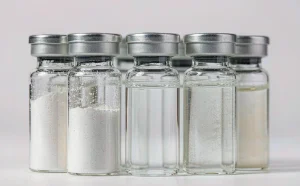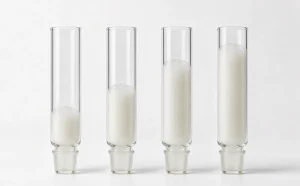
Short answer: SDS precipitates from cold buffers once the temperature drops near its Krafft point, which sits around 16 C. LDS, the lithium salt of the same C12 sulfate, stays soluble at 4 C and keeps proteins solubilised during low-temperature runs. For cold-room electrophoresis and chilled sample preparation, LDS is the practical choice.
This article is written for lab managers and procurement staff buying electrophoresis-grade surfactants. Our guide to choosing electrophoresis-grade SDS covers grade selection for room-temperature work; this one covers the cold end of the range. Solubility values are typical literature observations, not guaranteed specifications; confirm behaviour in your own buffer system before committing to a protocol.
What happens to SDS in a cold buffer?
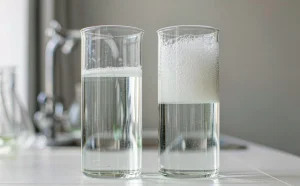
Every ionic surfactant has a Krafft point: the temperature below which solubility falls sharply and micelles stop forming. SDS sits close to room temperature, with published values around 16 C depending on purity and counterion impurities. Below that line, an SDS solution clouds, and anything the SDS was holding in solution, including denatured protein, can come out of solution with it.
That is the failure mode labs hit in winter and in cold rooms. A sample buffer prepared warm runs clean on the bench, then precipitates when the same buffer sits in a 4 C room or arrives in a drum that spent a night at minus 10 C. The surfactant is not off-spec; the temperature crossed its solubility limit.
LDS vs SDS: side-by-side properties
| Property | SDS (CAS 151-21-3) | LDS (CAS 2044-56-6) |
|---|---|---|
| Counterion | Sodium | Lithium |
| Molecular weight | 288.38 | 272.33 |
| Krafft point, typical | Around 16 C (published range roughly 15-20 C) | Below SDS; stays in solution at 0-4 C |
| Solubility at 4 C | Poor; clouding and precipitation likely | Good; solutions stay clear |
| Room-temperature PAGE | Standard choice | Works, at higher cost |
| Low-temperature PAGE and cold-room work | Risk of precipitation | Documented use case |
| Typical grades sold | SDS 97%, SDS 99% | LDS high-purity powder |
| Price position | Commodity grade | Specialty grade, small MOQ |
The lithium counterion is the whole story. Swapping sodium for lithium lowers the Krafft point enough that the salt stays soluble in the temperature range where most cold-room work happens. Micellisation behaves in the same order of magnitude as SDS, so the denaturing and solubilising function you rely on in a sample buffer carries over. A third salt in the same family, magnesium dodecyl sulfate (CAS 3097-08-3), is quoted for specific protocols and sits between the two in counterion behaviour.
Where does the low temperature actually matter?
| Situation | What goes wrong with SDS | What LDS changes |
|---|---|---|
| Gel run in a 4 C cold room | Running buffer clouds near the Krafft point; bands smear | Buffer stays clear through the run |
| Chilled sample preparation to limit proteolysis | Sample buffer precipitates on ice, taking protein with it | Samples stay in solution during the cold step |
| Membrane and hydrophobic protein work at low temperature | Loss of solubilisation as micelles collapse | Solubilisation holds at 0-4 C |
| Winter shipping to Russia, Iran or Central Asia | Drums and solutions transit at sub-zero temperatures | Tolerates cold transit without clouding |
| Standard room-temperature PAGE at 20-25 C | No issue | No advantage; SDS 97% or 99% is the economical choice |
Routine room-temperature work does not need LDS. If your lab runs at 20-25 C all year, SDS 97% or 99% is the right buy and LDS is money spent on a property you will never use. The specialty case is work that happens in the cold, whether in a 4 C room or in a winter shipment. The wider trade-offs sit in our LDS vs SDS performance comparison and the LDS vs SDS cost note.
What to confirm when you order
- Assay and moisture: ask for the COA values rather than the grade name. Electrophoresis grades are specified on assay, colour and heavy metals.
- Test method: confirm which method the supplier used for the active assay so you can compare lots across shipments.
- Packaging: lab-scale packs of 500 g to 5 kg suit protocol work; request a sample before committing to a case quantity.
- Companion reagents: Tris base and guanidine hydrochloride ship from the same catalogue, which keeps a cold-room build-out to one supplier and one shipment.
- Storage: keep both grades sealed and dry. LDS tolerates cold storage; SDS does not need it but does not suffer from it.
Key takeaways
- Krafft point decides it: SDS sits around 16 C; below that, solubility collapses and buffers cloud.
- LDS holds at 0-4 C: the lithium salt stays soluble where SDS precipitates, which is why cold-room protocols specify it.
- Same function, different temperature window: micellisation and protein solubilisation behave in the same order as SDS.
- Do not overspend: for room-temperature PAGE, SDS 97% or 99% is the economical choice.
- Buy on documentation: assay, moisture and heavy metals on the COA matter more than the grade label.
Frequently asked questions
What is the Krafft point of SDS?
Published values put it around 16 C, with the exact figure moving with purity and trace counterions. The practical reading is that SDS solutions can cloud at typical cold-room temperatures, which is why buffers for 4 C work are prepared and stored with that limit in mind.
Can I run SDS-PAGE at 4 C with LDS?
Yes, and that is the standard use case. LDS keeps the running buffer and the sample buffer clear through a cold-room run. Expect to re-optimise gel percentage and run time for your protein mix, because buffer temperature affects migration speed independently of the surfactant.
Is LDS a drop-in replacement for SDS in sample buffer?
For most protocols it is used at a comparable concentration on a weight basis, with the caveat that molecular weights differ (272.33 for LDS against 288.38 for SDS), so a molar-equivalent swap is about 5% less LDS by weight. Run a benchmark gel before switching a published protocol.
Which SDS grade should I buy for routine PAGE?
Electrophoresis-grade SDS at 97% or 99% assay is the standard buy. The higher assay grade is chosen when trace impurities interfere with sensitive detection, not because it denatures better.
How should electrophoresis-grade surfactants be shipped and stored?
Sealed, dry and away from moisture. SDS does not require cold chain, but a winter shipment through Russia or Central Asia can still see sub-zero temperatures in transit; ask the supplier for packaging rated for the route. LDS tolerates those temperatures, which is one reason labs standardise on it for cold districts.
Request a quote or a sample
For bulk pricing, MOQ and lead time on LDS, SDS 97% or SDS 99%, request a quote with your annual volume. If you are validating a low-temperature protocol, request a sample of LDS and request the COA and MSDS for the lot before you commit. Contact our team and we will confirm assay, packaging and shipping conditions for your destination in the same reply.
Written and reviewed by the ORID Chem technical team. Last updated: 25 October 2026. Solubility and Krafft point values are typical literature observations, not guaranteed specifications. Confirm current specifications on the product TDS and lot COA before ordering.