Short answer: In hand dishwashing liquids, SLES gives more stable foam in hard water and feels milder, while SLS gives stronger initial foam at a lower cost per kilogram of active matter. Most commercial formulas use SLES as the primary surfactant and keep SLS as a foam booster. The right split depends on your water hardness and price target.
This comparison is written for formulators and buyers setting the surfactant package for a hand dishwashing liquid. Our broader SLS vs SLES guide covers chemistry and grade selection; this article sticks to dishwashing. All test values shown are illustrative bench-trial ranges, not guaranteed performance. Run the same tests on your own water and your own grease load before you lock a formula.
SLS vs SLES: what actually changes in the formula?
| Property | SLS (CAS 151-21-3) | SLES (CAS 68585-34-2) |
|---|---|---|
| Chemistry | C12 alkyl sulfate (sulfate ester) | C12-14 alkyl ether sulfate (ethoxylated) |
| Commercial form | Powder, needles, 30% liquid | 70% paste |
| Typical active content | 92-95% powder, 30% liquid | 70% |
| Foam character | High, fast, larger bubbles | Creamy, dense, holds longer |
| Hard-water tolerance | Moderate; foam drops as Ca and Mg rise | Better than SLS; still loses foam at very high hardness |
| Skin feel at use dilution | Harsher | Milder |
| Salt thickening window | Narrow, easy to overshoot | Wide and predictable |
| Cost per kg of active matter | Usually the cheapest anionic | Higher; ships as 70% paste with 30% water |
One point of chemistry drives most of the differences. SLS is a sulfate ester, and calcium and magnesium bind to it and pull it out of solution as poorly soluble salts. SLES carries a short ethylene oxide chain ahead of the sulfate group, which buffers that effect. Neither grade matches a sulfonate such as AOS in very hard water, but between the two sulfates, SLES is the more forgiving one.
How much foam does each grade give?
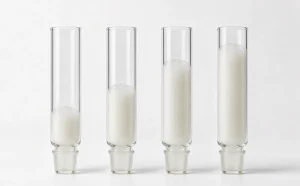
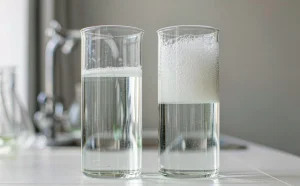
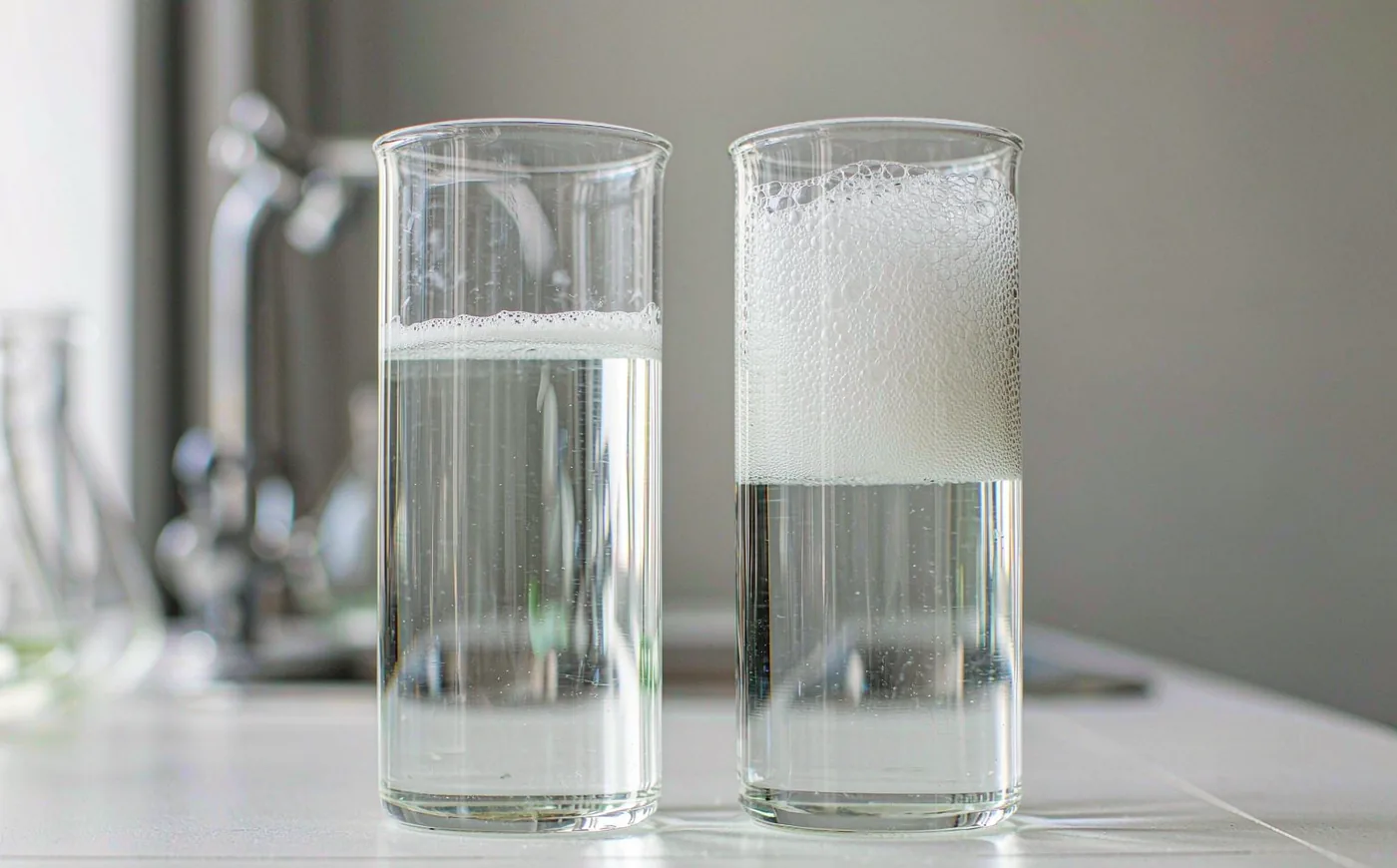
Foam is the first property a dishwashing buyer tests, usually with the Ross-Miles method or a simple shake test at 25 C. The pattern repeats across bench trials: SLS wins the first 30 seconds, SLES wins at 5 minutes, and AOS wins once the water gets hard.
| Test condition | SLS at 12% active | SLES at 12% active | Reading |
|---|---|---|---|
| Soft water, 150 mg/kg CaCO3 | 185 mm initial, 150 mm at 5 min | 165 mm initial, 155 mm at 5 min | SLS flashes faster, SLES holds better |
| Hard water, 300 mg/kg CaCO3 | 140 mm initial, 95 mm at 5 min | 160 mm initial, 130 mm at 5 min | illustrative bench values |
| Very hard water, 500 mg/kg CaCO3 | 110 mm initial, 60 mm at 5 min | 135 mm initial, 100 mm at 5 min | SLS collapses; builders help both grades |
Treat those numbers as a shape, not a specification. Co-surfactants, pH and grease load all move them. The direction is the part worth designing around: as hardness rises, the gap between the two sulfates widens in favour of SLES.
Which grade removes plate grease faster?
Grease removal follows a different ranking than foam. In side-by-side plate tests with a standard grease soil at 25 C, SLS and SLES land within a few points of each other at equal active dose. The practical difference shows up at low dose and in hard water, where SLES keeps more of its detergency and needs less builder to get there.
| Active dose | SLS removal, soft water | SLES removal, soft water | SLES removal, 300 mg/kg hardness |
|---|---|---|---|
| 6% | 62% | 64% | 58% |
| 10% | 74% | 76% | 72% |
| 14% | 81% | 83% | 79% |
Illustrative values from a bench trial. The curve flattens above roughly 12-14% active for both grades: past that point you are buying foam and viscosity, not cleaning.
What does each grade cost per kilogram of active matter?
SLES ships as a 70% paste, so one tonne of SLES product carries 700 kg of active matter and 300 kg of water. Compare the two sulfates on cost per kilogram of active matter, not per kilogram of drum. The formula is product price divided by active fraction, and our worked example on cost per kg of active matter runs the arithmetic in full.
With illustrative prices: SLS 92% powder at 1,650 USD per tonne gives about 1.79 USD per kg of active matter, while SLES 70% paste at 1,700 USD per tonne gives about 2.43 USD per kg. The SLES figure is easier to accept when you count the salt-thickening window and the milder positioning; it gets harder to accept when freight is charged on the 30% water. If your plant prefers liquid handling, SLS 30% liquid removes the dissolving step but roughly doubles the cost per kg of active matter.
What dosage levels do commercial formulas use?
| Ingredient | Typical range, as supplied | Function |
|---|---|---|
| SLES 70% paste | 15-25% | Primary surfactant, foam, viscosity with salt |
| SLS 95% powder | 1-4% | Foam booster, cost control |
| Betaine or amphoteric | 2-5% | Foam stabiliser, mildness |
| Sodium chloride | 0-2% | Viscosity adjustment |
| Preservative, dye, fragrance | q.s. | Standard |
These are starting ranges for bench work, not a finished formula. If your market runs on hard water, substitute part of the SLES with AOS 35% or AOS 38% instead of pushing the sulfate dose up. The case for AOS in hard water and the AOS 35% dishwashing application note work through that substitution in detail. Powder detergent buyers who need the same foam profile at low freight cost should look at AOS 95% powder as well.
Key takeaways
- Foam profile: SLS gives faster initial foam; SLES gives foam that lasts. Hard water amplifies the difference.
- Grease removal: at equal active dose the two sulfates are close. SLES holds up better as hardness rises.
- Cost: SLS is cheaper per kg of active matter. SLES buys the thickening window and a milder label.
- Dosage: above roughly 12-14% total actives, extra surfactant buys foam and viscosity rather than cleaning power.
- Hard water: above 300 mg/kg CaCO3, test AOS 35% or 38% alongside the sulfates before committing to a formula.
Frequently asked questions
Can I replace SLES with SLS in an existing dishwashing formula?
Not one-for-one. SLS is a powder rather than a paste, foams faster but less stably, and has a narrower salt-thickening window, so viscosity, foam and preservative levels all need rework. A partial swap is the lower-risk route: keep SLES as the primary surfactant and add 1-4% SLS as a booster.
Which grade foams better in hard water, SLS or SLES?
SLES. The ethoxylated head group tolerates calcium and magnesium better than the plain sulfate ester. At 300 mg/kg CaCO3 and above, the foam gap becomes visible in a shake test, and SLS formulas need extra builders or chelating agents to keep up.
Is SLS safe to use in a hand dishwashing product?
SLS is used in dishwashing and personal care products at controlled dosage levels. The questions a formulator needs to answer are rinse-off concentration and skin contact time, checked against the supplier TDS and the rules of the destination market. This article does not provide regulatory advice.
What active level do commercial dishwashing liquids usually run?
Most hand dishwashing liquids run between 10% and 18% total anionic actives, with mild higher-priced formulas at the lower end and value formulas at the upper end. Above roughly 14%, the cleaning curve flattens and the extra surfactant mostly builds foam and viscosity.
Where can I get samples for a bench trial?
Request samples of SLS 92%, SLS 95%, AOS 35% and AOS 38% through our contact page, with your target active level and water hardness. Include your destination port so we can confirm packaging, MOQ and lead time in the same reply.
Request a quote or a sample
For bulk pricing, MOQ and lead time on SLS 92%, SLS 95%, AOS 35% or AOS 38%, request a quote. If you are screening grades for a new dishwashing liquid, request a sample of each candidate and run the foam and grease tests on your own water. You can also request the COA and MSDS for any grade before you commit to a trial order, or contact our team with your water hardness data and we will reply with current specifications and shipping options.
Written and reviewed by the ORID Chem technical team. Last updated: 25 October 2026. Test values in this article are illustrative bench ranges, not guaranteed performance. Confirm current specifications on the product TDS and lot COA before ordering.