Short answer: AOS and LAS are both sulfonates, so both tolerate calcium and magnesium far better than sulfate esters such as SLS. In hard water AOS keeps higher, longer-lasting foam and holds detergency without heavy builder loads, while LAS foams less but cleans at a lower cost. For hard-water markets across India, Pakistan and Iran, AOS is usually the safer primary surfactant.
This comparison is written for detergent formulators and buyers supplying markets where tap water runs hard: much of India, Pakistan, Iran, and parts of Russia and Southeast Asia. LAS (linear alkylbenzene sulfonate) is included as the market benchmark; we do not sell it. The decision at the end is usually AOS alone versus AOS plus a reduced builder system.
AOS vs LAS: what is the chemical difference?
| Property | AOS (CAS 68439-57-6) | LAS (CAS 68411-30-3) |
|---|---|---|
| Chemistry | Alpha olefin sulfonate, sulfonate | Linear alkylbenzene sulfonate, sulfonate |
| Carbon chain | C14-16 olefin | C10-13 alkylbenzene |
| Foam level | High, fast, stable | Moderate, collapses faster |
| Detergency | Strong on grease and particulate soil | Strong on particulate soil, weaker on grease |
| Hard-water behaviour | Holds foam and detergency at high Ca and Mg | Tolerant, but foam drops and builders carry the load |
| Biodegradability | Ready biodegradation | Readily biodegradable |
| Commercial forms | 35% and 38% liquid, 92% and 95% powder | Pasties and liquids, various strengths |
| Cost position per kg active | Mid to high | Usually the cheapest anionic sulfonate |
Both are sulfonates: the sulfur atom sits directly on carbon, not behind an oxygen as in SLS or SLES. That C-S bond is why both tolerate calcium and magnesium better than sulfate esters such as SLS 92% powder do. The real difference between AOS and LAS is foam and solubility. AOS foams high and fast, which is why it anchors dishwashing liquids and visible-foam products, as our hard-water AOS write-up shows. LAS foams lower but cleans cheaply, which is why laundry powders ran on LAS for decades.
How does each grade perform in hard water?
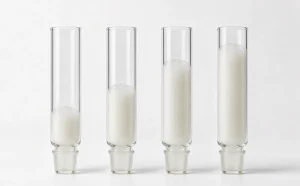
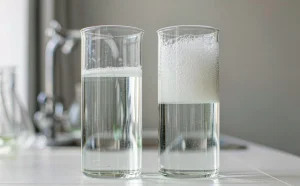
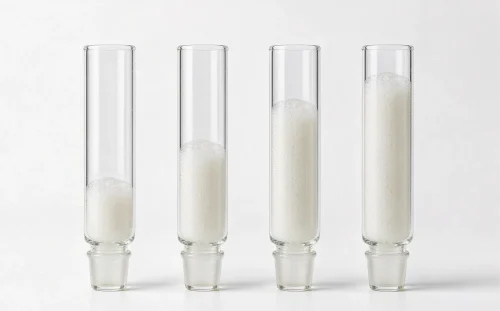
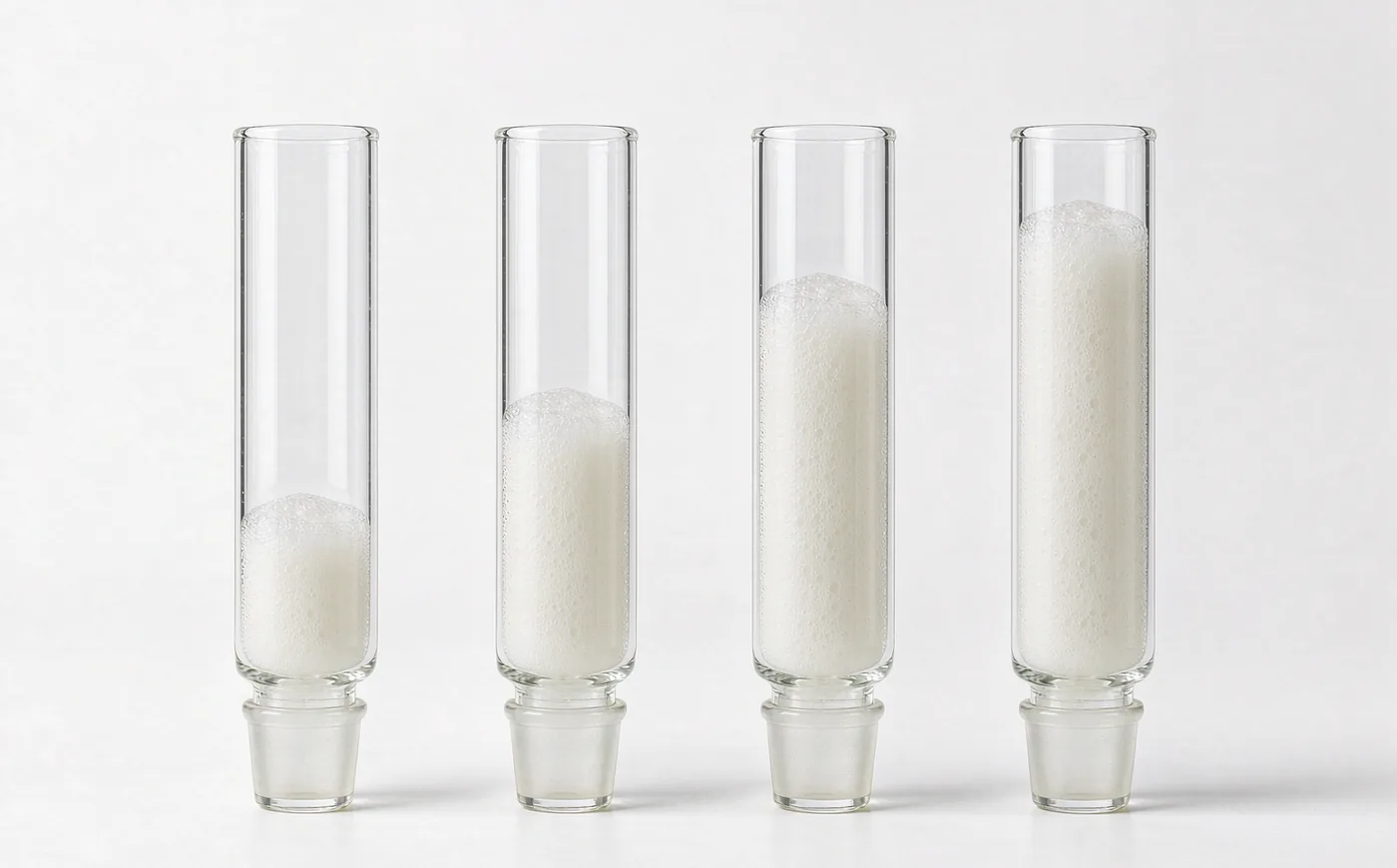
Foam retention is the quickest screening test. The illustrative bench values below come from 12% active solutions titrated with calcium carbonate at 25 C, foam measured immediately and after 5 minutes.
| Water hardness | AOS, initial / 5 min | LAS, initial / 5 min | Reading |
|---|---|---|---|
| 150 mg/kg CaCO3 | 175 mm / 170 mm | 130 mm / 110 mm | AOS foams about 35% higher |
| 300 mg/kg CaCO3 | 170 mm / 160 mm | 110 mm / 85 mm | LAS loses half its 5-minute foam |
| 500 mg/kg CaCO3 | 160 mm / 140 mm | 90 mm / 60 mm | AOS keeps a usable head at high hardness |
Detergency follows the same shape with a smaller gap. On a standard grease plate at equal active dose in soft water, LAS and AOS land within about 5 points of each other. The gap widens as hardness rises, and it widens further when builder dosage is capped by cost or by phosphate restrictions in the destination market.
What does each grade cost per kilogram of active matter?
On price alone, LAS is usually the cheapest route to detergency per kilogram of active matter. That advantage narrows once you add the builders LAS needs to perform in hard water. Illustrative numbers: AOS 35% liquid at 1,500 USD per tonne gives about 4.29 USD per kg of active matter, and AOS 95% powder at 2,100 USD per tonne gives about 2.21 USD per kg. Compare both against a LAS quote plus its builder package before you decide, and run the comparison on cost per kg of active matter rather than per tonne of product.
Freight flips the picture for liquids: AOS 35% and 38% ship 62-65% water, so long routes to Russia or Iran penalise the liquid grades on landed cost. Powder grades such as AOS 92% and AOS 95% usually win the landed-cost comparison on long routes, and they also suit spray-dried powder plants that cannot handle paste.
When should you choose AOS over LAS?
| Your situation | Better starting point | Why |
|---|---|---|
| Hand dishwashing liquid where visible foam sells the product | AOS 35% or 38% | Foam volume and stability that LAS does not reach |
| Laundry powder in hard water with capped builders | AOS 92% or 95% | Holds detergency where LAS needs more zeolite or citrate; see the AOS 95% phosphate-free laundry note |
| Light-duty liquid with a sulfate-free claim | AOS 35% or 38% | Sulfonate chemistry with no sulfate ester group |
| High-volume powder detergent, full builder system, tight cost target | LAS benchmark | Lowest cost per kg of active matter when builders are already loaded |
| Shampoo or body wash | AOS or SLES | Foam and mildness profile suits leave-on and rinse-off personal care |
Key takeaways
- Chemistry: AOS and LAS are both sulfonates; both beat sulfate esters such as SLS in hard water.
- Foam: AOS holds roughly 35% more foam than LAS at equal active dose, and the gap widens with hardness.
- Detergency: close in soft water, in AOS’s favour as hardness rises and builder dosage is capped.
- Cost: LAS is cheaper per kg of active matter before builders; AOS is cheaper once builder load and freight are counted.
- Logistics: for long routes to Russia, Iran or Central Asia, AOS powder grades beat the liquids on landed cost.
Frequently asked questions
Is AOS better than LAS in hard water?
For foam, yes, clearly: AOS keeps a higher and more stable foam column as calcium and magnesium rise. For detergency, AOS is better once builder dosage is capped, because it needs less help from zeolite, citrate or other builders to reach the same cleaning result.
Can AOS replace LAS one-for-one in a laundry powder?
Dose is not the only variable. AOS foams more, which changes the perceived performance of a hand-wash product, and its powder grades flow differently in spray-dried and agglomerated processes. Start by replacing 20-30% of the LAS charge, then check foam, bulk density and dissolution time before going further.
What dosage of AOS do hard-water formulas need?
Typical starting ranges are 8-15% active AOS in a hand dishwashing liquid and 5-12% in a laundry powder, adjusted for water hardness and builder level. Buyers benchmarking against a sulfate-ester baseline can run SLS 95% at the same active dose for reference. These are bench starting points; confirm the final level with your own foam and detergency tests.
Does AOS still need builders?
Less than LAS does, but not zero. AOS tolerates hardness ions directly, so a reduced builder package is often enough. The saving shows up twice: lower builder cost and lower total solids in the formula.
How do I test foam retention on my own water?
Use a graduated cylinder and a fixed shake protocol: 20 ml of 12% active solution, 20 shakes, measure immediately and after 5 minutes. Repeat at your local tap hardness and at 300 mg/kg CaCO3 made up with calcium chloride. The ratio of 5-minute foam to initial foam is the number to track across grades.
Request a quote or a sample
For bulk pricing, MOQ and lead time on AOS 35%, AOS 38%, AOS 92% or AOS 95%, request a quote. If you are benchmarking AOS against your current LAS package, request a sample of the grade that matches your plant format and run the foam retention test on your own water. The primary surfactant selection guide for powder and liquid detergents covers the same trade-off from the powder side. You can also request the COA and MSDS before a trial order, or contact our team with your destination port and we will confirm packaging, MOQ and lead time in the same reply.
Written and reviewed by the ORID Chem technical team. Last updated: 25 October 2026. Test values and prices in this article are illustrative bench ranges and example figures, not guaranteed performance or quotations. Confirm current specifications on the product TDS and lot COA before ordering.