Short answer: LDS, the lithium salt of dodecyl sulfate, stays soluble at wash temperatures where SLS clouds, because it does not share the sodium salt’s Krafft point near 16 C. The extra cost pays back only in cold-water lines, clear gels and winter markets such as Russia. For a standard 30-40 C wash, SLS or AOS do the job at a fraction of the cost.
This comparison is written for detergent formulators and buyers evaluating lithium dodecyl sulfate against the cheaper sodium grades. Bench values and prices below are illustrative working numbers. Test on your own soil load and water before locking a formula.
Why does wash temperature change the surfactant choice?
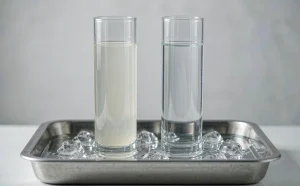
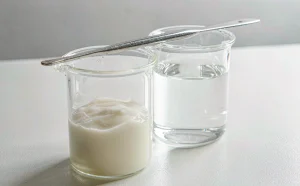
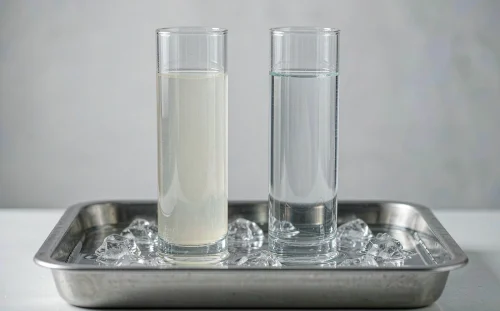
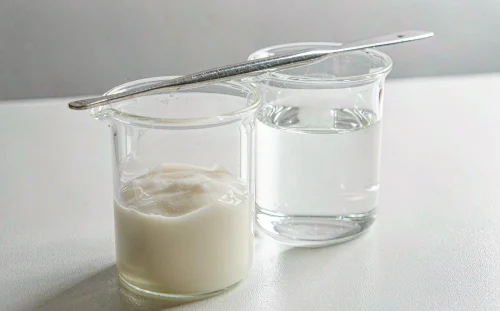
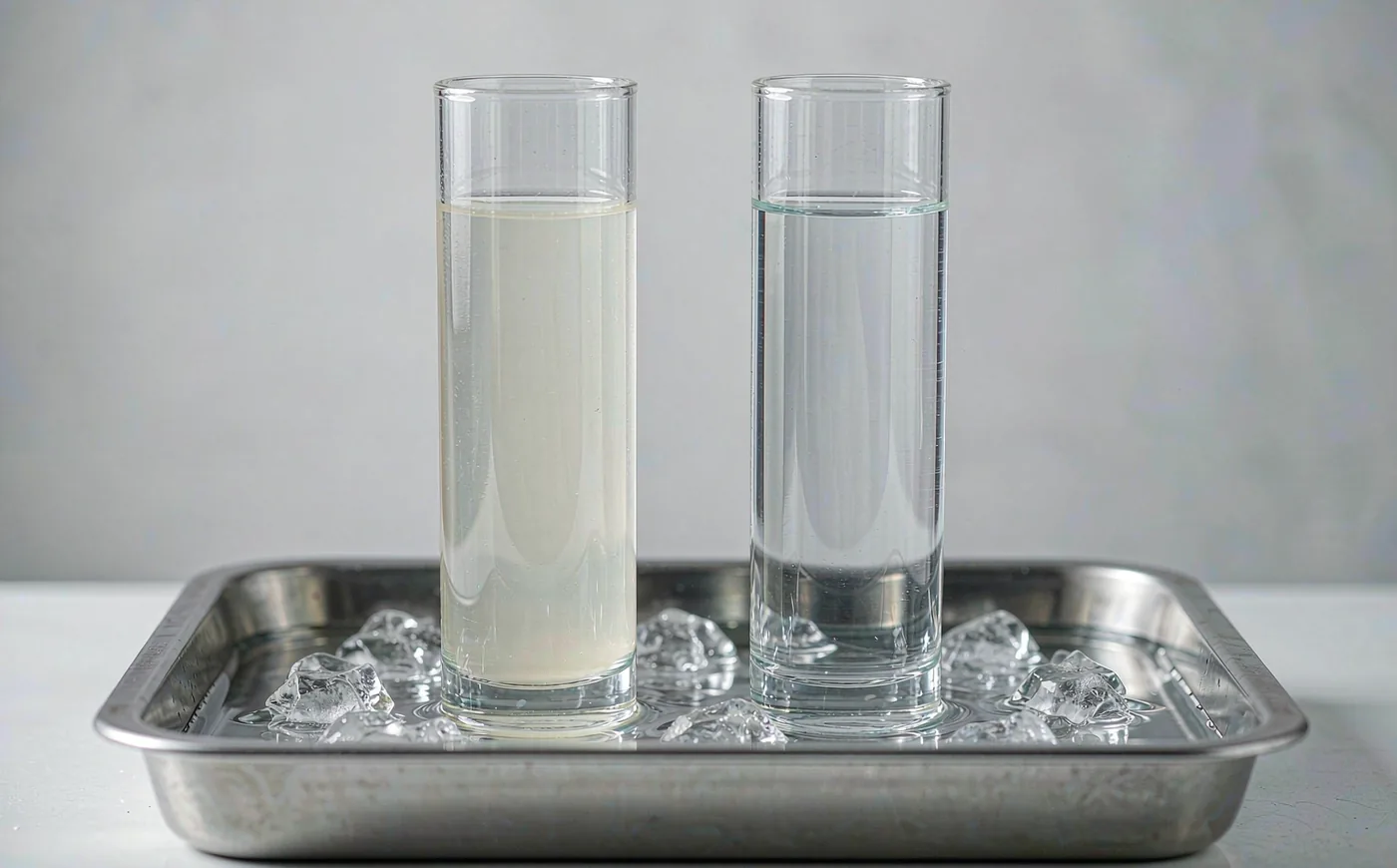
Surfactants have a temperature below which solubility collapses. For sodium lauryl sulfate, that Krafft point sits around 16 C in pure water: below it the product clouds, gels or throws a precipitate, and performance drops with the solubility. A 20 C wash program, an unheated plant in northern India in December, or a drum shipped through Russia in January all cross that line.
Cold-water programs also carry a real energy argument. A household machine typically draws roughly 0.3 kWh per 20 C cycle against about 0.6 kWh at 40 C, illustrative figures that vary by machine and load, so brands have pushed wash temperatures down for a decade. That trend is what created the demand for surfactants that work cold, and it is the gap LDS fills.
How do LDS and SLS compare at low temperature?
Side-by-side bench trials at 1 g/L active, checked for clarity and then for detergency on a standard blended soil. Illustrative values.
| Grade | Solution clarity at 10 C | Detergency at 20 C | Detergency at 40 C |
|---|---|---|---|
| LDS, CAS 2044-56-6 | Clear | About 82% | About 86% |
| SLS 92% | Cloudy to gelled | About 74% | About 85% |
| AOS 35% | Clear | About 80% | About 85% |
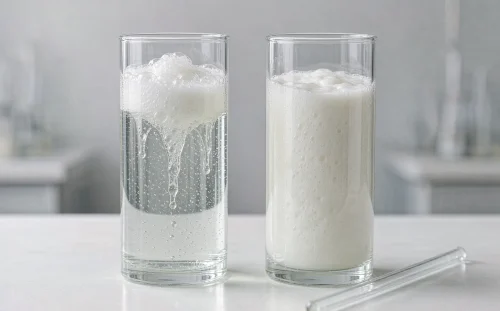
At 40 C the three grades converge. The separation appears as the temperature drops: SLS loses solubility and then detergency, while LDS and AOS hold both. LDS also carries a secondary advantage in lab work, where its cold solubility is the reason it replaced SDS in low-temperature electrophoresis protocols; our LDS vs SDS electrophoresis article covers that use in detail.
The CMC and Krafft point guide explains the mechanism, and the winter clouding guide covers the storage and transit failures that follow when a sodium-sulfate concentrate crosses its Krafft point.
What does LDS cost more than SLS?
Lithium is the expensive part of the molecule, so LDS quotes several times above SLS per tonne. Divide by active fraction to compare properly; the arithmetic is the same as in our cost per kg of active matter worked example.
| Grade, illustrative price | Product price per tonne | Active fraction | Cost per kg of active matter |
|---|---|---|---|
| LDS | 3,800 USD | 0.99 | 3.84 USD |
| SLS 95% | 1,750 USD | 0.95 | 1.84 USD |
| SLS 92% | 1,650 USD | 0.92 | 1.79 USD |
Run the payback at formula scale. A liquid laundry detergent carrying 3% LDS in the finished product spends about 114 USD per tonne of detergent on that surfactant, against about 50 USD if the same active dose came from SLS 92%. The difference is roughly 65 USD per tonne of finished product at illustrative prices. Whether that is acceptable is a positioning question, not a chemistry one.
Where does LDS fit in a cold-water formula?
| Product type | Typical LDS use | What it buys |
|---|---|---|
| Cold-water liquid laundry detergent | Partial replacement of the primary anionic, dosed on active matter | Clear, stable product at 10-20 C with detergency held |
| Clear gel and unit-dose formats | Co-surfactant where clarity is a spec | No clouding in cold storage or cold wash |
| Winter and cold-climate lines | Part of the anionic package for Russia and similar markets | Survives unheated warehouses and cold transit |
| Enzyme liquids | Co-surfactant where the enzyme system must stay active | Cold stability without raising the total active dose |
The usual pattern is a blend, not a swap. Formulators keep SLES, SLS or AOS as the bulk of the anionic package and add LDS where the cold performance gap shows. Our LDS laundry application note and the primary surfactant selection guide cover the full blend logic.
When does SLS or AOS do the same job for less?
In warm-wash markets, almost always. A 40 C wash sits well above the Krafft point of SLS, so the sodium grades perform and cost a fraction of the lithium salt. Even at 20 C, AOS holds clarity and detergency at a price close to SLS, which makes it the default cold-weather workhorse for value lines.
The case for LDS narrows to three situations: the wash temperature is genuinely at or below 20 C as a selling point, the product must stay clear in cold storage as a spec, or the formula already runs a cold-stable package and needs the last few points of detergency. Outside those, the honest answer is that AOS and SLS cover it. One more caution for liquid lines: SLS 30% liquid is the most exposed to cold clouding of anything on this page, so winter liquid lines are the first place to look at LDS or AOS.
Key takeaways
- Temperature split: at 40 C the grades converge; at 20 C and below, SLS loses clarity and detergency while LDS and AOS hold.
- Mechanism: the sodium salt’s Krafft point near 16 C is the failure line; the lithium salt does not share it.
- Premium: LDS costs roughly 3.84 USD per kg of active matter against about 1.8 for SLS at illustrative prices, about 65 USD per tonne of finished detergent at a 3% dose.
- Default workhorse: AOS covers most cold-water jobs at a price close to SLS. LDS is the upgrade, not the baseline.
- Winter storage: any sodium-sulfate concentrate, liquid or powder-made, needs heated storage for cold routes.
Frequently asked questions
Is LDS the same surfactant as SLS?
Same anion, different counter-ion. LDS is lithium dodecyl sulfate, CAS 2044-56-6; SLS and SDS are the sodium salt, CAS 151-21-3. The lithium swap changes cold solubility and price, not the basic cleaning chemistry.
Can I replace SLS with LDS one-for-one?
On active matter, yes, and the foam and detergency profiles stay close. The practical change is cost and cold stability, so most formulators use LDS as a partial replacement and keep the cheaper sodium grades as the bulk of the package.
Does LDS work in powder detergent?
It can be dosed into a powder, but the cold-water advantage matters most in liquid formats, where a sodium-sulfate concentrate is the thing that clouds. In powders the wash temperature, not the storage temperature, is the limiting factor, and AOS or SLS usually covers it at lower cost.
What wash temperature makes LDS worth the price?
Around 20 C and below, or wherever the product spec demands clarity after cold storage. At 40 C the grades converge and the extra cost buys nothing measurable in a bench trial.
Can LDS be blended with AOS?
Yes, and the combination is common in cold-water liquids: AOS carries the bulk of the anionic package and the hard-water performance, LDS adds cold solubility and the last points of low-temperature detergency. Run a stability trial at your lowest storage temperature before locking the ratio.
Request a quote or a sample
For bulk pricing, MOQ and lead time on LDS, SLS 92% or AOS 35%, request a quote with your destination port and volume. If you are building a cold-water line, request a sample of each grade and run the clarity and detergency checks at your lowest wash and storage temperatures. You can also request the COA and MSDS for any grade before a trial order, or contact our team with your wash program and storage conditions and we will confirm the most economical package for your market.
Written and reviewed by the ORID Chem technical team. Last updated: 2 November 2026. Test values and prices in this article are illustrative bench ranges, not guaranteed performance or quotations. Confirm current specifications on the product TDS and lot COA before ordering.