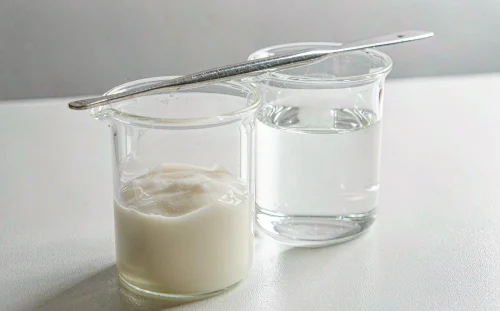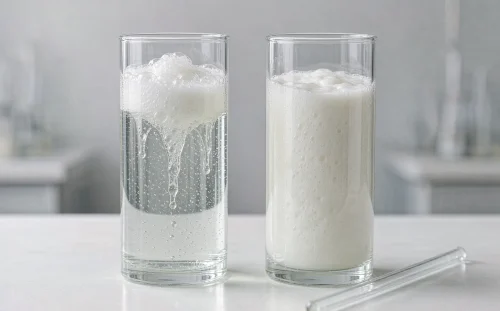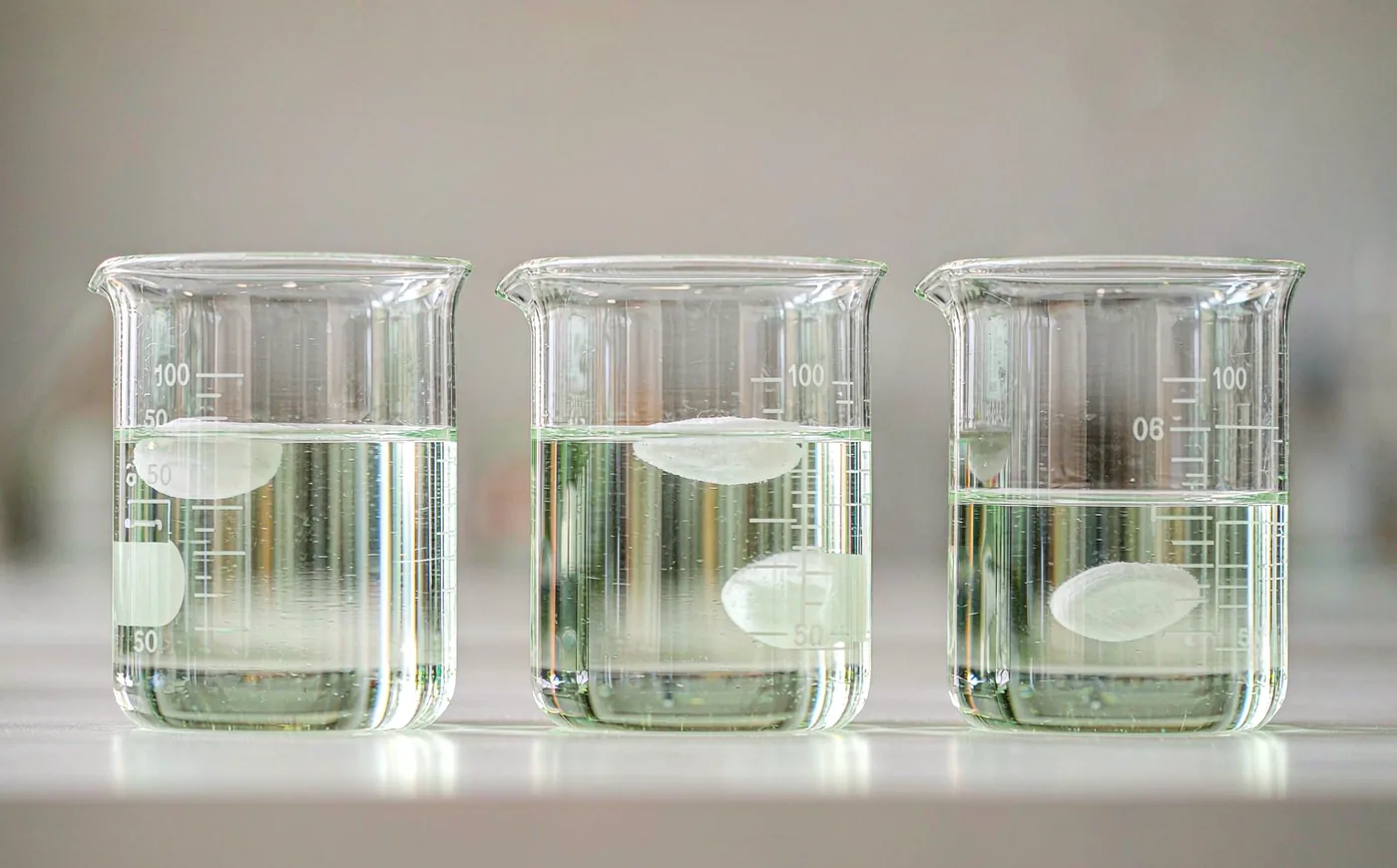
Short answer: At equal concentration and 25 C, AOS wets fastest, SLS sits mid-pack in soft water and falls behind in hard water, and SLES is the slowest. It matters wherever a liquid has to spread into fabric, a surface or soil before cleaning starts: textile scouring, spray-and-wipe cleaners and tank-mix penetration. Hard water widens the gap against SLS.
This article compares the three grades on the cotton disk sinking test, the bench method most plants use as a wetting screen. Values are illustrative bench ranges from side-by-side trials, not guaranteed specifications. Run the same test on your own water before you pick a grade.
What is the wetting time test, and why does it matter?
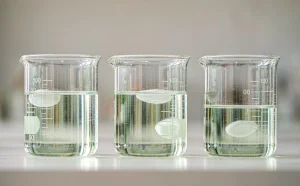
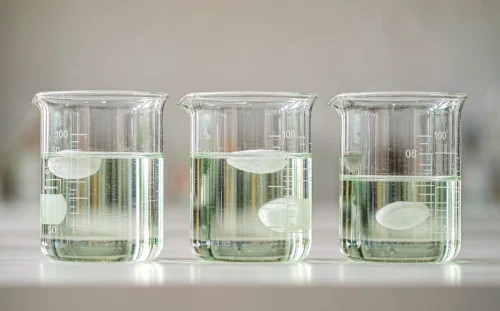
The standard bench test is simple. A cotton disk or skein is dropped onto the surface of a surfactant solution at a fixed concentration, usually 1 g/L, and the time it takes to sink is recorded in seconds at 25 C. Lower is better. Variants of the method use different cotton substrates and concentrations, so numbers are only comparable within the same setup.
Wetting time is the first step of every cleaning job. A surfactant that pulls the liquid into fabric, into a greasy film or into a powder bed does the rest of the work faster and at lower dose. Where wetting fails, the customer sees streaks on a wiped surface, uneven scouring in a rope of fabric, or clay that will not disperse in a drilling or ceramic slurry.
What wetting times do SLS, AOS and SLES give?
Side-by-side trials at 1 g/L active and 25 C, cotton disk sinking method. Illustrative bench values.
| Solution, 1 g/L active | Soft water, 150 mg/kg CaCO3 | Hard water, 300 mg/kg CaCO3 | Very hard water, 500 mg/kg CaCO3 |
|---|---|---|---|
| AOS 35% | About 12 s | About 15 s | About 20 s |
| SLS 92% | About 25 s | About 70 s | Above 120 s |
| SLES 70% | About 60 s | About 75 s | About 90 s |
Two readings come out of the table. AOS is the strongest wetter and the least sensitive to hardness, which follows from its sulfonate head group resisting calcium and magnesium. SLES is the slowest in soft water but the most stable as hardness rises, because its ether chain buffers the same effect that cripples SLS.
How does concentration change the wetting time?
Wetting improves with concentration and then flattens. The shape of the curve follows the same logic as the critical micelle concentration: below it, single molecules do the wetting and the numbers are noisy; above it, the surface saturates and extra surfactant buys little. SLS has a CMC of about 8.2 mM at 25 C, roughly 2.4 g/L in pure water, so a 1 g/L test solution sits just under its CMC and the sink times are more variable than they look.
| Active concentration, soft water | AOS 35% | SLS 92% | SLES 70% |
|---|---|---|---|
| 0.5 g/L | About 20 s | About 45 s | Above 100 s |
| 1 g/L | About 12 s | About 25 s | About 60 s |
| 3 g/L | About 8 s | About 15 s | About 35 s |
Doubling the dose from 1 to 3 g/L cuts wetting time by roughly half for all three grades. If a formula is fighting a wetting problem, dose is the first lever, and the CMC and Krafft point guide explains where the curve stops paying. The second lever is grade choice, which is what this table is for.
What do temperature and water hardness do to the numbers?
Cold water lengthens sink time across the board, and the effect is larger below the Krafft point of the grade. SLS has a Krafft point around 16 C in pure water, so a 10 C wash tank can turn an SLS solution cloudy and push wetting times up sharply. AOS and SLES tolerate colder water far better. For winter production in Russia or unheated plants in northern India and Iran, test the grade at your real tank temperature, not at 25 C.
Hardness attacks SLS specifically. Calcium and magnesium tie up the sulfate ester and pull it out of solution, which is why the SLS row jumps from about 25 s to above 120 s between soft and very hard water. AOS barely moves. If your supply water runs above 300 mg/kg CaCO3, the AOS hard-water comparison covers the same effect for foam and detergency.
Where does wetting time matter commercially?
| Application | Why wetting matters | Grade that usually leads |
|---|---|---|
| Textile scouring and pre-treatment | The bath must penetrate the rope or fabric in seconds for even treatment | AOS, or AOS blended with a nonionic |
| Spray-and-wipe hard-surface cleaners | Surface tension has to drop fast so the liquid spreads instead of beading | AOS 35% or 38% |
| Agrochemical tank mixes and adjuvants | The mix must wet leaf or soil surface on contact | AOS, with a nonionic for retention |
| Pigment, filler and clay dispersion | Powder must wet before it can disperse, or the slurry lumps | AOS 35% at low dose, SLS where cost dominates |
| General detergents where foam sells the product | Foam matters more than sink time | SLES or SLS rather than a pure wetter |
The general-purpose grades sit in between. SLS 95% powder covers value detergent lines, and AOS 95% powder is the low-water way to dose a wetting agent into a powder product. Our anionic surfactant comparison places all five grades side by side.
Key takeaways
- Ranking: AOS wets fastest, SLS is mid in soft water, SLES is slowest but steadiest. Illustrative bench values at 1 g/L and 25 C.
- Dose lever: going from 1 to 3 g/L active cuts sink time by roughly half for every grade.
- Hard water: SLS wetting collapses above 300 mg/kg CaCO3; AOS barely moves. Match the grade to your water.
- Cold tanks: below about 16 C, SLS loses solubility as well as wetting. Test at your real tank temperature.
- Application fit: choose the wetter for scouring, spraying and dispersion jobs; choose SLES or SLS where foam is the selling point.
Frequently asked questions
Which surfactant has the fastest wetting time?
Of the three compared here, AOS at equal active concentration. The sulfonate head group spreads quickly and holds up in hard water. Adding a nonionic surfactant usually improves wetting further, at the cost of foam.
Is the Draves test the only way to measure wetting?
No. Labs also use the canvas belt method, the cotton skein variant and surface tension readings as a proxy. Numbers from different methods do not convert into each other, so compare grades only within one method and one substrate.
Can I improve wetting without changing surfactant?
Yes. Raise the dose toward 3 g/L active, warm the bath above the Krafft point of the grade, and cut water hardness with a builder or chelant. If those three are exhausted and the sink time is still too long, the grade itself is the wrong tool and AOS is the usual replacement.
Does SLES foam more because it wets less?
The two properties trade off across grades. SLES puts its molecular weight into foam and viscosity, AOS into wetting and hard-water tolerance. A formula that needs both usually blends them rather than picking one.
How do I get bench samples for a wetting trial?
Request samples of AOS 35% or 38%, SLS 92% or 95%, SLS 30% liquid for liquid-fed lines, and SLES 70%, then run them at equal active dose on your own water at your tank temperature. Include your application, because a scouring bath and a spray cleaner optimise different points of the curve.
Request a quote or a sample
For bulk pricing, MOQ and lead time on AOS 35%, AOS 95%, SLS 92% or SLES 70%, request a quote with your destination port and volume. If you are screening grades for a scouring, spray or dispersion line, request a sample of each candidate and run the sink test on your own water. You can also request the COA and MSDS for any grade, or contact our team with your tank temperature and water hardness and we will suggest the grade that fits.
Written and reviewed by the ORID Chem technical team. Last updated: 2 November 2026. Test values in this article are illustrative bench ranges from side-by-side trials, not guaranteed performance. Confirm current specifications on the product TDS and lot COA before ordering.