Short answer: SLS is the standard surfactant in toothpaste, typically dosed at 1.0-2.0% as supplied powder, and it gives the highest, fastest foam during brushing. SLES works at similar active levels and reads as milder and creamier, at a higher cost per kilogram of active matter. Formulas aimed at sensitive users cut the SLS dose or switch to SLES.
This comparison is written for toothpaste formulators and for buyers sourcing surfactant grades for oral care production. The toothpaste grade buyers guide covers the full purchasing checklist; this article stays on the SLS versus SLES formulation question. All bench values below are illustrative ranges, not guaranteed performance.
What does each grade bring to a toothpaste formula?
| Property | SLS (CAS 151-21-3) | SLES (CAS 68585-34-2) |
|---|---|---|
| Commercial form | Powder or needles, 92-95% active | 70% paste |
| Foam during brushing | High and fast, larger bubbles | Creamier, denser, slightly slower to build |
| Perceived tolerance | Harsher at the top of the dose range | Generally read as milder in use |
| Water added to the batch | None; powder dissolves into the water phase | About 30% of the paste is water |
| Compatibility notes | Anionic; keep apart from cationic actives such as chlorhexidine | Anionic; same rule, slightly more forgiving with electrolytes |
| Cost per kg of active matter | Lower of the two at powder grades | Higher, because 30% of the drum is water |
Both grades are anionic, so both need the same compatibility checks against cationic antimicrobials and against the abrasive and fluoride systems. The practical differences are foam character, the water each grade drags into the batch, and price per kilogram of active matter.
What dosage do commercial toothpastes use?
Published formula ranges put SLS at roughly 1.0-2.0% as supplied powder, with most mass-market tubes at the lower end of that window and value formulas at the upper end. SLES, where it is used, runs at a similar active level, which means a larger as-supplied dose because the paste is only 70% active: 1.4% of SLES 70% carries about 1.0% active matter.
| Grade | Typical dose, as supplied | Active matter delivered | Notes |
|---|---|---|---|
| SLS 95% powder | 1.0-2.0% | 0.95-1.9% | Standard choice for foam-driven mass-market tubes |
| SLS 92% powder | 1.0-2.0% | 0.92-1.84% | Same use, slightly lower assay |
| SLES 70% paste | 1.4-2.9% | 1.0-2.0% | Milder positioning; count the paste water in the water phase |
| SDS 97% / SDS 99% | 1.0-2.0% | 0.97-1.98% | Higher assay grades where the COA spec is tight |
Assay is not the whole spec. Toothpaste buyers also screen for whiteness, odor, mesh size and residual sulfate, and the COA is where those numbers live. Our COA reading guide lists the lines to check before releasing a lot to production.
How much foam does each grade give during brushing?
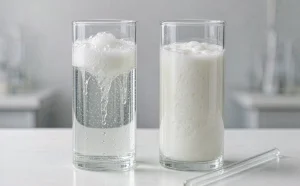
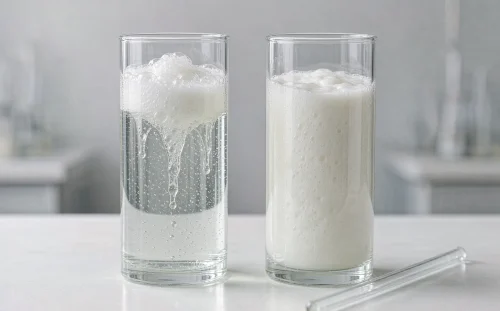
Foam was compared in a simple bench simulation: 2 g of a plain abrasive base mixed with 50 mL of water at 25 C for 30 seconds, with the surfactant dosed at equal active matter. The numbers below are illustrative.
| Surfactant at 1.5% active | Foam volume after 30 s | Foam character | Foam at 5 min |
|---|---|---|---|
| SLS 95% | About 120 mL | Quick, large bubbles, thin films | About 60 mL |
| SLES 70% | About 95 mL | Creamy, small bubbles, rich feel | About 70 mL |
Foam is a perception game as much as a measurement. SLS wins the volume number that marketing likes to quote; SLES wins the creaminess that higher-priced lines describe on pack. Neither number changes cleaning much at toothpaste dilution, because the surfactant is doing foam and solubilisation work, not heavy-duty detergency.
What changes for tolerance as the dose moves?
Tolerance is the reason many formulas sit at the bottom of the dose range instead of the top. Users with sensitive mucosa, and anyone managing recurrent mouth ulcers, tend to report a better experience on lower-SLS tubes, and the two levers a formulator has are dose reduction and switching the surfactant. Moving from SLS to SLES at equal active is the common route; cutting the dose to 1.0-1.2% is the cheaper one.
Treat tolerance as a formulation variable and verify it with your own in-use panel. The SLS 95% application note and the SDS 97% application note cover the single-grade formulas, including where foam and tolerance trade off against each other.
What does each grade cost per kilogram of active matter?
Divide the product price by the active fraction. The gap between SLS powder and SLES paste is mostly the 30% water in the paste.
| Grade, illustrative price | Product price per tonne | Active fraction | Cost per kg of active matter |
|---|---|---|---|
| SLS 92% powder | 1,650 USD | 0.92 | 1.79 USD |
| SLS 95% powder | 1,750 USD | 0.95 | 1.84 USD |
| SDS 97% | 1,700 USD | 0.97 | 1.75 USD |
| SDS 99% | 1,800 USD | 0.99 | 1.82 USD |
| SLES 70% paste | 1,700 USD | 0.70 | 2.43 USD |
At a 1.5% dose in a 100 g tube, the surfactant itself is a small line item either way, so the grade choice usually turns on foam and tolerance positioning rather than on cost. A third route exists for lines that want no sulfate at all: AOS 35% is a sulfonate rather than a sulfate and is used in sulfate-free oral care formats.
Key takeaways
- Dose: 1.0-2.0% as supplied is the published range for SLS; keep SLES at the same active level, not the same as-supplied weight.
- Foam: SLS gives more volume, faster; SLES gives creamier foam that holds slightly longer. Illustrative bench values, not specs.
- Tolerance: lower-SLS or SLES-based tubes are the two levers for sensitive-user positioning. Verify with your own panel.
- Cost: SLS powder lands near 1.8 USD per kg of active matter against about 2.43 for SLES paste at illustrative prices.
- Compatibility: both grades are anionic. Keep them apart from cationic actives such as chlorhexidine and run abrasive and fluoride compatibility trials.
Frequently asked questions
Can I use SLES instead of SLS in an existing toothpaste formula?
Yes, matched on active matter. Replace the SLS powder with about 1.4-1.5 times its weight of SLES 70% paste for the same active dose, subtract the extra water the paste brings in, and re-check viscosity because the paste thickens the water phase differently. Foam will shift from high-volume to creamy, so align marketing copy with the new foam profile.
Which SLS grade is right for toothpaste?
Most toothpaste lines use 92-95% powder, and buyers with tight COA requirements move up to SDS 97% or 99% for the higher assay. Screen the COA for assay, whiteness, odor and residual sulfate, and keep mesh size matched to your dispersion step so the powder dissolves without fisheyes.
Does SLS in toothpaste cause mouth ulcers?
SLS is used in toothpastes worldwide at controlled dose levels, and the regulatory picture varies by market. Some users with recurrent ulcers report a better experience on lower-SLS or SLS-free tubes, which is why dose reduction is a common formulation lever. This article does not provide regulatory advice; check the rules of your destination market.
Why is SLES more expensive per kilogram of active matter?
SLES ships as a 70% paste, so 30% of every tonne is water that you pay freight on and then have to account for in the water phase. SLS powder carries 92-95% active matter. The same active dose therefore costs less from a powder grade.
Can SLS and cationic antimicrobials be used in the same tube?
Generally not without a compatibility trial. Anionic surfactants like SLS and SLES can form insoluble complexes with cationic actives such as chlorhexidine, which costs you both foam and antimicrobial performance. If your formula needs a cationic active, test the pair at your use dilution before locking the spec.
Request a quote or a sample
For bulk pricing, MOQ and lead time on SLS 95%, SDS 97% or SLES 70% for oral care production, request a quote with your destination port and annual volume. If you are comparing foam and tolerance on your own base, request a sample of each grade at your target dose. You can request the COA and MSDS for any lot before a trial order, or contact our team with your formula sheet and we will confirm the grade, packaging and lead time that fit your line.
Written and reviewed by the ORID Chem technical team. Last updated: 2 November 2026. Test values and prices in this article are illustrative bench ranges, not guaranteed performance or quotations. Confirm current specifications on the product TDS and lot COA before ordering.