Short answer: SVS and SSS are both sulfonate monomers, but they ship in different forms: SVS as a 25% aqueous solution (CAS 3039-83-6, MW 130.09) and SSS as a 90% solid (CAS 2695-37-6, MW 206.19). Per kilogram of dry active, the solid is usually cheaper and much cheaper to freight. The liquid wins where a plant already doses solutions and wants no dissolving step.
This comparison is written for buyers and formulators at adhesive, textile auxiliary and water-treatment plants. Both monomers are stocked here: sodium vinylsulfonate (SVS) and sodium p-styrenesulfonate (SSS). Prices below are illustrative working numbers, not quotations.
What are the two molecules?
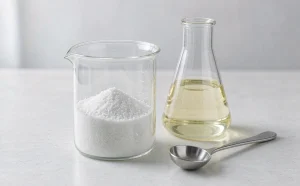
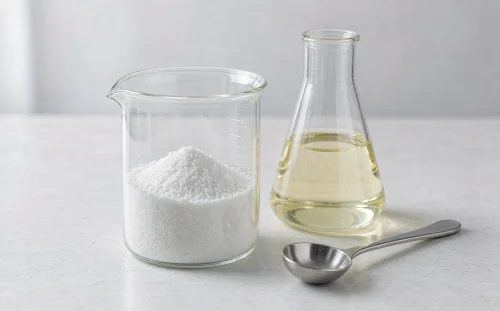
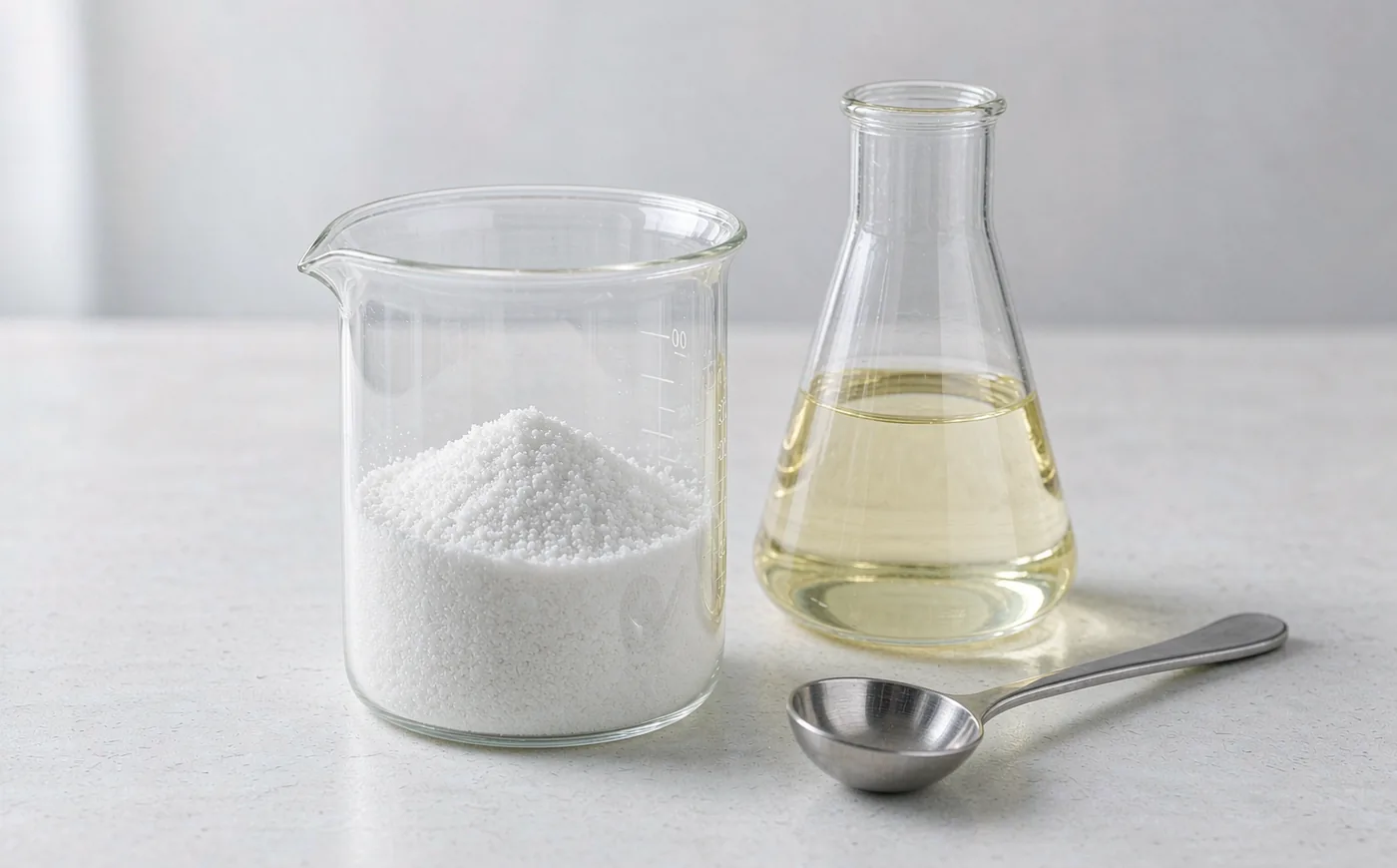
SVS is the small aliphatic sulfonate: formula C2H3NaO3S, molecular weight 130.09, CAS 3039-83-6, supplied as a colorless to light yellow clear solution above 25% active. It is completely miscible with water, and the spec sheet flags it as light sensitive. SSS is the aromatic one: formula C8H7NaO3S, molecular weight 206.19, CAS 2695-37-6, supplied as a white to light yellow powder or crystal at 90% purity or better by HPLC.
The reactive group is the same sulfonate, so both put a strong anionic anchor into a polymer backbone. The backbone differs: SVS contributes a short vinyl unit, SSS contributes a styrene unit. That difference in bulk and rigidity is why the two are not drop-in substitutes in a copolymer, even at equal sulfonate content.
What is the dry-active cost, in numbers?
The form difference decides the arithmetic. One kilogram of dry active needs 4.0 kg of SVS solution at 25% active, or 1.11 kg of SSS powder at 90%. Worked at illustrative prices of 1.80 USD per kg of SVS solution and 2.40 USD per kg of SSS powder.
| Grade | Form and active | Product per kg of dry active | Illustrative cost per kg of dry active | Freight per tonne of dry active, illustrative |
|---|---|---|---|---|
| SVS | 25% aqueous solution | 4.0 kg | 7.20 USD | About 304 USD |
| SSS | 90% solid powder | 1.11 kg | 2.67 USD | About 84 USD |
Freight is charged on product weight, so the liquid carries three tonnes of water per tonne of dry active. At an illustrative 76 USD per tonne on a South Asia route, that is 304 USD of freight per tonne of dry active for SVS against 84 USD for SSS. The solid wins the landed cost by a wide margin unless the plant saves enough on dissolving labor and equipment to close a gap of several hundred dollars per tonne. The same logic runs through our import guide for bulk chemicals.
Where is each monomer used?
SSS shows up where an aromatic sulfonate anchor is wanted: dyeing auxiliaries and dispersants, scale and deposit control, and copolymer systems that need a rigid unit in the chain. Our SSS in dyeing auxiliaries write-up covers that duty in detail.
SVS shows up where a short reactive vinyl sulfonate is wanted: adhesives and films, water-treatment copolymers, and formulations that need the sulfonate group close to the backbone. The SVS in adhesive write-up covers the film and tack duties. In both cases the monomer is a building block rather than a finished surfactant, which is why the dry-active cost, not the headline price, is the number to compare.
How do handling and storage compare?
SSS powder needs a dry, sealed store and normal dust control at the weigh-out station, the same discipline as any hygroscopic powder. SVS solution is dosed straight from the drum or IBC, rinses clean because it is water-miscible, and needs protection from light per the spec sheet. If your line already pumps liquid additives, the SVS solution removes the dissolving step entirely; if your line is built around powder dosing, the SSS powder avoids a 75% water shipment.
Plants that evaluate these monomers usually also run anionic surfactants. The grades on this site quoted most often alongside them are SLS 95%, AOS 95%, SLES 70% and LDS, and the anionic surfactants compared overview places both monomers in the wider range.
Key takeaways
- Form first: SVS ships as a 25% solution, SSS as a 90% solid powder; that single fact drives cost, freight and handling.
- Dry-active arithmetic: 4.0 kg of SVS solution or 1.11 kg of SSS powder per kilogram of dry active.
- Landed cost: the solid is cheaper per kilogram of dry active and cheaper to freight by roughly 220 USD per tonne at illustrative rates.
- Not substitutes: the aliphatic and aromatic backbones behave differently in copolymers; match the monomer to the polymer design.
- Logistics decide: pick the solution if the line already doses liquids, the powder if it is built around powder dosing.
Frequently asked questions
Which is cheaper per kilogram of dry active?
SSS, usually by a wide margin. The illustrative arithmetic puts SSS at about 2.67 USD per kg of dry active against 7.20 USD for SVS solution, before freight. Confirm against current quotes for your volume and destination.
Can I use SVS 25% solution where a solid was specified?
Recalculate on dry active and re-check the water balance of the formula, because the solution brings 3 kg of water per kilogram of active. Run a trial batch to confirm conversion and film or dispersion properties before scaling.
Is SSS powder hygroscopic?
Store it sealed and dry like other sulfonate powders, and close part-used bags promptly. Follow the storage statement on the TDS for the lot you receive.
Do the two monomers behave the same in copolymerization?
No. SVS contributes a short vinyl unit and SSS a styrene unit, so reactivity ratios and polymer rigidity differ. Treat them as different monomers and design the copolymer around the one you need, not around equal sulfonate content.
What documents come with the shipment?
COA and MSDS ship with every lot, and our shipment documents FAQ lists the full set. Ask for both before placing a first order.
Request a quote or a sample
For bulk pricing, MOQ and lead time on SVS or SSS, request a quote with your destination port and annual volume. If you are switching between the solution and the powder for the first time, request a sample of both forms and run a dissolving and a trial-batch comparison side by side. You can request the COA and MSDS for either grade before you commit, or contact our team with your dosing setup and we will confirm the form that fits your line.
Written and reviewed by the ORID Chem technical team. Last updated: 11 November 2026. Prices in this article are illustrative working numbers, not quotations. Confirm current specifications on the product TDS and lot COA before ordering.