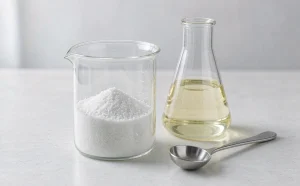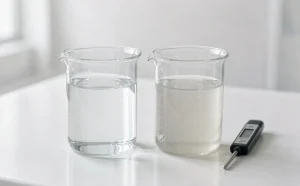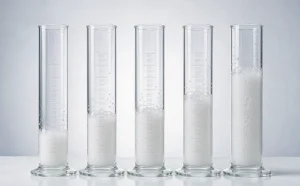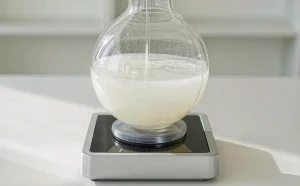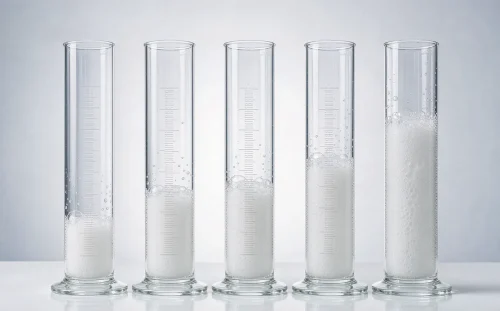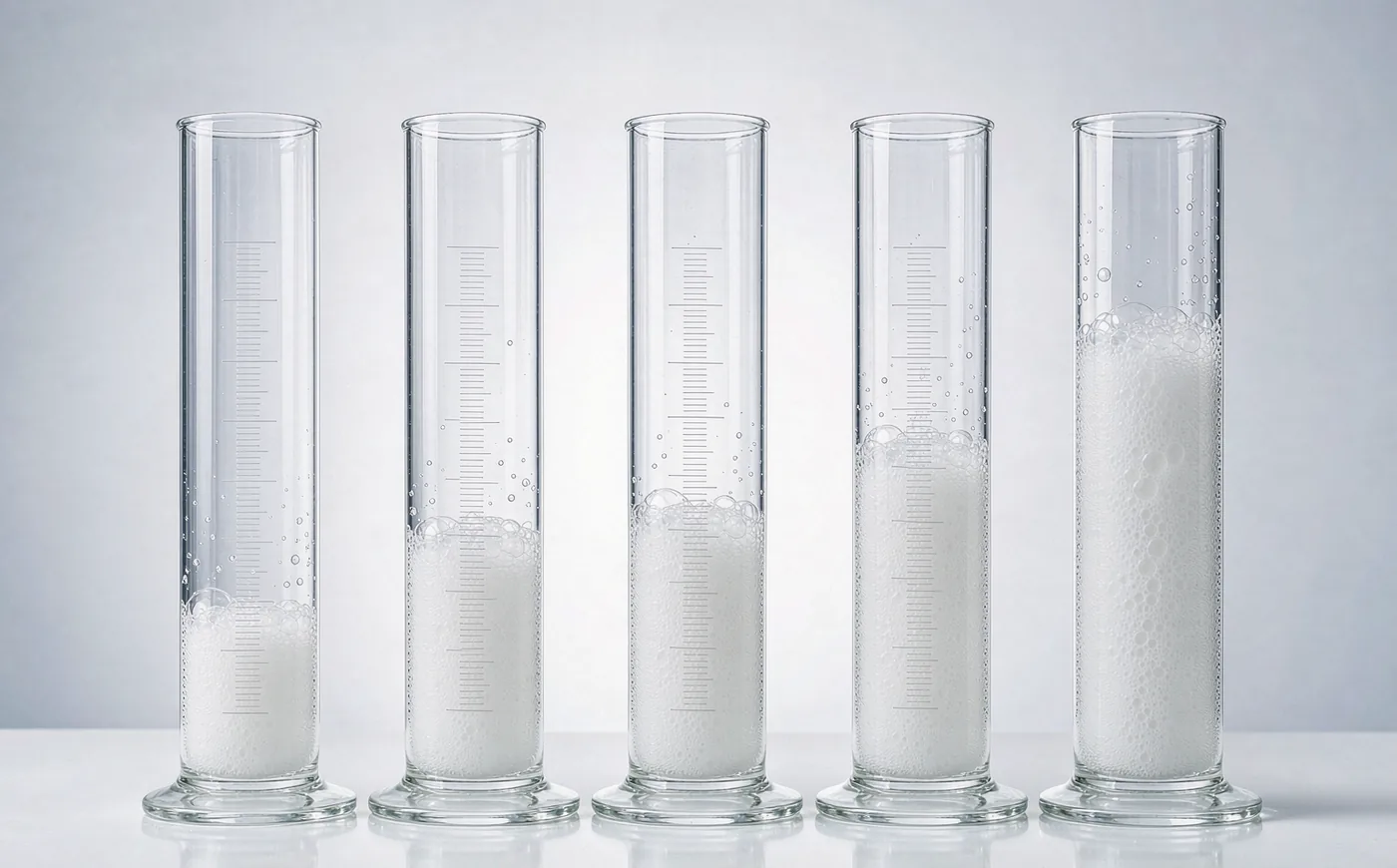
Short answer: Foam height climbs steeply between 0.25% and 1.0% active and flattens above 1.5% for SLS, AOS and SLES. AOS gives the tallest column, SLS builds the fastest, and SLES produces the densest foam that drains slowest. Above the CMC, extra surfactant buys drainage stability rather than height, so the last half percent is rarely worth its cost.
This article compares the three grades on a bench foam series at equal active concentration. The values are illustrative bench readings from a Ross-Miles style setup, not guaranteed specifications. Water hardness, temperature and cylinder geometry all move the numbers, so treat the shape of the curves as the finding and run your own series before fixing a dose.
How is foam height measured on the bench?
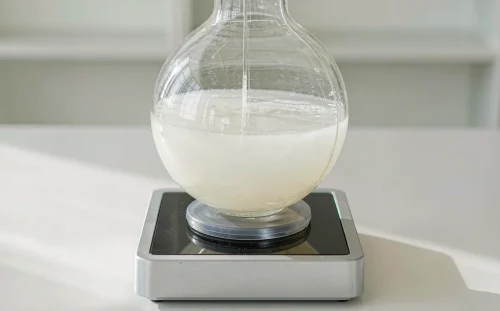
The classic setup is simple. A graduated cylinder holds a small volume of test solution, and a larger volume of the same solution is released from a pipette at a fixed height above the surface. Foam height is read immediately after the pour and again after five minutes of drainage. The immediate reading measures how fast the surfactant adsorbs at the air-water interface; the five-minute reading measures how well the lamellae hold water.
Two details decide whether two labs can compare numbers: the drop height and the solution temperature. This series was run at 25 C with the pour released from 45 cm, on synthetic water at 150 mg/kg CaCO3. Any of those changed, the absolute heights change with them.
What does the concentration series look like?
Foam height at 0.25% to 2.0% active matter, immediate reading and after five minutes, in millimeters.
| Active concentration | SLS 92%, immediate / 5 min | AOS 35%, immediate / 5 min | SLES 70%, immediate / 5 min |
|---|---|---|---|
| 0.25% | 95 / 45 | 105 / 55 | 70 / 35 |
| 0.50% | 145 / 100 | 160 / 115 | 110 / 70 |
| 1.00% | 185 / 150 | 200 / 165 | 150 / 110 |
| 1.50% | 200 / 170 | 215 / 185 | 165 / 125 |
| 2.00% | 208 / 178 | 222 / 192 | 172 / 132 |
Three readings come out of the table. The steep part of every curve sits between 0.25% and 1.0%, where doubling the dose roughly adds half again to the column. Between 1.5% and 2.0% all three grades gain single-digit millimeters. And the ranking is stable across the series: AOS tallest, SLS second, SLES shortest but densest.
The character of the foam differs as much as the height. SLES foam is creamy and fine-bubbled, which is why it reads shorter in the cylinder yet lasts longer on skin and hair. SLS foam is looser and drains faster. AOS sits between the two on texture with the tallest column, which is why it anchors dishwashing liquids where visible foam sells the product.
Why does the curve flatten above the CMC?
The critical micelle concentration sets the knee. SLS has a CMC of about 8.2 mM at 25 C, roughly 2.4 g/L of active matter in pure water. Below the CMC, every added molecule goes to the surface and the foam column climbs. Above it, the surface is saturated and extra molecules form micelles in the bulk instead, which thickens the lamellae and slows drainage but adds almost no height.
That mechanism explains the whole table. The steep rise happens as each grade crosses its own CMC, and the flattening above 1.5% is micelle formation doing nothing for the column. Our CMC and Krafft point article covers the mechanism in more detail, and the SLS CMC FAQ gives the numbers in short form.
What do hard water and salt do to the column?
Hardness punishes SLS hardest. Calcium and magnesium form insoluble salts with sulfate esters, so the same 1.0% SLS solution that foams to 185 mm in synthetic water can drop by a third at 300 mg/kg CaCO3. AOS, as a sulfonate, holds its column far better at the same hardness, and SLES drifts down slowly because its ether chain buffers the same effect. The AOS vs LAS hard-water comparison shows the mechanism, and the dishwashing foam and grease comparison runs it at full formulation strength.
Salt cuts both ways. A modest level of sodium chloride can tighten foam in some anionic systems, while the same salt can salt out SLES from a thickened formula. If your line runs a salt-thickened shampoo or body wash, the foam series belongs in the finished formula, not in water alone.
How do I use the curve in a formula?
Price the last half percent and decide what it buys. Moving from 1.0% to 1.5% active adds about 15 mm of immediate foam for SLS at illustrative prices, which is about 0.5 g of extra surfactant per 100 g of formula, roughly one tenth of a US cent. The same move buys 30 to 35 mm of drainage retention, which the customer feels as foam that survives the wash.
The rule that falls out of the series is simple. Stop adding surfactant above 1.5-2% active unless drainage stability is the goal, because the height has flattened and the cost has not. If the formula needs more body at that point, spend on the thickener or the foam stabiliser instead. For dishwashing liquids where the foam is the product, the AOS 35% and SLES 70% grades carry the column; for detergent and industrial foaming, SLS 92% and SLS 95% are the working grades.
Key takeaways
- Shape of the curve: steep from 0.25% to 1.0%, flat above 1.5% for all three grades; the CMC sets the knee.
- Ranking: AOS tallest, SLS second, SLES shortest but densest and slowest draining.
- Hard water: SLS loses the most foam as hardness rises; AOS and SLES hold their columns better.
- Cost rule: the last half percent of surfactant buys drainage stability, not height; price it before you add it.
- Method discipline: absolute heights move with drop height, temperature and water, so compare within one setup only.
Frequently asked questions
Is AOS always the tallest foam?
In this series, yes, across the whole concentration range in synthetic water. SLES still wins on foam texture and drainage, and hard water narrows or reverses the ranking against SLS. Run the series on your own water before fixing a grade.
Why does my foam look lower than the table?
Method differences. Drop height, cylinder diameter, solution temperature and water hardness all move the absolute numbers, sometimes by 30% or more. Keep the grade and form constant as well: needles and powder dissolve at different rates and shift early foam readings, as the SLS needles versus powder comparison shows, and our colored SLS needle grades make the form easy to verify in a premix. Use the table for shape and ranking, and calibrate your own setup against a reference grade.
Does foam height correlate with cleaning power?
Not directly. Detergency depends on wetting, emulsification and soil type, and some low-foam systems clean better in machine applications. Foam is a consumer signal in hand-wash products, which is why it is worth measuring, but it is not a cleaning metric.
What concentration should a hand dishwashing liquid run?
Most hand dishwashing liquids run 8-14% total anionic surfactant, with AOS or SLES as the primary grade for hard-water markets. The foam series above covers single-surfactant solutions; the finished formula with amphoterics and salt will read differently, so validate at formula strength.
How do I measure drainage fairly?
Read at fixed times, usually immediately and at five minutes, with the same cylinder, the same operator and the same pour height. Report both numbers, because a tall foam that collapses in one minute and a shorter foam that holds are different products.
Request a quote or a sample
For bulk pricing, MOQ and lead time on AOS 35%, SLS 92% or SLES 70%, request a quote with your destination port and annual volume. If you are setting a new foam specification, request a sample of the grades above and run the concentration series on your own water. You can request the COA and MSDS for any grade before you commit, or contact our team with your target foam height and drainage time and we will confirm which grade fits the brief.
Written and reviewed by the ORID Chem technical team. Last updated: 11 November 2026. Foam heights in this article are illustrative bench readings from a standard setup, not guaranteed specifications. Confirm current specifications on the product TDS and lot COA before ordering.