Short answer: SLS is the default emulsifier for vinyl and acrylic emulsion work, dosed at 0.5 to 3% on monomer. LDS costs roughly three to four times more per kilogram but stays soluble in cold weather and improves freeze-thaw stability. SDS 97% and SDS 99% fit high-purity lattices where residue and color matter. Decide on temperature exposure first and price second.
This comparison is written for plant engineers and procurement staff at latex, adhesive and coating plants in India, Pakistan, Iran, Russia and Southeast Asia. The grades discussed are SLS 92%, SLS 95%, SDS 97%, SDS 99% and LDS. Dosage ranges and prices are illustrative working numbers, not guaranteed specifications.
What does the emulsifier actually do in the reactor?
The emulsifier does three jobs. It solubilizes monomer in micelles so the reaction has somewhere to start, it stabilizes the growing particles so they do not coagulate, and it sets the final particle size, which drives latex viscosity and film formation. In surfactant-stabilized lattices the emulsifier is typically dosed at 0.5 to 3% on monomer, and particle sizes land between roughly 100 and 300 nm. More emulsifier means more nucleation sites, so the particles finish smaller and the latex runs thicker.
SLS vs LDS vs SDS 97%: how do the grades compare?
All four grades carry the same C12 sulfate anion; the differences are purity, form, price and how the salt behaves in cold water.
| Grade | Active matter | Form | CMC at 25 C, literature | Cold-water behaviour | Illustrative price per tonne |
|---|---|---|---|---|---|
| SLS 92% | At or above 92% | Powder or needles | About 8.2 mM | Clouds near its Krafft point around 16 C | 1,650-1,800 USD |
| SLS 95% | At or above 95% | Powder or needles | About 8.2 mM | Same molecule, less water and sulfate | 1,750-1,900 USD |
| SDS 97% | At or above 97% | Powder | About 8.2 mM | Same Krafft behaviour, tighter spec | 2,200-2,600 USD |
| SDS 99% | At or above 99% | Powder | About 8.2 mM | Same Krafft behaviour, lowest residue | 2,800-3,200 USD |
| LDS | High-purity powder | Powder | Same order of magnitude as SDS | Stays in solution at 0-4 C | 5,000-7,000 USD |
The lithium counterion is the whole story for LDS. Swapping sodium for lithium lowers the Krafft point enough that the salt stays soluble in the range where cold rooms and unheated stores operate. Our CMC and Krafft point explainer covers the mechanism, and the LDS vs SDS cold-work comparison shows the solubility side by side.
Why does cold weather decide the salt?
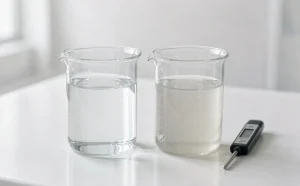
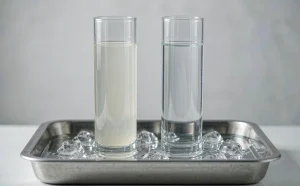
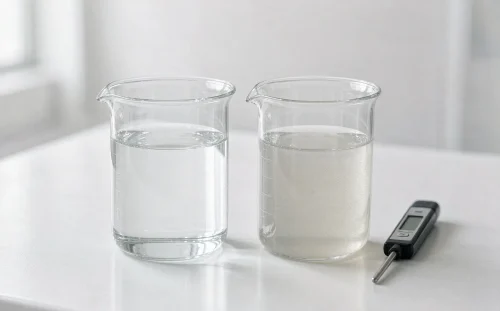
SLS has a Krafft point near 16 C, published values sit in a range of roughly 15-20 C depending on purity. Below that line the salt stops forming micelles efficiently and a warm-made emulsifier solution can cloud in the feed tank. A plant in Russia or northern Iran running winter batches with an unheated raw-material store is the classic case: the drum is fine, the feed line is not.
LDS avoids that failure mode at the temperature where it matters. The extra cost buys a reactor that keeps running in January without heated feed lines. If your store and reactor room stay above 20 C year round, the cheaper sodium salts are the rational choice and LDS earns nothing.
What does the emulsifier choice cost per tonne of latex?
The arithmetic is short. Emulsifier kilograms equal monomer kilograms times the dose percentage, and latex tonnage follows from the solids target. Worked below for one tonne of monomer at 45% target solids, which yields about 2.22 tonnes of latex, with an emulsifier dose of 1.5% on monomer and illustrative prices.
| Grade, illustrative price | Emulsifier per tonne of monomer | Cost per tonne of monomer | Cost per tonne of latex |
|---|---|---|---|
| SLS 95% at 1.80 USD/kg | 15 kg | 27 USD | 12 USD |
| SDS 97% at 2.40 USD/kg | 15 kg | 36 USD | 16 USD |
| LDS at 6.50 USD/kg | 15 kg | 98 USD | 44 USD |
Against a latex price measured in hundreds of dollars per tonne, even LDS adds a single-digit percentage. That is why the decision is rarely price: it is whether the reactor runs in winter, whether the film needs low residue, and whether the coagulum level on the filter press is acceptable. Higher emulsifier levels also cut particle size, which can raise viscosity and reduce the stabiliser the formula needs elsewhere.
What about residue, color and batch-to-batch drift?
The non-active fraction of the grade is mostly water, sodium sulfate and unsulfated matter. In lattices where color and residue matter, SDS 97% and SDS 99% pay for themselves; in general-purpose adhesives and paints, SLS 92% is the working grade. Whatever you choose, hold the supplier to a consistent spec: our QC process write-up describes how batch consistency is controlled, and the COA reading guide lists the specifications worth checking per lot. Sulfonates such as AOS appear in specific lattices such as ABS, where the process differs; this comparison sticks to the sulfate esters because they are the grades stocked for this duty.
Key takeaways
- Default grade: SLS 92% for general-purpose lattices, dosed at 0.5-3% on monomer, typically 1.0-1.5% for a first trial.
- Cold-weather grade: LDS when the store or reactor room drops below 15 C; the Krafft point, not the price, decides it.
- High-purity grades: SDS 97% and SDS 99% for low-residue, low-color lattices where the non-active fraction shows up in the film.
- Cost scale: at 1.5% on monomer, the emulsifier adds about 12 to 44 USD per tonne of latex at illustrative prices, a small share of the formula.
- Consistency: particle size and coagulum move with grade and dose, so re-check both after any switch.
Frequently asked questions
What emulsifier level should I start with?
Start at 1.0-1.5% on monomer and adjust against particle size, viscosity and coagulum. Below 0.5% the latex usually runs unstable; above 3% you are paying for particle size you may not need. Run a 2 L bench reactor before touching the plant.
Can I switch from SLS to LDS mid-production?
Yes, but treat it as a formulation change. Expect small shifts in particle size and viscosity and re-check freeze-thaw stability on the new latex. A side-by-side trial batch is cheaper than a filter press full of coagulum.
Does LDS change the latex particle size?
Micellisation is in the same order of magnitude as SDS, so differences are usually small. Confirm by laser diffraction on the bench trial rather than assuming the numbers carry over from the literature.
Is SLS 95% worth the extra over SLS 92% in polymerization?
The gap between the two grades is water, sodium sulfate and minor impurities. Most lattices run fine on 92%. Move to 95% when the water balance in the reactor is tight or sulfate carry-over affects the film.
How should emulsifier drums be stored in winter?
Keep powder grades sealed and dry, above 20 C where possible. Solutions made from SLS can cloud below the Krafft point near 16 C, so warm the feed tank rather than forcing a cold, cloudy charge into the reactor.
Request a quote or a sample
For bulk pricing, MOQ and lead time on SLS 92%, SDS 97% or LDS, request a quote with your monomer type and annual latex output. If you are switching salts for winter operation, request a sample and run a bench reactor side by side. You can request the COA and MSDS for any grade before you commit, or contact our team with your reactor temperature profile and we will confirm which grade fits your line.
Written and reviewed by the ORID Chem technical team. Last updated: 11 November 2026. Dosage ranges and prices in this article are illustrative working numbers, not guaranteed specifications. Confirm current specifications on the product TDS and lot COA before ordering.