| Item | Value |
|---|---|
| Charge on the anion | -1 on the sulfate head group |
| Counterion | Na+ |
| Behaviour in water | Dissociates; anionic across normal pH |
| CMC (literature) | approx. 8 mmol/L at 25 °C |
| Incompatible with | Cationic surfactants (ion-pair risk) |
For compatibility data and bulk pricing on anionic CAS 151-21-3 grades, request a quote or request a sample for a blend trial.
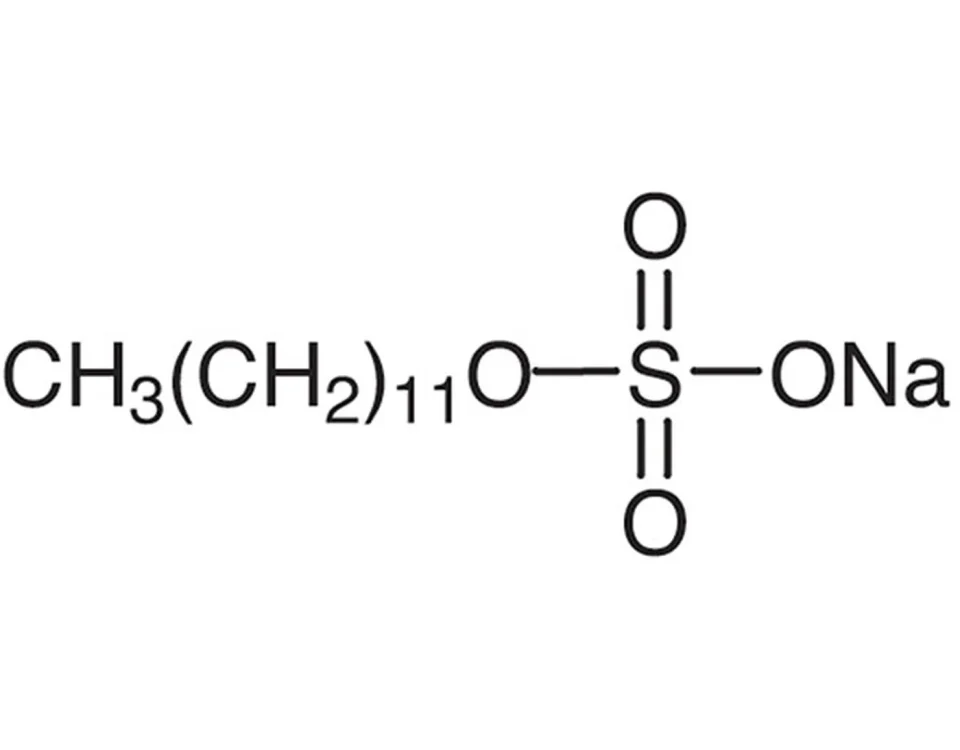
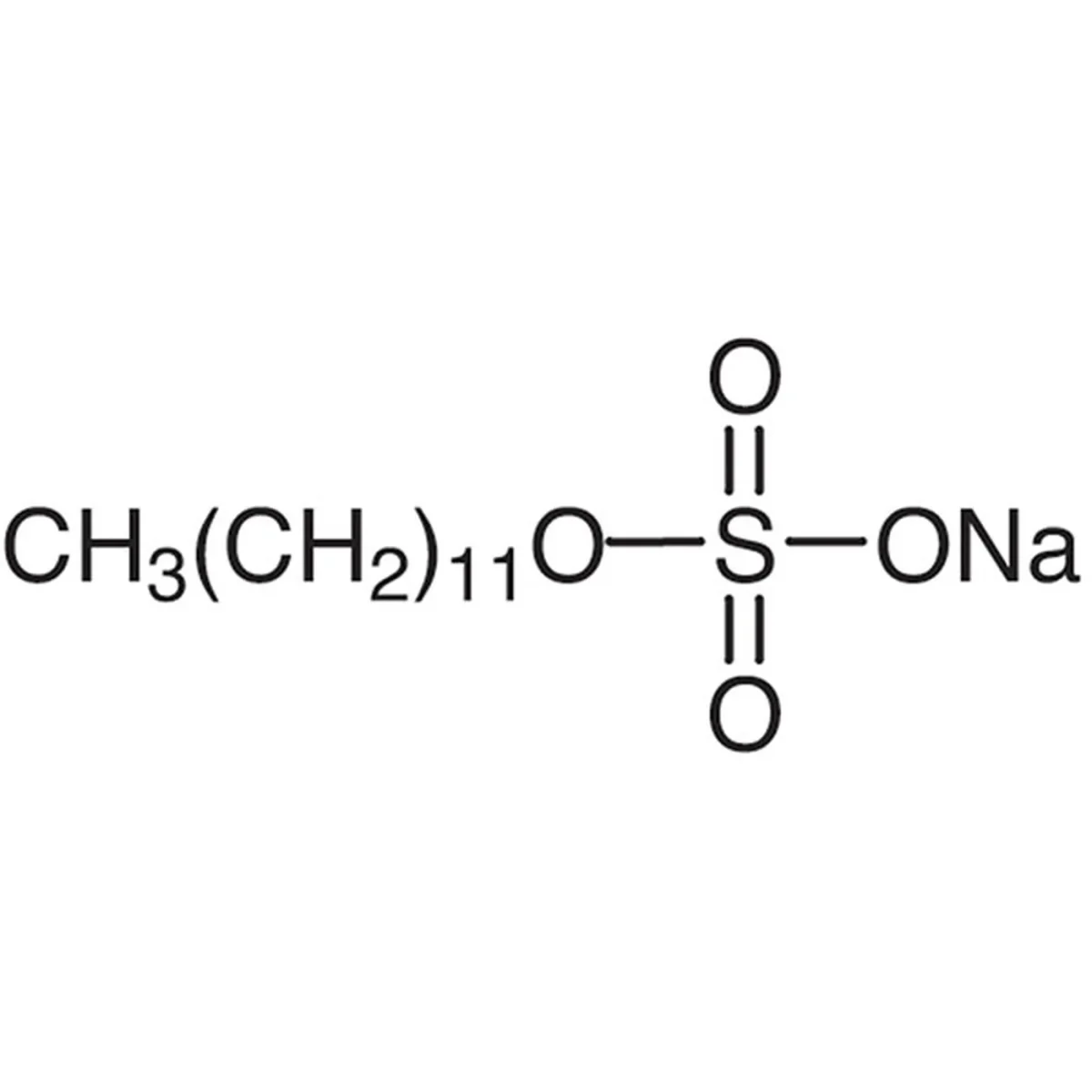
Short answer: The molecule carries one negative charge on its sulfate head group and one sodium counterion. In water it dissociates into a surface-active anion and Na+. The charge stays negative across the normal formulation pH range, which is why SDS binds cationic ingredients, coats proteins in electrophoresis, and drives foam at the air-water interface.
Key takeaways
- One negative charge sits on the sulfate head; sodium is the free counterion.
- The charge stays anionic across normal formulation pH; strong acid attacks the ester instead.
- Salt screens head-group repulsion and changes micelle size and viscosity.
- Cationic partners can form insoluble ion pairs, so check compatibility before blending.
- Uniform negative charge per unit mass is the basis of SDS-PAGE separation.
Where the charge sits on the molecule
CH3(CH2)11OSO3Na splits in water at the sodium-oxygen bond. The dodecyl sulfate anion keeps the -1 charge delocalised over the sulfate oxygens; sodium becomes a free cation. The hydrophobic C12 tail carries no charge. That separation is what makes the molecule amphiphilic and lets it pack at interfaces with the charged head in water and the tail out of it.
Does pH change the charge on SDS?
Across the pH window used in detergent and personal care work, the sulfate ester remains ionised. Strong acid over a long hold can hydrolyse the ester, which is a chemical change rather than a charge switch. This behaviour differs from amine-based or carboxylate surfactants, whose effective charge moves noticeably with pH. A formulator can therefore treat SDS as a fixed anionic component in most systems.
| Condition | Charge state | Practical consequence |
|---|---|---|
| Neutral to mildly alkaline | Anion, -1 | Stable foam and wetting |
| Mildly acidic | Anion, -1 | Charge retained, watch ester stability |
| Strong acid, long hold | Ester may hydrolyse | Run a stability hold |
| With cationic surfactant | Ion pair forms | Precipitation risk |
Micelle charge and what it does in a formulation
Above the critical micelle concentration the anions assemble into micelles whose surface carries a net negative charge. Electrostatic repulsion between head groups sets the aggregation number and the shape of the micelle. Adding salt screens that repulsion, which is why sodium chloride thickens a sulfate surfactant system up to a point and then thins it again. Our cost per kilogram of active matter example uses the same dose logic from the purchasing side.
Compatibility with cationic, nonionic and amphoteric surfactants
Opposite charges attract. Mixing an alkyl sulfate with a quaternary ammonium or an amine oxide in its cationic form can produce an insoluble ion pair and a hazy or separated batch. Nonionics and amphoterics are the usual partners when a formulator wants milder behaviour. Our AOS versus SLES comparison and SLES 70% page cover sulfate systems that are frequently blended.
| Partner class | Expected interaction | Formulation note |
|---|---|---|
| Cationic quaternary | Ion pairing, precipitation risk | Keep separate or sequence addition |
| Nonionic | Mixed micelles | Common route to milder formulas |
| Amphoteric | Charge depends on pH | Check the pH window |
| Inorganic salt | Screens head-group repulsion | Viscosity peaks then falls |
Why charge matters in SDS-PAGE protein separation
In polyacrylamide gel electrophoresis the anion binds along the polypeptide backbone and gives proteins a roughly uniform negative charge per unit mass. Separation then depends mainly on size rather than the protein’s native charge. That application is unusually sensitive to impurities, so buyers usually request SDS 99% or SDS 97% and a lot COA. Lithium dodecyl sulfate is chosen instead when runs are performed at low temperature.
Charge-related checks in incoming QC
Active matter titration measures the anionic surfactant content directly. pH of a 1% solution, inorganic salt and unsulfated matter tell you how much of the charge behaviour is diluted by non-surface-active material. Our guide to reading anionic active matter on a COA sets out the two common titration methods. Contact our team for a sample and the current TDS.
Related grades on this site include SLS 30% solution, SLS 92% powder.
Frequently asked questions
Is SDS an anionic or a cationic surfactant?
Anionic. The dodecyl sulfate ion carries -1 charge after dissociation, while sodium is the cation. Cationic surfactants carry a positive charge on the surface-active ion itself.
Can I mix SDS with a quaternary ammonium disinfectant?
Usually not in the same concentrate. Oppositely charged ions pair up and can precipitate. Test a small batch or keep the two actives in separate phases.
Why does adding salt first thicken and then thin a sulfate formula?
Salt screens the repulsion between charged head groups, letting micelles grow and viscosity rise. Past a certain level the structure changes again and viscosity falls. Build a salt curve for your own system.
Does a lower assay grade carry less charge per kilogram?
Per kilogram of product, yes, because part of the weight is salt, water and unsulfated matter. Per mole of the surfactant molecule the charge is unchanged at -1.
Which grade suits electrophoresis work?
A high-assay reagent grade such as SDS 99%, with a lot COA confirming low inorganic salt and unsulfated matter. Request a sample before standardising the buffer.
Request a quote or a sample
For bulk pricing, MOQ and lead time on anionic CAS 151-21-3 grades, request a quote with your target assay. Request a sample for compatibility testing and request the COA/MSDS before production.
Written and reviewed by the ORID Chem technical team. Last updated: 20 November 2026. Figures marked illustrative are working values, not quotations. Confirm current specifications on the product TDS and lot COA before ordering.