Short answer: Two-phase titration measures the total anionic active matter in a product, including the fraction that will not dissolve cleanly in water. Direct aqueous titration measures only what is in solution at the test temperature. Expect the direct number to read low by 1 to 3 points when a product carries neutral oil or is titrated cold.
This article is for QC labs and buyers who read surfactant COAs and need to know why the active-matter number on a certificate does not always match the in-house titration. We sell SLS 92%, SLS 95%, AOS 92% and SLES 70%. Method details and worked numbers below are illustrative working values for orientation, not laboratory instructions.
Why does the titration method matter to a buyer?
Because active matter is the number you dose on and the number you pay for. A 1-point gap between two methods on a 25-tonne order of SLS 92% is 250 kg of active matter, and at illustrative prices that is about 450 USD of value that neither side can see. When your in-house titration disagrees with the supplier COA, the first question is not who is right but which method each side ran. A second reason: products with high unsulfonated or neutral-oil content behave differently in the two methods, and AOS 92% is exactly such a product, with petroleum ether soluble substances allowed up to 3.0% on its specification.
How does two-phase titration work?
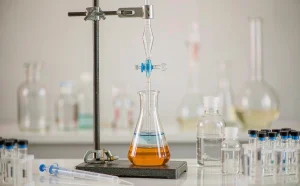
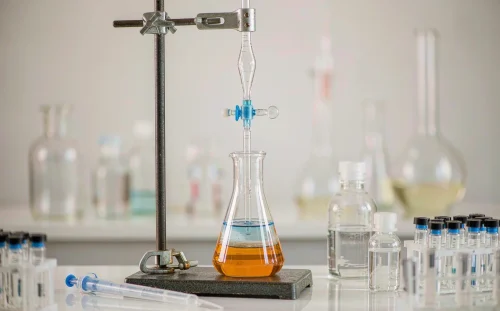
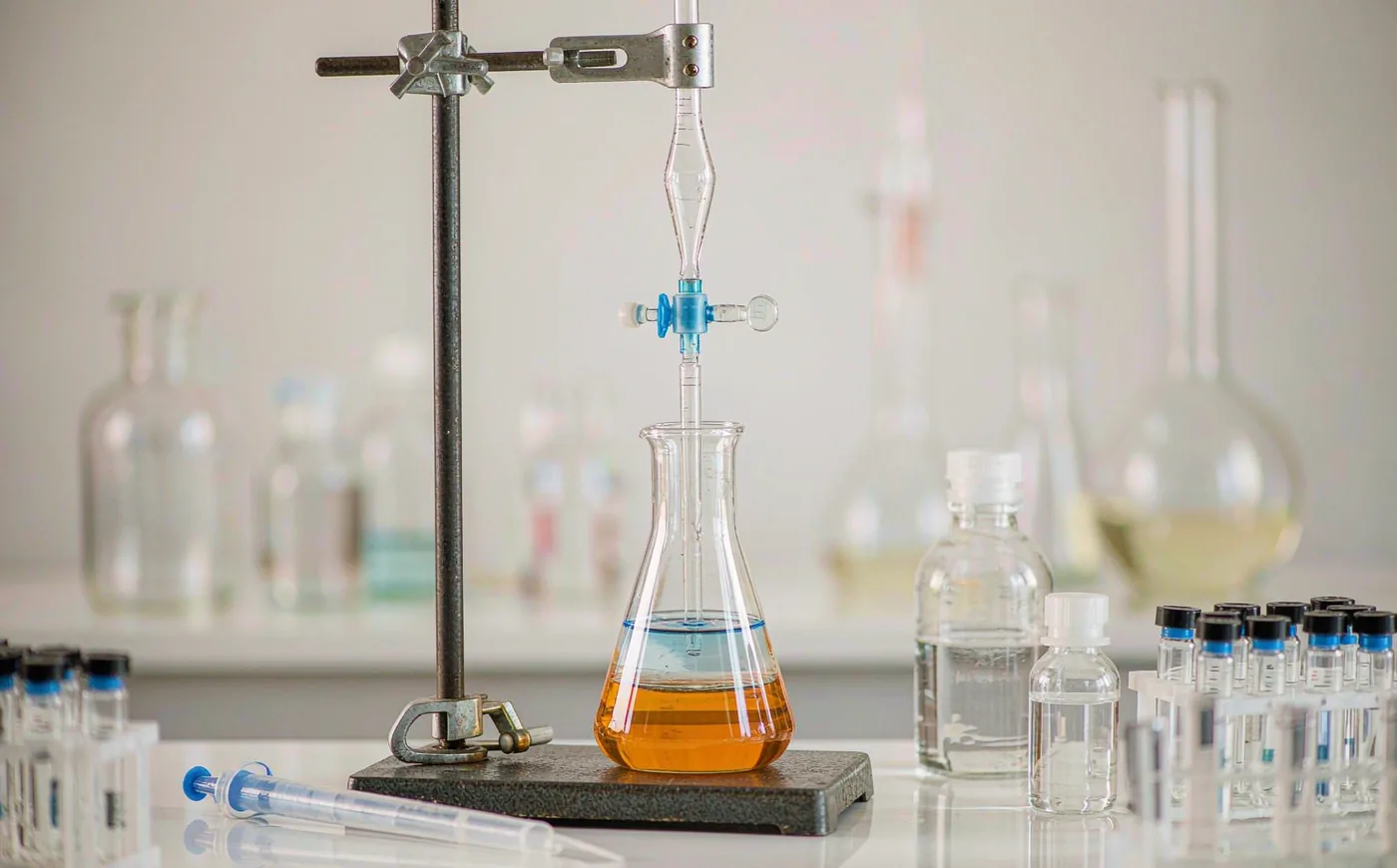
The sample is dissolved in water, a water-immiscible solvent such as chloroform is added, and a cationic titrant is dosed from a burette while the mixture is stirred. The anionic surfactant partitions into the organic phase, and the endpoint is read either with a mixed indicator that changes colour as the anionic is carried across, or with a potentiometric electrode. The titration continues until the anionic is fully complexed in both phases.
The arithmetic is stoichiometry. For an anionic titrated with a cationic titrant of concentration c, the active matter in percent is:
Active matter (%) = (V – V0) x c x M / (10 x m)
where V is the titre in mL, V0 the blank, c the titrant concentration in mol/L, M the molar mass of the anionic surfactant in g/mol, and m the sample mass in g. Worked example, illustrative: 0.200 g of SLS 92% titrated with a 0.02 mol/L cationic titrant, titre 31.9 mL, blank 0.1 mL. M for sodium lauryl sulfate is 288.38 g/mol. (31.9 – 0.1) x 0.02 x 288.38 / (10 x 0.200) = 92.0%. The result lands on the COA figure, which is the point of the reference method.
How does direct aqueous titration differ?
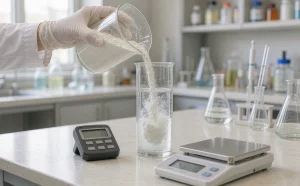
Same titrant chemistry, no organic phase. The sample is dissolved in water, sometimes with a little ethanol, and titrated with the cationic surfactant to the indicator or potentiometric endpoint. No chloroform, shorter run, less solvent handling, lower cost per test. The catch is what the method cannot see: any anionic that is not dissolved at the test temperature is simply not titrated, and the result reads low. That failure has a name in surfactant chemistry, the Krafft point, and it bites hardest when the lab bench is cold. Our CMC and Krafft point article covers the underlying solubility behaviour.
When do the two methods disagree?
| Cause | Effect on the direct number | Where it shows up |
|---|---|---|
| Neutral oil or unsulfonated matter | No direct effect, but two-phase reads higher total actives | AOS 92% with petroleum ether solubles up to 3.0% |
| Inorganic sulfate and chloride | No effect in either method | SLS 92% carries up to 4.0% inorganic salts |
| Titration below the Krafft point | Reads low by 1 to 3 points | Cold bench, below roughly 20°C for SLS |
| Nonionic surfactant in the blend | Two-phase can co-titrate part of it | Blended dishwashing and shampoo bases |
| Poor endpoint visibility | Scatter of plus or minus 1 point | Dark or coloured products such as SLS colour needles |
Read the table from the buyer’s side. If your lab titrates at 18°C and reports 90.4% against a COA figure of 92.0% for the same lot, warm the sample to 40°C, repeat, and the gap usually closes. If the gap survives the temperature fix, ask which phases each method used, because that is where neutral oil and blend interference live.
What should a COA state?
A usable COA names the analysis method, the active-matter figure, and the supporting numbers: appearance, petroleum ether soluble substances, inorganic salts, water, pH of a defined solution, and colour. Our COA reading guide walks the full specification sheet. When a lot arrives and your titration disagrees, ask three questions in this order: what temperature, what phases, what titrant concentration. Most disputes end at the first question. If they do not, the quote comparison method shows how to normalise two offers onto the same active-matter basis before arguing about the number.
Which method should my lab run?
For incoming inspection against a COA, match the supplier method; that is the only comparison that closes a dispute. For line QC where the question is drift between lots, direct aqueous titration is faster and cheaper, and consistency matters more than the absolute figure. For a product like AOS 35% liquid, which is fully water-soluble at test strength, the two methods agree closely and the direct route is fine. For AOS 92% powder with its neutral-oil allowance, run the two-phase method at least on the qualification lot and keep the direct method for routine checks. The same logic applies to AOS 95% powder, where the tighter salt ceiling makes the active-matter figure worth confirming by the reference method.
Key takeaways
- Two-phase titration measures total anionic active matter and is the reference method for COAs.
- Direct aqueous titration is faster and solvent-free, but reads low when the anionic is not fully dissolved.
- Temperature is the first suspect when numbers disagree: warm the sample to 40°C and repeat before anything else.
- Neutral oil and blends are the second suspect: AOS 92% allows petroleum ether solubles up to 3.0%.
- Inorganic salts do not titrate in either method, so the salt ceiling on the COA is a separate line item.
Frequently asked questions
Why is my SLS 92% titration 90.4% when the COA says 92.0%?
Most often the bench was cold. Sodium lauryl sulfate dissolves slowly below roughly 20°C, so part of the anionic was not in solution and the direct titration missed it. Warm the sample to 40°C, dissolve fully, and titrate again. If the gap survives, check the titrant concentration and the blank.
Does water content affect the titration result?
Yes, in the sense that the result is reported on the product as received. SLS 92% carries up to 5.0% water and SLS 95% up to 4.0%, so two lots of the same grade titrate differently if their moisture differs. That is why active matter, not purity on a dry basis, is the number to dose and pay on.
Can I compare a two-phase COA figure against my direct titration?
Only after matching conditions. Warm the sample, use the same titrant concentration, and run a blank. Expect agreement within about 1 point on a clean single-surfactant product. Wider gaps point to neutral oil, blend components, or a temperature problem.
Is the two-phase result the same as purity?
No. It measures anionic active matter. Sulfate and chloride salts do not titrate in either method, and neither does water, so a product at 92% anionic active matter is not 92% pure in the absolute sense. The grade comparison article shows how the salt and water ceilings move between grades.
What titre should I expect for SLES 70%?
Illustrative, for orientation only: 0.200 g of a 70% product with a 0.02 mol/L titrant needs roughly 24 mL at the same molar mass basis, and the same cold-water caution applies because the paste gels below about 15°C. Dissolve the sample warm, then titrate at a controlled temperature rather than on a cold bench.
Request a quote or a sample
For bulk pricing, MOQ and lead time on SLS 92%, SLS 95%, AOS 92% or SLES 70%, request a quote with your destination port and annual volume. If you are qualifying a new lot against your COA, request a sample and run your reference method on it before the bulk order. You can request the COA and MSDS for any grade, or contact our team with your titration conditions and we will confirm the method used on the lot certificate.
Written and reviewed by the ORID Chem technical team. Last updated: 15 November 2026. Method descriptions and worked numbers in this article are illustrative working values for orientation, not laboratory instructions. Confirm current specifications on the product TDS and lot COA before ordering.