Short answer: At equal active dose in hard water, AOS 38% usually removes more grease and needs less salt to thicken than SLES 70%, while SLES gives a thicker, longer-lasting foam at a lower cost per liter. Above about 250 mg/kg CaCO3 the grease gap widens. Run both on your own water before locking the formula.
This comparison is written for formulators and buyers building hand dishwashing liquid for markets where tap water runs hard: much of India, Pakistan, Iran, and parts of Russia and Southeast Asia. We sell AOS 38%, AOS 35% and SLES 70%; dose, foam and price figures below are illustrative working numbers, not quotations.
What does a hand dishwashing liquid have to do?
Four jobs, in this order: lift grease off plates at hand temperature, hold enough foam to read as cleaning power, rinse without a film, and stay stable from the plant to the shelf in a warm warehouse. Water hardness decides how hard the first job is, because calcium and magnesium tie up anionics into salts that stop wetting. A formula tuned on soft plant water foams flat at a customer site in Lahore or Isfahan, which is why the comparison below is run at 300 mg/kg CaCO3 as well as 100.
How much product does one liter of dishwashing liquid take?
Dose on active matter, not on kilograms of paste. A typical hand dishwashing liquid carries 8 to 14% active anionic surfactant; 12% is a common mid-point. The table converts a 12% active target into product weight for each grade.
| Grade | Active matter | Product per 1,000 L at 12% active | Notes |
|---|---|---|---|
| AOS 38% liquid | ≥38% | 316 kg | Light yellow transparent liquid, pH 7-9 in 5% solution |
| AOS 35% liquid | 35±1% | 343 kg | Same molecule, lower active per drum |
| SLES 70% paste | 70% | 171 kg | White to pale yellow gel cream, needs heated storage below 15°C |
| SLS 92% powder | ≥92% | 130 kg | White needles, foam booster rather than main wash active |
The freight consequence runs the other way from the drum count. AOS 38% ships roughly 380 kg of active per tonne, SLES 70% ships 700 kg. For import markets where freight dominates landed cost, the paste wins per kilogram of active; for plants that already blend liquids and cannot handle a paste that gels in winter, the AOS liquid wins on handling. Our liquid versus powder freight comparison runs that arithmetic in full for a different molecule.
AOS vs SLES at equal active dose: what do the tests show?
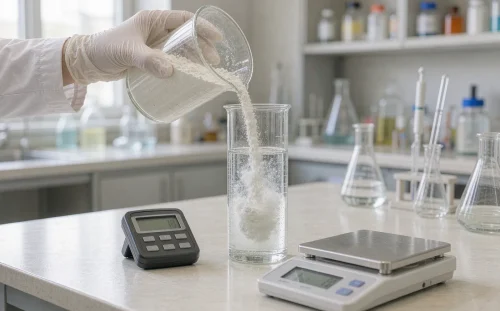
The screen below is illustrative: 12% active in the finished liquid, tested at 25°C in 100 and 300 mg/kg CaCO3 water. Grease removal is indexed to the top performer at 100 mg/kg. Foam is read immediately and after 5 minutes in a 500 mL cylinder with a 0.2% working solution.
| Grade at 12% active | Grease removal index, 100 mg/kg | Grease removal index, 300 mg/kg | Foam, initial | Foam after 5 min | Salt needed to reach 1,200 mPa·s |
|---|---|---|---|---|---|
| AOS 38% | 100 | 96 | 310 mL | 285 mL | 1.2% |
| SLES 70% | 104 | 88 | 420 mL | 395 mL | 1.8% |
| SLS 92% | 99 | 74 | 290 mL | 240 mL | 1.5% |
SLES starts ahead on foam and grease in soft water. In hard water its grease index drops about 15 points, and it needs roughly 1.8% salt to build the viscosity customers expect from a hand dishwashing liquid. AOS 38% loses about 4 points in the same hard water and thickens at 1.2% salt, which matters because salt costs money, adds bulk, and pushes up the freezing risk in transit. Foam stays the SLES advantage in both waters; customers in manual-wash markets read tall cream as cleaning power, so a 100% AOS formula sometimes gets blamed for weak performance even when the grease number says otherwise. A 4 to 1 AOS to SLES blend on active matter is the usual compromise.
What does one liter of finished product cost?
The formula is short: product kilograms per 1,000 L times product price per tonne, divided by 1,000. Illustrative prices for the arithmetic: AOS 38% at 1,700 USD per tonne, SLES 70% at 1,500 USD per tonne, SLS 92% at 1,800 USD per tonne.
| Surfactant at 12% active | Product per 1,000 L | Surfactant cost per 1,000 L | Surfactant cost per liter |
|---|---|---|---|
| AOS 38% | 316 kg | 537 USD | 0.54 USD |
| SLES 70% | 171 kg | 257 USD | 0.26 USD |
| SLS 92% | 130 kg | 234 USD | 0.23 USD |
On surfactant cost per liter the paste wins clearly. The gap narrows once freight enters: a 20 ft container moves about 20 tonnes of AOS 38% or 22 tonnes of SLES 70% in the same slot, so per kilogram of active the freight difference is about 0.09 USD in favor of the paste. Water hardness is the third lever. In hard-water markets the AOS formula needs less salt and less builder to hold its grease number, and those savings sit outside the surfactant line. Our AOS versus SLES shampoo comparison shows the same salt effect in a personal wash formula.
Which grade fits which line?
Liquid lines that pump by drum take AOS 38% directly; nothing to dissolve, no heater needed. AOS 35% works in the same line at a 7% higher dose on active matter, so choose it only when the price per kilogram of product is at least 7% lower. Plants that make concentrates or sachets usually start from powder: AOS 92% for standard concentrates, AOS 95% for low-dose sachets where freight per kilogram of active dominates. SLES 70% paste needs heated or jacketed storage below about 15°C; in plants without that, it gels in the feed tank and the dosing pump stalls. Where the formula also wants a denser foam, SLS 92% at 1 to 2% of the surfactant package lifts initial foam, at the cost of hard-water grease performance. Grade and form selection for powders is covered in the AOS buyer’s guide.
Key takeaways
- Dose on active matter: 12% active means 316 kg of AOS 38%, 171 kg of SLES 70% or 130 kg of SLS 92% per 1,000 L.
- Hard water decides it: SLES grease index falls about 15 points from 100 to 300 mg/kg CaCO3; AOS 38% falls about 4.
- Foam stays with SLES: 420 mL initial against 310 mL for AOS 38%, illustrative.
- Salt for viscosity: about 1.8% for SLES against 1.2% for AOS 38% to reach 1,200 mPa·s.
- Cost per liter favors the paste, then freight and hard-water performance pull the gap back toward AOS.
Frequently asked questions
Can AOS 38% fully replace SLES in hand dishwashing liquid?
Yes, and many hard-water markets run 100% AOS formulas. The trade is foam height and a slightly higher surfactant cost per liter in exchange for hard-water grease performance and a lighter salt load. If your customers read foam as cleaning power, blend 3 to 5 parts AOS with 1 part SLES on active matter instead of switching outright.
Why does my dishwashing liquid go thin in winter?
Two usual causes. SLES 70% paste gels below about 15°C in storage and in the feed tank, so dosing drifts low. Salt-thickened formulas also lose viscosity when the product is diluted or when the plant water runs soft in the rainy season. Keep the paste heated, dose on active matter, and re-check the salt curve on soft water.
How do I dose AOS 35% if the formula calls for AOS 38%?
Multiply the product weight by 38/35, about 1.086. A formula calling for 316 kg of AOS 38% needs roughly 343 kg of AOS 35% for the same active matter. The extra 27 kg per 1,000 L is water that comes out of the water phase of the batch.
Does SLS 92% belong in a dishwashing liquid?
As a foam booster, yes; as the main wash active, no. SLS 92% is the cheapest kilogram of active matter here, but its grease index drops about 25 points in hard water. Keep it at 1 to 2% of the surfactant package for initial foam and let AOS or SLES carry the wash.
What test should I run before switching suppliers?
Grease removal on a soiled panel at 25°C in your worst-case water, foam height initial and at 5 minutes, and a 3-month stability check at 45°C and 4°C. Run the incumbent and the candidate side by side at equal active matter, not equal product weight.
Request a quote or a sample
For bulk pricing, MOQ and lead time on AOS 38%, AOS 35% or SLES 70%, request a quote with your destination port and annual volume. If you are reformulating for hard water, request a sample of both AOS grades and run the panel test at 300 mg/kg CaCO3. You can request the COA and MSDS for either grade before you commit, or contact our team with your target active dose and water hardness and we will check the per-liter arithmetic against your formula.
Written and reviewed by the ORID Chem technical team. Last updated: 15 November 2026. Prices, dose figures and test values in this article are illustrative working numbers, not quotations. Confirm current specifications on the product TDS and lot COA before ordering.