Short answer: In a mild caustic bath of 3% or less, SLS 92% gives more foam and more grease cutting per dollar than AOS 92%. Above about 5% NaOH the balance changes: SLS solubility drops from the common sodium ion and AOS 92% stays in solution, so heavy caustic and hard water belong to AOS.
This article is for formulators of industrial hard-surface cleaners and for plants running maintenance degreasing on machine parts, floors and vehicles. We sell SLS 92%, SLS 95% and AOS 92%. Foam, solubility and price figures below are illustrative working numbers, not quotations.
What does a caustic degreaser have to survive?
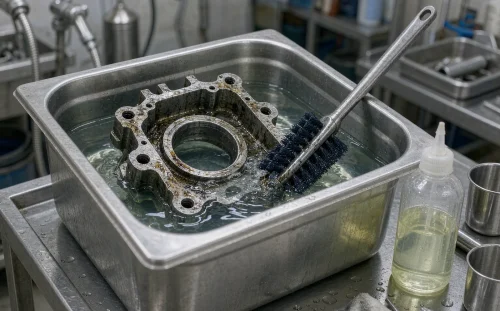
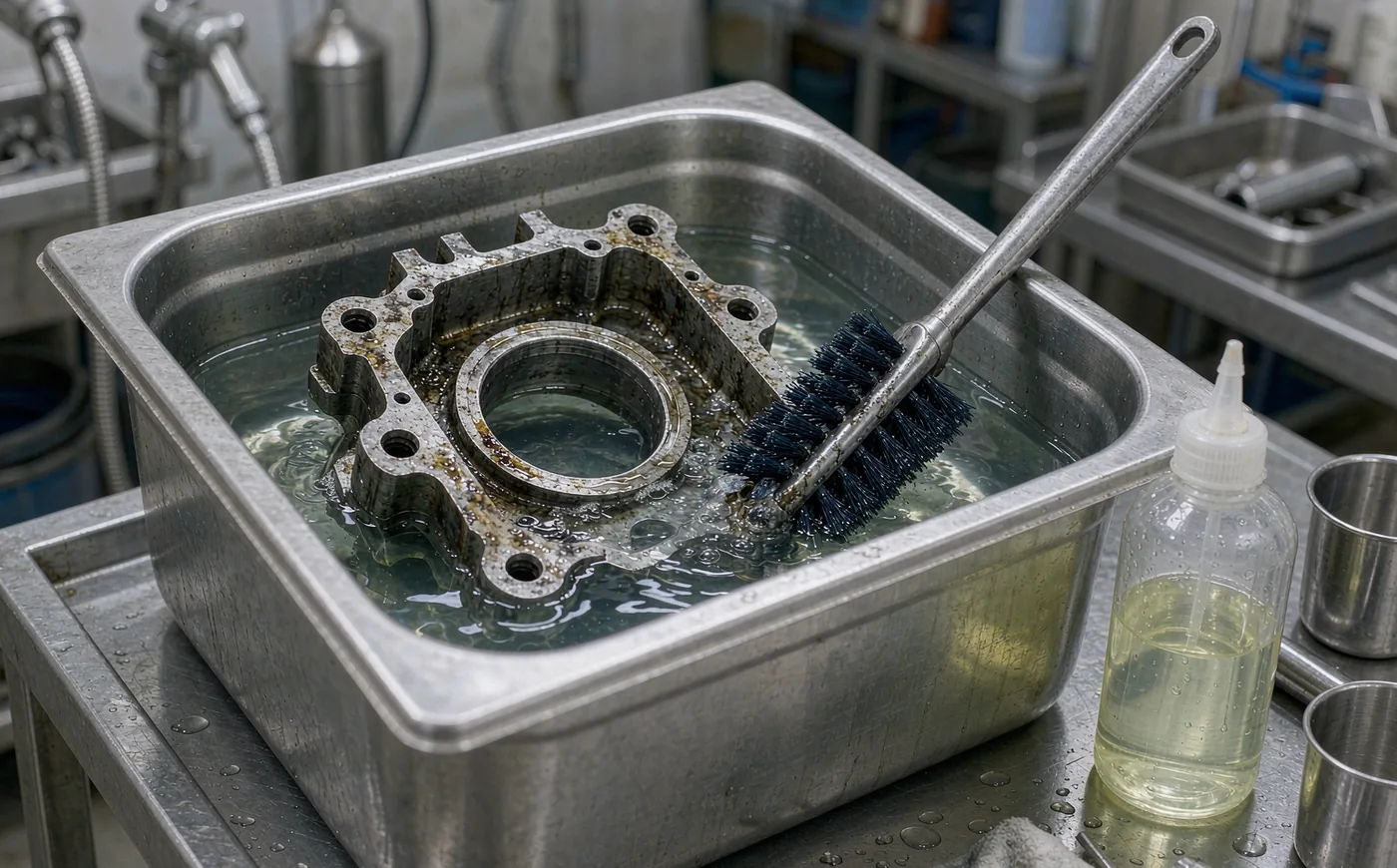
Three stresses at once. Caustic saponifies the grease, which turns it into soap and lets it rinse away; that is the main cleaning mechanism, and the surfactant mostly helps the bath wet the metal and keep the emulsified soil from redepositing. High electrolyte load follows: 3 to 10% NaOH or KOH plus gluconate, silicate or phosphate builders. Hard feed water adds calcium and magnesium on top. A surfactant that salts out in the tank stops working even though the caustic is still strong, and the operator reads the failure as a weak bath.
Where does SLS 92% stop dissolving?
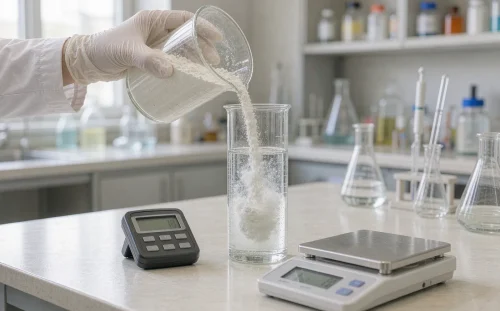
SLS is a sulfate ester with a Krafft point around 20°C, and concentrated caustic pushes the solubility down through the common-ion effect. The screen below is illustrative: 2% surfactant in caustic solution, held at 20°C for one hour, then read for haze, precipitate and gel.
| Caustic in the bath | SLS 92% at 2% | AOS 92% at 2% | SLES 70% at 2% |
|---|---|---|---|
| 0% NaOH | Clear | Clear | Clear |
| 2% NaOH | Clear | Clear | Clear |
| 5% NaOH | Slight haze | Clear | Clear |
| 10% NaOH | Precipitate and gel | Clear | Slight haze |
| 5% KOH | Clear | Clear | Clear |
Two practical rules fall out. Sodium hydroxide is the problem, not hydroxide as such: the same 5% level as KOH keeps SLS in solution because potassium dodecyl sulfate is the more soluble salt. And temperature buys room. At 40°C the 5% NaOH bath holds SLS 92% clear for a working shift, while at 20°C it hazes. If your line runs hot and the caustic stays at or below 3%, SLS is viable; if the bath sits cold or the recipe calls for 8 to 10% caustic, move the surfactant to AOS.
Foam and grease removal: what do the tests show?
Illustrative panel test at 25°C: 2% surfactant plus 5% NaOH on a standardized grease film on steel, with foam read in a 500 mL cylinder on a 0.5% working solution.
| Surfactant at 2% in 5% NaOH | Grease removal index | Foam height | Rinse film on steel | Cost per liter of concentrate |
|---|---|---|---|---|
| SLS 92% | 100 | 340 mL | None | 0.036 USD |
| SLS 95% | 100 | 330 mL | None | 0.039 USD |
| AOS 92% | 94 | 210 mL | None | 0.035 USD |
| SLES 70% | 97 | 390 mL | None | 0.030 USD |
On grease and foam in a 5% NaOH bath, SLS 92% leads AOS by about 6 index points and 130 mL of foam, at nearly the same cost per liter. Where the extra foam is wanted, for parts washers and manual brush stations where the operator sees the foam as agitation, SLS is the better buy. Where foam is a problem, for spray cabinets and high-pressure systems where foam blankets the part and blocks the jet, AOS 92% at 210 mL is the safer choice and the 6-point grease difference is inside the noise of most field trials.
What does one liter of concentrate cost?
Worked example, illustrative. A maintenance degreaser at 8% total surfactant, with SLS 92% priced at 1,800 USD per tonne, SLS 95% at 1,950, AOS 92% at 1,750 and SLES 70% at 1,500.
| Surfactant system at 8% | Product per 1,000 L | Surfactant cost per 1,000 L | Cost per liter |
|---|---|---|---|
| SLS 92% | 80 kg | 144 USD | 0.14 USD |
| SLS 95% | 80 kg | 156 USD | 0.16 USD |
| AOS 92% | 80 kg | 140 USD | 0.14 USD |
| SLES 70% | 114 kg | 171 USD | 0.17 USD |
The surfactant line is small next to caustic, builders and freight, so treat the choice as a performance decision with a small cost tail. The one place cost really moves is powder versus liquid on the freight line: a 20 ft container moves about 20 tonnes of SLS powder or 20 tonnes of AOS 92% powder, so the freight difference between the two is negligible. Liquid products like SLS 30% solution ship about 300 kg of active per tonne, and pumped lines that prefer a liquid can also take AOS 35%; powder still dominates the concentrate business, and the liquid versus powder freight comparison runs those numbers.
How do I pick for a real line?
Three questions, in order. How much caustic does the recipe need? Above 5% NaOH, use AOS 92% and stop worrying about solubility. Does the equipment foam over? Spray cabinets and high-pressure rigs go to AOS 92%; parts washers and manual stations can run SLS 92%. Does the feed water run hard? Above 300 mg/kg CaCO3, AOS 92% holds wetting while SLS drops grease removal, and the AOS hard-water data shows the shape of the penalty. A blend of 4 parts SLS 92% with 1 part AOS 92% on active matter is a common middle setting where the bath sits at 3 to 4% caustic and the equipment tolerates moderate foam. For food-adjacent plants that want the milder surfactant on skin-contact grounds, AOS 92% is the usual answer, and the foam versus concentration data helps set the dose.
Key takeaways
- Caustic ceiling: SLS 92% stays clear up to about 3 to 5% NaOH at 20°C; at 10% it precipitates and gels.
- Potassium buys room: the same hydroxide level as KOH keeps SLS in solution where NaOH hazes it.
- Foam and grease: SLS 92% beats AOS 92% by about 6 index points of grease removal and 130 mL of foam in 5% NaOH, illustrative.
- Cost per liter is a tie between SLS 92% and AOS 92% at an 8% surfactant system, so choose on solubility and foam.
- Hard water pushes to AOS above roughly 300 mg/kg CaCO3.
Frequently asked questions
Why did my degreaser gel in the storage tank?
Most often the surfactant salted out. Check the caustic level in the concentrate, the storage temperature, and whether the batch water ran hard. A 2% SLS 92% bath in 10% NaOH at 20°C precipitates; the same bath at 40°C or in KOH stays clear. Moving the surfactant to AOS 92% fixes the recipe without touching the caustic.
Can I use SLS 95% instead of SLS 92% in a caustic bath?
Yes, and the higher grade behaves almost identically in caustic: less water and less sulfate, so marginally faster dissolution at a small extra cost. There is no caustic-tolerance advantage to the higher grade, so choose it for dissolution speed in cold water, not for alkali stability.
Does SLES 70% survive caustic better than SLS?
Somewhat. In the illustrative screen SLES 70% stayed clear at 5% NaOH and only hazed at 10%, and it gives the tallest foam of the group. Its weaknesses are different: the paste gels below about 15°C in storage, it costs more per kilogram of active, and it carries a 1,4-dioxane specification that the buyers guide explains.
How do I stop foam in a spray cabinet?
Three levers, in order of preference. Switch the surfactant to AOS 92%, which foams about 40% lower than SLS at equal dose. Drop the surfactant dose to the lowest level that still wets, usually 4 to 6% of the concentrate. Only then add a defoamer, which costs money and can leave a residue on the part.
What documents should I request before ordering?
Lot COA with active matter, inorganic salts, water, pH of a 1% solution and color, plus the MSDS. For caustic-containing products also check the supplier’s storage and handling guidance, since a gelled concentrate is a dosing-pump problem before it is a cleaning problem.
Request a quote or a sample
For bulk pricing, MOQ and lead time on SLS 92%, SLS 95% or AOS 92%, request a quote with your destination port and annual volume. If you are reformulating a gelling bath, request a sample of both surfactants and run the one-hour haze test at your caustic level. You can request the COA and MSDS for either grade before you commit, or contact our team with your caustic level, feed water hardness and equipment type and we will suggest a starting surfactant system.
Written and reviewed by the ORID Chem technical team. Last updated: 15 November 2026. Prices, dose figures and test values in this article are illustrative working numbers, not quotations. Confirm current specifications on the product TDS and lot COA before ordering.