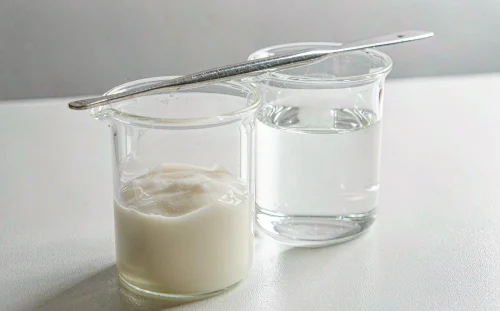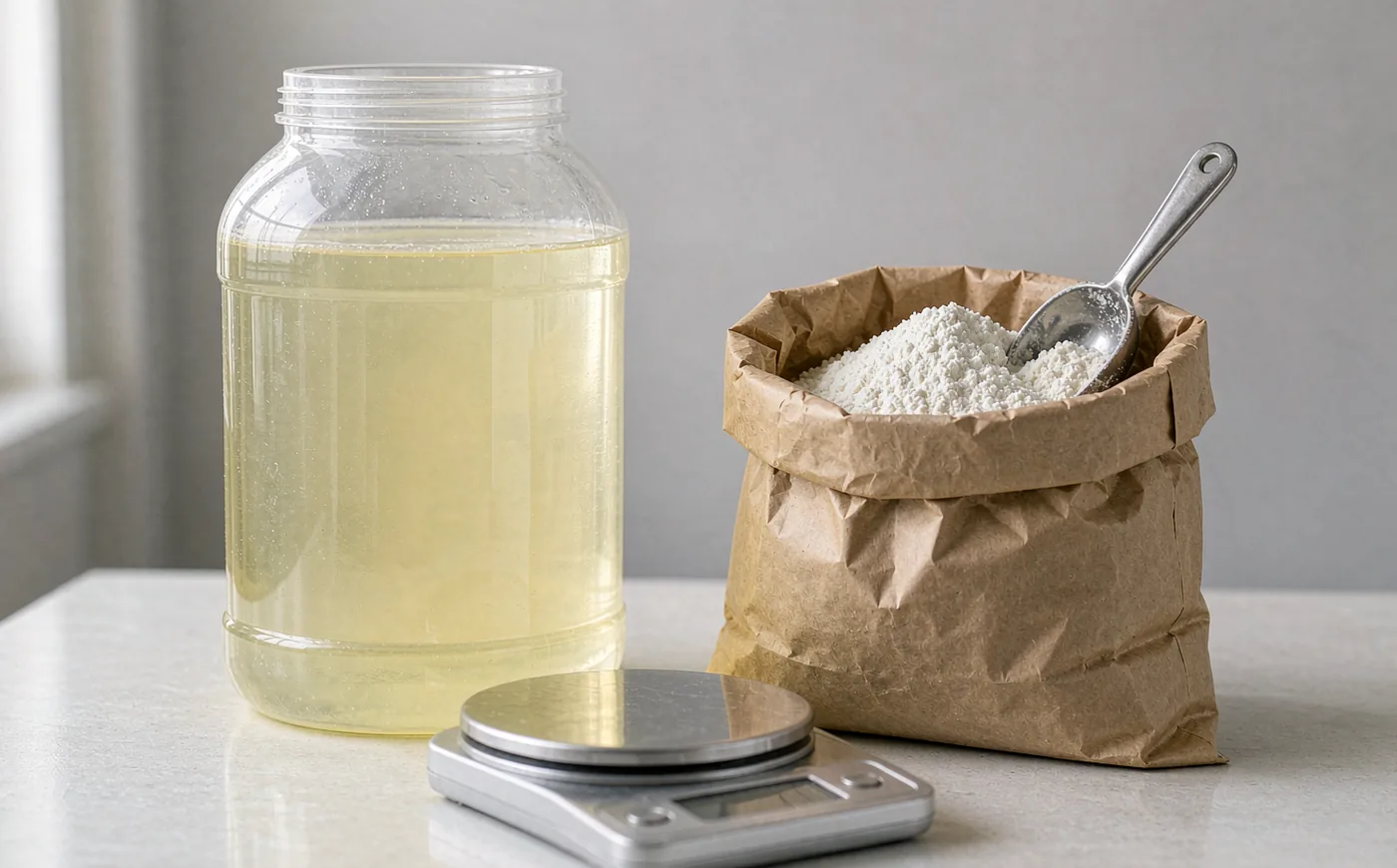
Short answer: SLS 30% liquid ships with 70% water, so freight and packaging cost about three times more per kilogram of active matter than SLS 92% powder. Powder grades also store longer and handle winter transport better. The liquid earns its place only when a plant cannot dissolve powder safely or needs pump-ready dosing.
This comparison is written for buyers and plant engineers weighing quotes for SLS 30% liquid against SLS 92% powder and SLS 95% powder. All prices and freight figures below are illustrative working numbers for the arithmetic, not quotations. Ask for current pricing against your destination port before you decide.
What is actually inside each package?
The molecule is the same in every SLS grade: sodium lauryl sulfate, CAS 151-21-3, molecular weight 288.38. What changes is how much of the drum is active matter and how much is water or inert carrier.
| Grade | Active matter | Appearance | Typical packaging |
|---|---|---|---|
| SLS 30% liquid | About 30% | Pale yellow mobile liquid | 200 L drum, 1,000 L IBC |
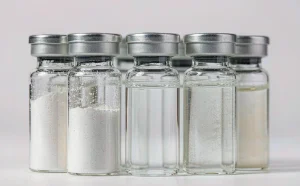
| SLS 92% powder | About 92% | White to off-white powder or needles | 25 kg bag, 500 kg jumbo bag |
| SLS 95% powder | About 95% | White powder or needles | 25 kg bag, 500 kg jumbo bag |
| SLES 70% paste | About 70% | White to pale yellow paste | 200 L drum, 1,000 L IBC |
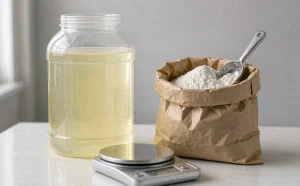
A tonne of SLS 30% carries roughly 300 kg of active matter. A tonne of SLS 92% carries about 920 kg. You are buying and shipping the same molecule, but one shipment is mostly water and the other is almost entirely surfactant.
How much does the water cost in freight?
Freight is charged per tonne of product, not per tonne of active matter. The cost per kilogram of active matter is therefore the freight per tonne divided by the active fraction, and that is where the liquid loses. Dividing by 0.30 instead of 0.92 multiplies the freight burden by about 3.1 times.
| Freight basis, illustrative | SLS 30% liquid | SLS 92% powder | SLS 95% powder |
|---|---|---|---|
| Active kg per tonne of product | 300 | 920 | 950 |
| Freight per tonne of product, 20 ft container to Nhava Sheva | 76 USD | 76 USD | 76 USD |
| Freight per kg of active matter | 0.25 USD | 0.08 USD | 0.08 USD |
| Container cost per tonne of active matter | 507 USD | 166 USD | 160 USD |
Those container figures assume a 21 tonne payload at 1,600 USD per 20 ft container, which is an illustrative rate for a South Asia route. The ratio holds at any freight rate: liquid forms carry roughly three times the container cost per tonne of active matter. Packaging adds a second gap, because an empty 200 L drum or 1,000 L IBC weighs more and costs more to return than a stack of flat 25 kg bags.
Import paperwork follows the same logic. One container of SLS 30% clears about 6.3 tonnes of active matter through customs; one container of SLS 92% clears about 19.3 tonnes. The import guide for bulk surfactants covers HS codes and documentation, and the landed-cost comparison method shows how to put freight, duty and packaging into one number per kilogram of active matter.
What does dissolving cost on the plant floor?
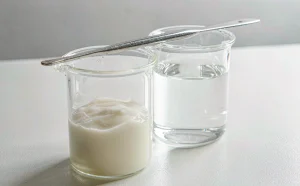
Powder has to be dissolved before it does anything. Making one tonne of active matter from SLS 92% means dispersing about 1,087 kg of powder into roughly 2,600 L of water and mixing until clear. A turbine mixer handles a batch like that in 20 to 30 minutes at 40 to 50 C. Heating 2,600 L of water from 20 C to 50 C takes about 87 MJ, roughly 24 kWh, which at an illustrative 0.10 USD per kWh works out to about 2.4 USD per tonne of active matter.
That is the honest cost of dissolving: a couple of dollars of energy per tonne, plus mixer time, plus labor, plus dust control at the dumping station. Against a freight penalty of roughly 340 USD per tonne of active matter for the liquid, the dissolving cost rarely closes the gap. It only matters when the alternative is dust complaints, a closed liquid-dosing line that cannot accept powder, or a plant with no mixer capacity at all.
Which grade wins on cost per kilogram of active matter?
Divide the product price by the active fraction. The formula and a full worked example are in our cost per kg of active matter article.
| Grade, illustrative price | Product price per tonne | Active fraction | Cost per kg of active matter |
|---|---|---|---|
| SLS 30% liquid | 1,450 USD | 0.30 | 4.83 USD |
| SLS 92% powder | 1,650 USD | 0.92 | 1.79 USD |
| SLS 95% powder | 1,750 USD | 0.95 | 1.84 USD |
| SLES 70% paste | 1,700 USD | 0.70 | 2.43 USD |
The same arithmetic applies to every liquid grade we sell. AOS 35% ships with 65% water and AOS 38% with 62% water, so both carry the same freight penalty per kilogram of active matter. AOS 95% powder is the low-water alternative for plants that can handle powder. Our AOS powder versus liquid guide runs those numbers for the AOS range.
When does SLS 30% liquid still make sense?
Three situations justify the extra cost. Plants with no powder dosing equipment and no mixer capacity can dose the liquid straight into the batch. Lines that must stay closed for hygiene reasons, such as some food-adjacent cleaning formulations, avoid the dust step entirely. And small-volume users ordering one drum at a time care less about freight per kilogram of active matter than about handling convenience.
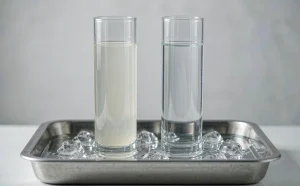
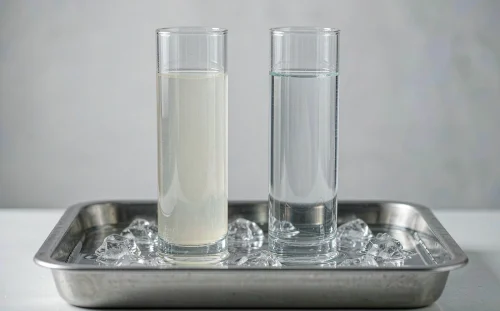
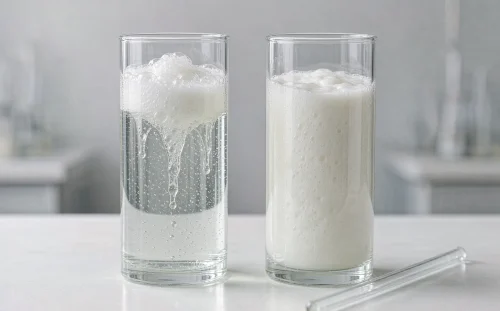
Winter changes the picture again. A 30% solution sits close to its solubility limit, and SLS has a Krafft point around 16 C in pure water. Below that temperature the liquid can cloud or gel in transit or in an unheated warehouse. Shipments to Russia in January, or storage in an unheated warehouse in Iran, need heated or insulated storage; the winter clouding and freezing guide covers the checks. Powder grades tolerate the same route with far less risk, which is one more reason cold-climate buyers usually stay with powder.
Key takeaways
- Same molecule: SLS 30%, 92% and 95% are all CAS 151-21-3. The difference is active fraction and form, not chemistry.
- Freight penalty: liquid forms cost roughly three times more per kg of active matter in freight, because the container is charged on the water too.
- Dissolving cost is small: about 2.4 USD of energy per tonne of active matter at illustrative rates, against a freight penalty of hundreds of dollars.
- Winter risk: SLS 30% can cloud or gel below its Krafft point near 16 C; heated storage is required for cold routes.
- Decision rule: choose powder when you have mixing capacity and freight matters; choose liquid when handling convenience outweighs the water cost.
Frequently asked questions
Is SLS 30% liquid the same active as SLS 92% powder?
Yes, both are sodium lauryl sulfate, CAS 151-21-3. The 30% grade is a ready-to-dose aqueous solution; the 92% grade is a dried powder with about 92% active matter. Performance at equal active dose is the same, so the choice comes down to handling, freight and storage.
Does SLS 30% freeze or cloud in winter?
It can cloud or gel at low temperature. The Krafft point of SLS in pure water is around 16 C, and a 30% solution sits close to its solubility limit, so cold storage or an unheated container can push it out of solution. Warming usually reverses it. Store above 20 C and protect from freezing.
How should SLS 30% liquid be stored?
Keep drums and IBCs sealed, indoors, above 20 C, away from freezing. Avoid long storage above 40 C. Rinse pumps and lines with warm water before long shutdowns so residue does not gel in the dead legs.
Is powder always cheaper after freight?
Almost always, at container scale. The freight advantage per kg of active matter is roughly three to one, and the dissolving cost on the plant floor is a few dollars per tonne. The exception is very small volumes where handling, not freight, dominates the total cost.
Can I substitute SLS 30% for powder in an existing formula?
Yes, but recalculate the water balance. If a formula calls for 10 kg of SLS 92% powder, that is 9.2 kg of active matter, which needs about 30.7 kg of SLS 30% liquid, and the free water in the liquid comes out of the formula’s water addition. Run a trial batch to confirm viscosity and preservative performance.
Request a quote or a sample
For bulk pricing, MOQ and lead time on SLS 30% liquid, SLS 92% or SLS 95%, request a quote with your destination port and annual volume. If you are switching between liquid and powder for the first time, request a sample of both forms and run a dissolving and a stability trial side by side. You can request the COA and MSDS for any grade before you commit, or contact our team with your batch size and water hardness and we will confirm the most economical grade for your line.
Written and reviewed by the ORID Chem technical team. Last updated: 2 November 2026. Prices, freight rates and energy figures in this article are illustrative working numbers, not quotations. Confirm current specifications on the product TDS and lot COA before ordering.