Short answer: AOS is a sulfonate, so it holds foam in hard water and fits sulfate-free claims. SLES is a sulfate that thickens predictably with salt and feels creamier. Most shampoos run SLES as the primary surfactant with part replaced by AOS, and at powder grades both cost about the same per kg of active matter. Hardness and label claims decide the split.
This comparison is for formulators and buyers setting the surfactant package for a shampoo or a liquid body wash. Our SLS vs SLES selection guide covers the sulfate side; this article stays on the AOS versus SLES question. Test values below are illustrative bench ranges, not guaranteed performance.
What is the chemical difference between AOS and SLES?
| Property | AOS (CAS 68439-57-6) | SLES (CAS 68585-34-2) |
|---|---|---|
| Chemistry | C14-16 olefin sulfonate (sulfonate head group) | C12-14 alkyl ether sulfate (ethoxylated sulfate) |
| Commercial form | 35% or 38% liquid, 92% or 95% powder | 70% paste |
| Foam character | Dense, stable, small bubbles | Creamy, quick to build, larger bubbles |
| Hard-water tolerance | Good; calcium and magnesium bind weakly to sulfonates | Better than plain SLS, weaker than AOS |
| Salt thickening | Works, but the window is narrower and less predictable | Wide, predictable window with sodium chloride |
| Label positioning | Sulfonate, not a sulfate, so it supports sulfate-free claims | A sulfate; not usable in sulfate-free claims |
One structural fact drives the rest. AOS carries a sulfonate group, which resists calcium and magnesium better than a sulfate ester. That is why AOS holds foam in hard water and why the personal care industry moved it into mild and sulfate-free ranges. SLES keeps a short ethylene oxide chain ahead of its sulfate group, which softens the same effect but does not remove it.
How does each grade foam in a shampoo base?
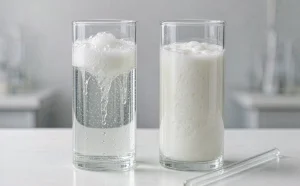
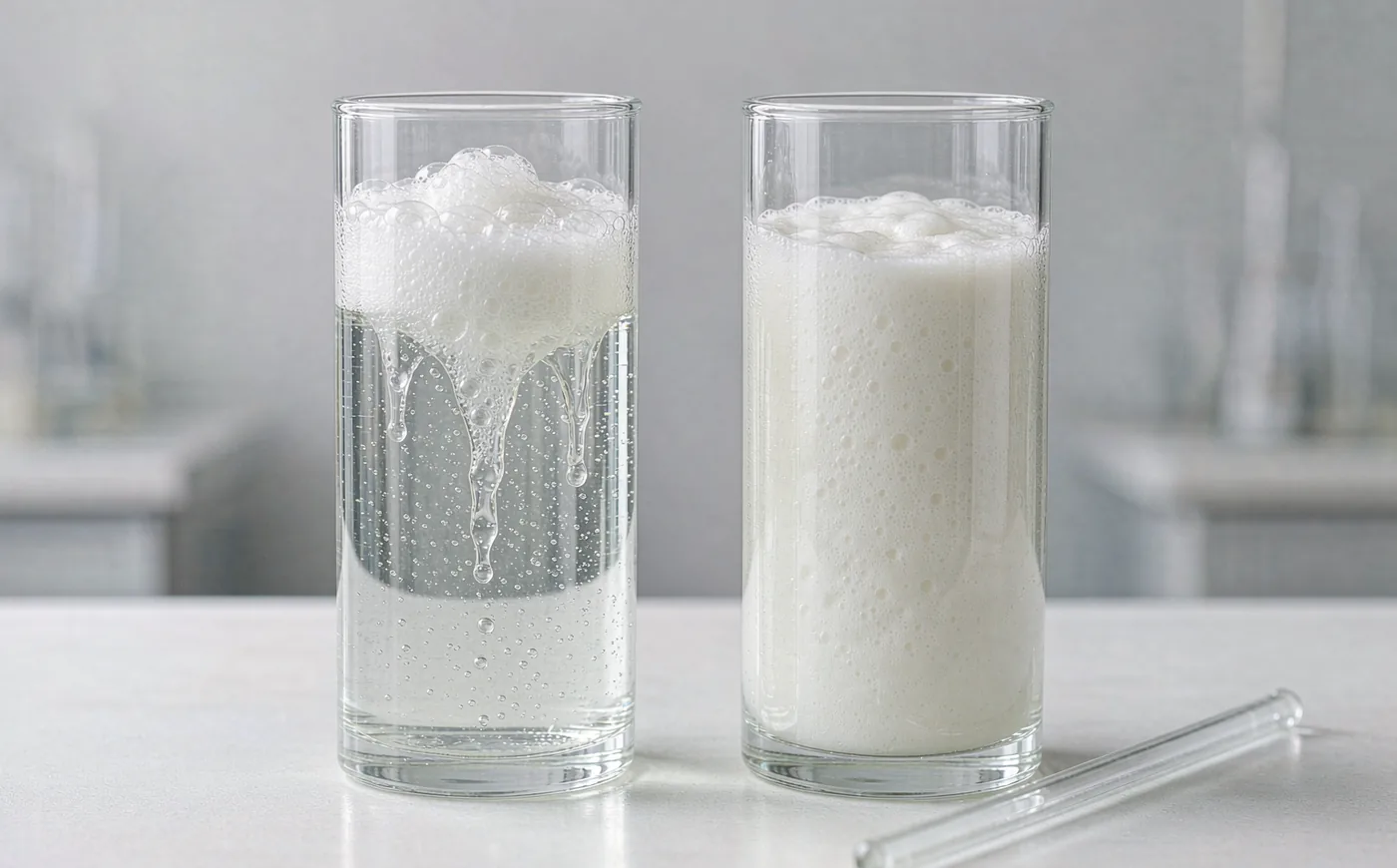
Foam was measured at equal active dose in a simple shampoo base at 25 C using the Ross-Miles method. The pattern below repeats across bench trials, with your own numbers shifting on water hardness, pH and the co-surfactant.
| Test condition, 12% active | AOS foam height | SLES foam height | Reading |
|---|---|---|---|
| Soft water, 150 mg/kg CaCO3 | 150 mm initial, 150 mm at 5 min | 165 mm initial, 155 mm at 5 min | SLES flashes faster, AOS holds flat |
| Hard water, 300 mg/kg CaCO3 | 148 mm initial, 145 mm at 5 min | 160 mm initial, 130 mm at 5 min | illustrative bench values |
| Very hard water, 500 mg/kg CaCO3 | 140 mm initial, 135 mm at 5 min | 135 mm initial, 95 mm at 5 min | SLES collapses, AOS keeps most of its foam |
Read the table as a shape, not a specification. Two directions matter for product design: SLES wins the first impression in soft water, and AOS wins the five-minute and hard-water case. Buyers in Rajasthan, Punjab or Balochistan, where supply water often runs above 300 mg/kg CaCO3, should run the hard-water row before locking a formula.
Which grade thickens more predictably?
SLES is the easier grade to thicken. Adding sodium chloride builds viscosity in a wide, flat window, which is why most commercial shampoos are SLES-based and salted to spec. AOS thickens with salt too, but the window is narrower and the curve steeper, so overshooting is easier and the batch can flip from thin to rubbery with a small salt addition.
If your base is AOS-heavy, plan for a co-thickener such as a guar derivative or a polyacrylate and build viscosity in stages. The salt thickening guide walks through the failure mode where more salt makes the product thinner, which applies to both grades. A practical compromise used by many contract manufacturers: SLES at 10-15% as supplied for the thickening backbone, AOS at 4-8% as supplied for hard-water foam and mildness.
What does each grade cost per kilogram of active matter?
Divide the product price by the active fraction. AOS powder is priced above SLES paste per tonne of product, but it carries far less water, so the gap per kilogram of active matter narrows sharply.
| Grade, illustrative price | Product price per tonne | Active fraction | Cost per kg of active matter |
|---|---|---|---|
| AOS 35% liquid | 1,600 USD | 0.35 | 4.57 USD |
| AOS 38% liquid | 1,700 USD | 0.38 | 4.47 USD |
| AOS 92% powder | 2,100 USD | 0.92 | 2.28 USD |
| AOS 95% powder | 2,300 USD | 0.95 | 2.42 USD |
| SLES 70% paste | 1,700 USD | 0.70 | 2.43 USD |
At the powder end the two surfactants land within about 0.15 USD per kg of active matter of each other, which is inside the noise of a single freight quote. The liquid AOS grades look expensive per kilogram of active matter for the same freight-on-water reason covered in our liquid versus powder freight comparison. Freight, packaging and MOQ usually decide the number before the drum price does.
What dosage levels do commercial formulas use?
| Ingredient, as supplied | Typical range | Function |
|---|---|---|
| SLES 70% paste | 10-16% | Primary surfactant, foam, salt-thickened viscosity |
| AOS 35% or AOS 38% | 4-8% | Hard-water foam, mildness, sulfate-free positioning |
| Betaine or amphoteric | 2-5% | Foam stabiliser, mildness, conditioning |
| Sodium chloride | 0-2% | Viscosity adjustment, added in stages |
| SLS 95% powder | 0-3% | Foam booster in value formulas, cost control |
| Preservative, dye, fragrance, pH adjuster | q.s. | Standard |
These are starting ranges for bench work, not a finished formula. If your target market sells on a sulfate-free claim, the SLES line comes out entirely and AOS becomes the primary anionic, with foam and viscosity rebuilt around a nonionic co-surfactant. Our AOS in shampoo application note and the SLES in shampoo note cover the single-grade formulas in detail.
Key takeaways
- Hard water: AOS holds foam above 300 mg/kg CaCO3 where SLES drops off. Test both at your supply water hardness.
- Thickening: SLES has the wider salt window. AOS-heavy bases need staged salt addition or a co-thickener.
- Cost: AOS 95% powder and SLES 70% paste land within about 0.15 USD per kg of active matter of each other at illustrative prices.
- Positioning: AOS is a sulfonate, so it fits sulfate-free label claims; SLES does not.
- Dosage: a 10-16% SLES backbone with 4-8% AOS covers most mid-market shampoos before fine-tuning.
Frequently asked questions
Can I replace SLES with AOS one-for-one in an existing shampoo?
Not on an as-supplied basis. Match on active matter first: 15% of SLES 70% paste is 10.5% active, which needs about 30% of AOS 35% liquid. Then rework viscosity, because AOS does not thicken with salt in the same window, and re-check preservative performance. A partial replacement is the lower-risk route.
Which grade foams better in hard water?
AOS. The sulfonate head group tolerates calcium and magnesium better than the ethoxylated sulfate. At 500 mg/kg CaCO3 an AOS base keeps most of its five-minute foam while an SLES base loses roughly 40% of it, based on illustrative bench trials.
Is AOS milder than SLES on skin?
AOS is generally used where mildness drives the formula, including baby and sulfate-free ranges, and it is often paired with betaine for that reason. Mildness still depends on total active dose, pH and rinse time, so run a repeat insult or in-use test on your own base before making a claim.
Why is AOS powder priced above SLES paste per tonne but similar per kg of active?
SLES ships as a 70% paste, so 30% of every tonne is water. AOS 95% powder ships with about 5% water. The higher per-tonne price of AOS powder mostly pays for the missing water, which is why the two grades converge per kilogram of active matter.
What samples do I need for a comparison trial?
Request AOS 35% or 38% for a liquid line, AOS 95% powder for a powder-fed line, and SLES 70% paste as the control. Run all three at equal active dose on your own water, with the same salt curve and the same preservative, and compare foam at 30 seconds and 5 minutes.
Request a quote or a sample
For bulk pricing, MOQ and lead time on AOS 35%, AOS 38%, AOS 95% or SLES 70%, request a quote with your water hardness data and destination port. If you are reformulating for a sulfate-free claim or a hard-water market, request a sample of each candidate grade and run the foam and salt-curve trials side by side. You can also request the COA and MSDS for any grade before a trial order, or contact our team with your formula sheet and we will reply with the grades that fit your viscosity and foam targets.
Written and reviewed by the ORID Chem technical team. Last updated: 2 November 2026. Test values and prices in this article are illustrative bench ranges, not guaranteed performance or quotations. Confirm current specifications on the product TDS and lot COA before ordering.