Short answer: For 12.5 mm gypsum board, SLS 92% at 0.05 to 0.15% on stucco weight lowers core density from about 1,100 to 650-750 kg/m3. At 0.10% the illustrative surfactant cost is 16 USD per 1,000 m2, while the gypsum saved is worth about 50 USD. Foam stability at the mixer, not foam height in a beaker, sets the upper dose.
This is for board plant engineers and buyers in India, Pakistan, Iran, Russia and Southeast Asia who are setting a foaming agent dose or comparing a powder grade against a liquid one. We supply a dedicated gypsum board foaming agent plus SLS 92% and the other grades below. Densities, dose figures and prices in this article are illustrative working numbers for the arithmetic, not measured board tests or quotations.
How does a foaming agent actually change board density?
The mixer entrains air into the stucco slurry. Surfactant lowers surface tension enough to hold those bubbles until the gypsum sets. If the foam breaks before set, the air escapes and density rises; if it survives too well, cells coalesce and the core loses strength. Density is a direct function of the air fraction left in the set core:
density = solid density x (1 – air fraction). With a fully compacted gypsum matrix at about 1,100 kg/m3, a 700 kg/m3 core means an air fraction of 1 – 700/1100, or 36%. A 650 kg/m3 core needs 41%. That is the number the foam generator has to deliver, and it is why a foaming agent is specified by air entrainment and foam stability rather than by foam height alone.
What does the dose curve look like?
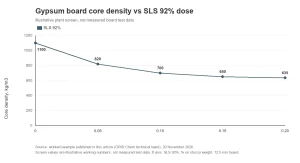
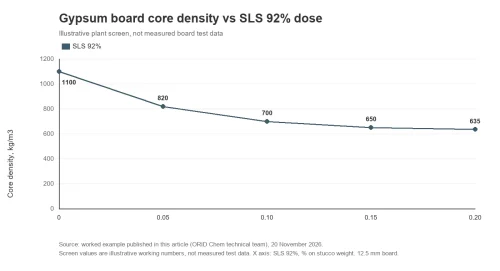
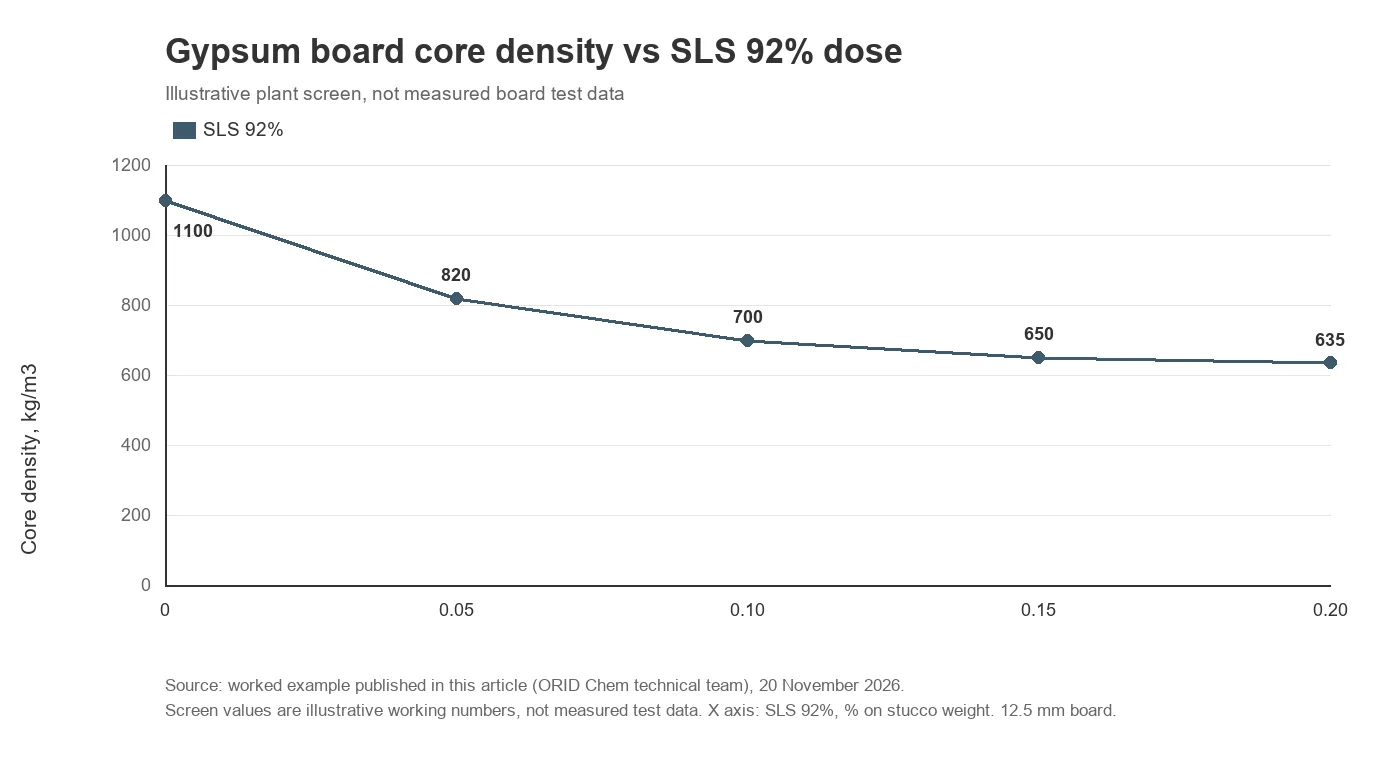
Illustrative plant screen: 12.5 mm board, stucco slurry at a fixed water to stucco ratio, foam generated inline, density read after drying to constant weight. SLS 92% dosed as percent of stucco weight.
| SLS 92% on stucco, % | Core density, kg/m3 | Air fraction, % | Board weight, kg/m2 | Foam drainage half-life, s |
|---|---|---|---|---|
| 0 | 1,100 | 0 | 13.75 | n/a |
| 0.05 | 820 | 25 | 10.25 | 95 |
| 0.10 | 700 | 36 | 8.75 | 130 |
| 0.15 | 650 | 41 | 8.13 | 155 |
| 0.20 | 635 | 42 | 7.94 | 150 |
The curve flattens after about 0.15%. Going from 0.15% to 0.20% buys only 15 kg/m3 of density while doubling the surfactant load, and the drainage half-life stops improving. That is the practical ceiling for this illustrative line. Our foam height versus concentration data shows the same diminishing return in a detergent solution, measured in a column rather than a board core.
What does the dose cost per 1,000 m2 of board?
Work from the finished area. A 12.5 mm board at 700 kg/m3 weighs 0.0125 x 700 = 8.75 kg/m2, so 1,000 m2 carries 8,750 kg of board. Take stucco at 8,750 kg for the arithmetic. At 0.10% dose that is 8.75 kg of SLS 92%. Illustrative price 1,800 USD per tonne gives 15.8 USD of surfactant per 1,000 m2.
| Dose, % on stucco | SLS 92% per 1,000 m2 | Surfactant cost at 1,800 USD/t | Board weight saved vs no foam | Illustrative gypsum value saved |
|---|---|---|---|---|
| 0.05 | 4.38 kg | 7.9 USD | 3,500 kg | 280 USD |
| 0.10 | 8.75 kg | 15.8 USD | 5,000 kg | 400 USD |
| 0.15 | 13.13 kg | 23.6 USD | 5,620 kg | 450 USD |
| 0.20 | 17.50 kg | 31.5 USD | 5,810 kg | 465 USD |
The gypsum column uses an illustrative 80 USD per tonne of stucco and compares board weight at each density against an unfoamed 13.75 kg/m2 board. It is a material-balance figure, not a plant saving: a lighter board also has lower bending strength and different screw-holding, so the dose is set by the strength specification first and the material arithmetic second. Going from 0.15% to 0.20% adds 7.9 USD of surfactant for 15 USD of notional gypsum value, which is a thin margin once strength testing is counted. The cost per kilogram of active matter worked example gives the general conversion for comparing a powder quote with a liquid one.
Which grade fits the foam generator?
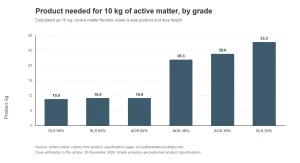
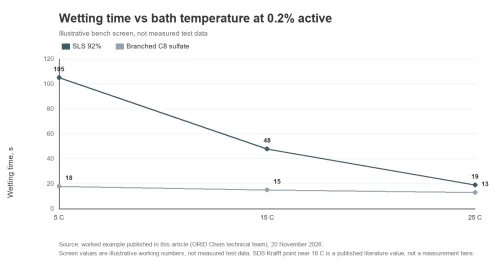
Powder grades need a dissolving step before the foam generator or a slurry side injection that fully wets the powder. SLS 92% is the usual starting point; SLS 95% carries less inorganic salt per kilogram of active, which matters where the mix water is hard. Plants without powder handling take SLS 30% solution or AOS 38% directly by metering pump, at roughly three times the product weight for the same active matter. Short-chain sulfates give faster wetting and less persistent foam: sodium 2-ethylhexyl sulfate and sodium octyl sulfate are worth a trial where the slurry sets fast and long foam life is a liability. The SOS versus SLS chain length comparison explains why the shorter chain drains faster. Freight and water content for the liquid grades are worked through in the liquid versus powder freight comparison.
Key takeaways
- Density is an air-fraction calculation: 700 kg/m3 from a 1,100 kg/m3 matrix means 36% air.
- Illustrative dose window: 0.05 to 0.15% SLS 92% on stucco weight; the curve flattens above 0.15%.
- Surfactant cost is small: about 15.8 USD per 1,000 m2 at 0.10% and an illustrative 1,800 USD/t.
- Strength sets the ceiling: a lighter core loses bending strength, so do not dose for minimum density alone.
- Check drainage half-life, not beaker foam height, when comparing a powder grade with a liquid one.
Frequently asked questions
Can I use standard detergent SLS 92% as a gypsum board foaming agent?
It is the same molecule and many board lines run it. The differences are in dosing consistency and foam stability at the mixer, so run a plant trial with your own slurry water and set time. We also supply a grade sold specifically for board foaming; ask for both samples and compare drainage half-life side by side.
Why did board density rise after I increased the foaming agent dose?
Over-dosing can produce coarse cells that coalesce and drain before the gypsum sets. Hard mix water and a slurry temperature change have the same effect. Check water hardness in mg/kg CaCO3, slurry temperature and foam generator pressure before adding more surfactant.
How do I convert a liquid AOS 38% dose to SLS 92% powder?
Multiply the liquid product weight by 38/92, about 0.413. A line dosing 20 kg of AOS 38% for 7.6 kg of active needs roughly 8.3 kg of SLS 92% for the same active matter. Confirm the activity on each lot COA rather than the nominal grade.
Does a lower board density always save money?
Only up to the strength specification. Below that point the board fails bending or screw-holding tests, and the saving in stucco is lost in downgraded output. In the illustrative table the density gain from 0.15% to 0.20% is 15 kg/m3 for nearly double the surfactant.
What should a board plant send when requesting a quote?
Target board thickness and density, strength specification, slurry water hardness, set time, whether foam is generated inline or in a separate generator, and annual tonnage. Ask for the COA and a sample sized for a plant trial, plus MOQ and lead time to your destination port.
Request a quote or a sample
For bulk pricing, MOQ and lead time on the gypsum board foaming agent, SLS 92% or SLS 30%, request a quote with your destination port and annual volume. If you are setting a dose on a new board line, request a sample of the powder and liquid grades and run the density curve at your own slurry temperature. You can request the COA and MSDS before committing, or contact our team with your target board density and stucco throughput and we will check the per-1,000 m2 arithmetic against your line.
Written and reviewed by the ORID Chem technical team. Last updated: 20 November 2026. Densities, dose figures, drainage times, prices and cost figures in this article are illustrative working numbers, not quotations or measured board test results. Confirm current specifications on the product TDS and lot COA before ordering.