Short answer: Below about 15°C, SLS 92% loses wetting speed because its Krafft point sits near 16°C in published data. Branched C8 sulfates keep working at 5°C and need no heated tank, at roughly twice the cost per kilogram of active. For a cold metal cleaning line, a 3:1 short-chain to SLS blend on active matter is the usual starting point.
This is for plants running spray or immersion metal cleaning in unheated bays in Russia, Iran, Pakistan, northern India and inland Southeast Asia during winter. We supply SLS 92%, sodium 2-ethylhexyl sulfate and the other grades below. Wetting times, temperatures, prices and costs in this article are illustrative working numbers, not measured test results or quotations.
Why does a cold bath wet more slowly?
An ionic surfactant only forms micelles above its Krafft point. Below that temperature the solubility is low, the dissolved monomer concentration is capped, and wetting of an oily metal surface slows down sharply. Published values put the Krafft point of sodium dodecyl sulfate near 16°C. A branched or shorter chain sulfate has a much lower Krafft point because the hydrophobic tail packs poorly into a crystal, so it stays dissolved in cold water. That is a molecular property, not a marketing claim, and it is the reason a 5°C cleaning bath behaves differently from the same bath at 25°C.
The cost of ignoring it is usually a heated tank. Heating 1,000 L of water from 5°C to 25°C takes about 84 MJ, or roughly 23 kWh at the burner or element, before standing losses are counted. Our CMC and Krafft point explainer gives the definition and the formulation consequences for both numbers.
How much does temperature change wetting time?
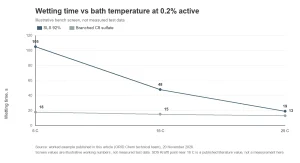
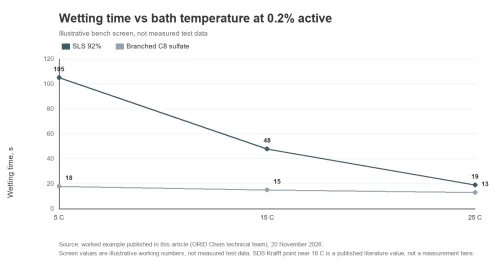
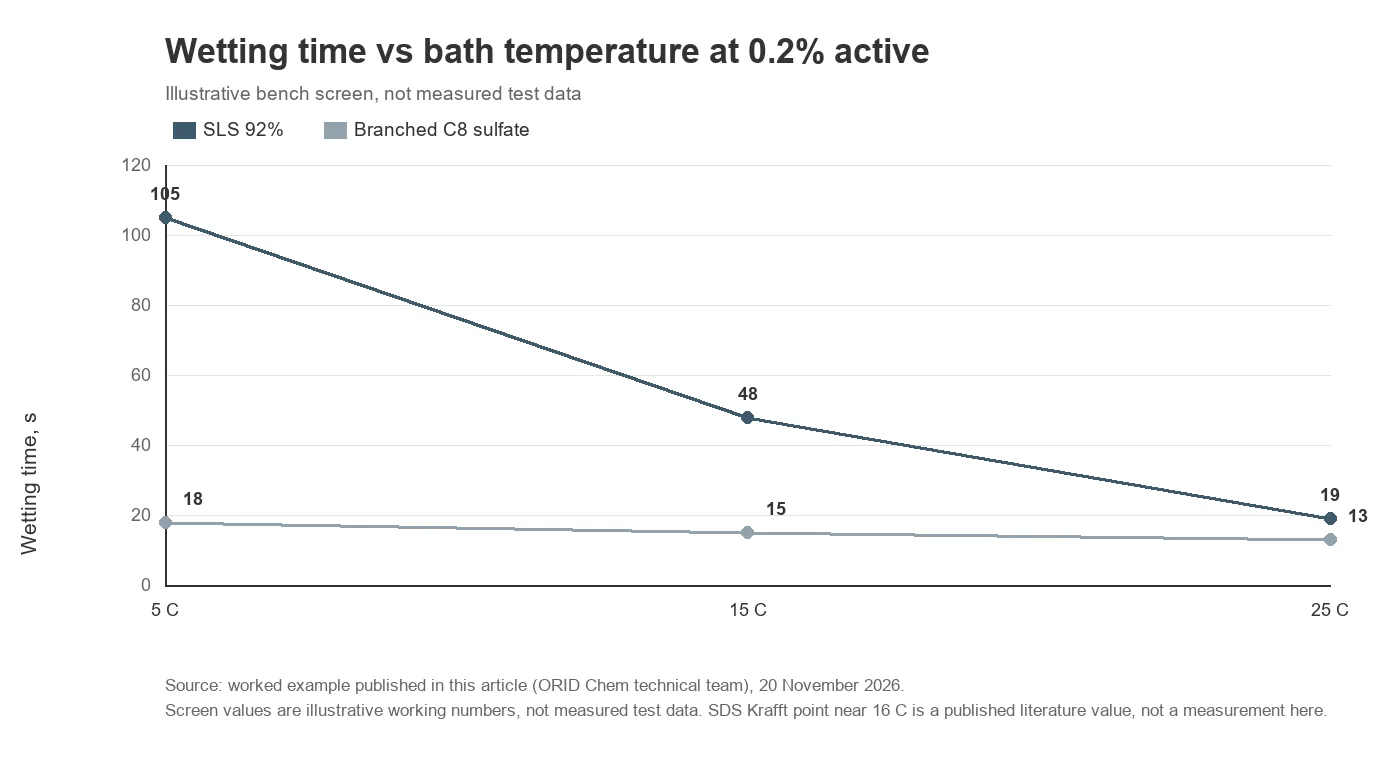
Illustrative bench screen: 0.2% active anionic surfactant in a 5 g/L NaOH cleaning bath, Draves-style wetting of a standard cotton skein, three temperatures. Lower is faster.
| Grade at 0.2% active | Wetting time 5°C, s | Wetting time 15°C, s | Wetting time 25°C, s | Foam in a spray line |
|---|---|---|---|---|
| SLS 92% | 105 | 48 | 19 | High |
| Sodium 2-ethylhexyl sulfate (C8 branched) | 18 | 15 | 13 | Low |
| Sodium octyl sulfate (C8 linear) | 21 | 17 | 14 | Low |
| Sodium decyl sulfate (C10) | 34 | 26 | 17 | Medium |
| AOS 38% | 41 | 30 | 20 | Medium |
| SLS 92% + C8 branched, 1:3 active | 29 | 21 | 16 | Low to medium |
SLS 92% goes from 19 s at 25°C to 105 s at 5°C, about 5.5 times slower. The branched C8 sulfate moves only from 13 s to 18 s. The low foam of the short-chain grades is a second advantage in a spray line, where a tall foam blanket trips the pump and hides the part from the nozzle. Our surfactant wetting time comparison covers the three main anionics at room temperature, and the SOS versus SLS chain length comparison explains why the C8 grades wet faster and foam less.
What does the cold bath cost per 1,000 L?
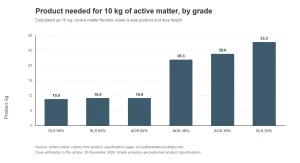
Dose on active matter. At 0.2% active in 1,000 L, the bath needs 2 kg of active. Illustrative prices: SLS 92% at 1,800 USD/t, sodium 2-ethylhexyl sulfate (40% liquid) at 2,200 USD/t, sodium octyl sulfate (35% liquid) at 2,100 USD/t, sodium decyl sulfate at 2,400 USD/t, AOS 38% at 1,700 USD/t.
| Grade at 0.2% active | Product for 2 kg active | Surfactant cost per 1,000 L | Cost per kg active | Heating to 25°C needed |
|---|---|---|---|---|
| SLS 92% | 2.17 kg | 3.91 USD | 1.96 USD | Yes |
| C8 branched, 40% liquid | 5.00 kg | 11.00 USD | 5.50 USD | No |
| C8 linear, 35% liquid | 5.71 kg | 12.00 USD | 6.00 USD | No |
| C10 sulfate | 2.50 kg | 6.00 USD | 3.00 USD | No |
| AOS 38% | 5.26 kg | 8.95 USD | 4.47 USD | No |
| SLS 92% + C8 branched, 1:3 active | 0.54 kg + 3.75 kg | 9.23 USD | 4.61 USD | No |
The SLS bath is cheapest in surfactant but needs heat. At an illustrative 0.10 USD per kWh, the 23 kWh to lift 1,000 L by 20°C adds 2.30 USD, and a real unheated bay loses that heat continuously over a shift. The 1:3 blend costs 9.23 USD per 1,000 L against 3.91 USD plus heating for straight SLS. Whether the 5.32 USD difference pays depends on how long the bath stays cold: a line that runs warm for nine months of the year should not pay for a cold-grade package year round. The LDS versus SLS cold water laundry comparison works the same trade for a lithium salt.
Which grade fits which cleaning line?
Immersion tanks with existing heating and a foam-tolerant overflow stay on SLS 92% or SLS 30% solution. Spray cabinets in unheated bays need the short-chain grades: sodium 2-ethylhexyl sulfate for the lowest foam, sodium octyl sulfate where a linear chain is preferred, sodium decyl sulfate for a middle cost point, or sodium octyl decyl sulfate where a mixed chain length is already approved. Where the bath also carries high caustic, check solubility in your own NaOH concentration first; the caustic degreaser comparison covers the 5 to 10% NaOH case. A plant that only wants to reduce foam without changing the wetter can add AOS 38% to the SLS base and accept the illustrative 41 s wetting time at 5°C.
Key takeaways
- Krafft point drives the cold result: published SDS values sit near 16°C, so SLS slows sharply below 15°C.
- Illustrative wetting at 5°C: 105 s for SLS 92% against 18 s for branched C8 sulfate at 0.2% active.
- Short chains cost more: about 5.50 USD per kg of active against 1.96 USD for SLS 92%, illustrative.
- Heating is a real line item: roughly 23 kWh to lift 1,000 L by 20°C, before standing losses.
- Blend at 3:1 short-chain to SLS on active matter as the starting screen for an unheated spray line.
Frequently asked questions
Why does my metal cleaning bath stop degreasing in winter?
Check bath temperature against the Krafft point of the surfactant first, then the caustic concentration and the oil load. A linear C12 sulfate can lose most of its wetting speed between 25°C and 5°C. Take a wetting time reading at the actual bath temperature, not at the lab bench.
Can I just heat the tank and keep using SLS 92%?
Yes, if the tank is insulated and the heat is already installed. The illustrative 23 kWh per 1,000 L to gain 20°C is a one-time lift; a continuous spray bay loses heat all shift. Compare your measured energy cost per 1,000 L with the surfactant price difference before deciding.
How do I convert an SLS 92% dose to a 40% liquid C8 sulfate?
Multiply product weight by 92/40, about 2.3. A bath using 2.17 kg of SLS 92% for 2 kg of active needs 5.00 kg of a 40% liquid for the same active matter. Confirm the activity on the lot COA; liquid C8 grades vary by supplier.
Does low foam mean weak cleaning?
No. Foam height and wetting speed are separate measurements. Short-chain sulfates wet fast and foam little because the tail is too short to build a stable film. In a spray cabinet that is an advantage, since foam blocks the nozzle and trips the recirculation pump.
What should I send when requesting a cold-cleaning grade?
Minimum bath temperature, NaOH or builder concentration, spray or immersion, foam limit at the pump, target wetting time, and annual volume. Ask for a sample from the same lot as the COA plus MOQ and lead time, and run the wetting test at your own lowest temperature.
Request a quote or a sample
For bulk pricing, MOQ and lead time on sodium 2-ethylhexyl sulfate, SLS 92% or sodium octyl sulfate for a cold cleaning bath, request a quote with your destination port and annual volume. If you are qualifying a winter grade, request a sample of the C8 and C12 grades and run the Draves wetting test at 5°C and 15°C in your own caustic concentration. You can request the COA and MSDS before committing, or contact our team with your bath temperature and NaOH level and we will check the per-1,000 L arithmetic against your line.
Written and reviewed by the ORID Chem technical team. Last updated: 20 November 2026. Wetting times, temperatures, prices, energy and cost figures in this article are illustrative working numbers, not quotations or measured test results. Published physical constants are cited as literature values. Confirm current specifications on the product TDS and lot COA before ordering.