Short answer: In a phosphate-free laundry powder, LAS usually gives the lower surfactant cost per wash in soft to moderately hard water. Above roughly 250 mg/kg CaCO3 the gap narrows, because hard water ties up LAS and forces heavier builder loads, while AOS holds foam and detergency with a lighter builder system. Run the arithmetic on your own water before choosing a primary surfactant.
This comparison is written for detergent formulators and buyers building or re-sourcing phosphate-free laundry powder for markets where tap water runs hard: much of India, Pakistan, Iran, and parts of Russia and Southeast Asia. We sell AOS 92% powder and AOS 95% powder; LAS (CAS 68411-30-3) is included as the market benchmark and is not part of our range. Prices and dose figures below are illustrative working numbers, not quotations.
What does a phosphate-free powder cost to build?
Phosphate-free powders replaced STPP with a mix of zeolite, carbonate, silicate and synthetic polymers. Each builder has one job: zeolite 4A captures calcium and magnesium, soda ash softens and buffers pH, silicate carries alkalinity and protects machine parts, and polycarboxylate keeps released soil dispersed. The prices below are illustrative 2026 working numbers for the arithmetic.
| Builder | Typical level in powder | Illustrative price per tonne | Main job |
|---|---|---|---|
| Zeolite 4A | 18-25% | 320 USD | Calcium and magnesium exchange |
| Sodium carbonate | 10-20% | 180 USD | Alkalinity and softening |
| Sodium silicate | 3-8% | 400 USD | Alkalinity, corrosion protection |
| Sodium citrate | 2-6% | 900 USD | Chelation, fast dissolution |
| Polycarboxylate, 45% | 0.5-2.0% | 2,200 USD | Soil anti-redeposition |
| Percarbonate plus TAED | 8-15% plus 1-2% | 700 / 2,800 USD | Bleach system |
Builders carry most of the formula cost, so the surfactant share of a wash is smaller than buyers expect. A 12% surfactant loading in a 60 g dose is 7.2 g of product. At illustrative prices that is about 1.0 to 1.4 US cents per wash. The choice between AOS and LAS usually moves the total by a few tenths of a cent, which is why it deserves arithmetic instead of habit.
How much surfactant does one wash need?
Surfactant dose per wash scales with hardness, because calcium and magnesium consume surfactant and builder capacity at the same time. A working rule for a 5 kg load with a 60 g powder dose is 4.0 g of active matter per wash in soft water, rising to about 7.2 g at 25 dH. Note the conversion: 1 dH equals 17.8 mg/kg CaCO3.
| Water hardness | mg/kg CaCO3 | Active per wash, illustrative | Loading in a 60 g dose |
|---|---|---|---|
| Soft, up to 5 dH | Up to 90 | 4.0 g | 6.7% |
| Moderate, 10 dH | About 180 | 4.8 g | 8.0% |
| Hard, 20 dH | About 356 | 6.0 g | 10.0% |
| Very hard, 25 dH | About 445 | 7.2 g | 12.0% |
AOS vs LAS: what is the worked cost per wash?
The formula is short. Cost per wash equals powder dose times surfactant loading times product price per kilogram. Divide the product price by the active fraction if you prefer to think in kilograms of active matter; our worked cost-per-kg example runs that arithmetic in full.
| Grade, illustrative price per tonne | Price per kg active | Cost per wash at 8% loading | Cost per wash at 12% loading |
|---|---|---|---|
| LAS 96%, 1,400 USD | 1.46 USD | 0.67 US cents | 1.01 US cents |
| AOS 92%, 1,750 USD | 1.90 USD | 0.84 US cents | 1.26 US cents |
| AOS 95%, 1,900 USD | 2.00 USD | 0.91 US cents | 1.37 US cents |
LAS stays cheaper on the surfactant line. The hard-water penalty for LAS shows up in the builder system instead: above roughly 250 mg/kg CaCO3, LAS powders need more polycarboxylate and more carbonate to hold soil in suspension, an illustrative 0.3 to 0.8 US cents per wash. AOS tolerates calcium better, so its builder load stays flatter as hardness rises. In soft and moderately hard water LAS wins the cost comparison; in hard water the gap narrows to a fraction of a cent and AOS buys foam and solubility with the difference.
Where does AOS earn the higher price?
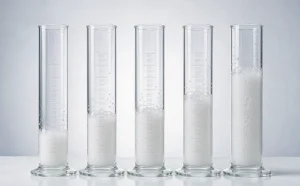
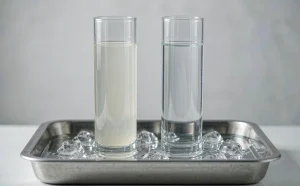
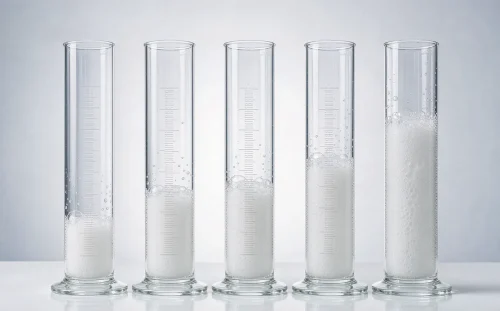
Foam is the first place. In the same hard-water screen, AOS held a taller and longer-lasting foam column than LAS at 300 and 500 mg/kg CaCO3, and our AOS vs LAS hard-water comparison shows the numbers. Manual-wash customers read that foam as cleaning power, and a powder that foams flat gets blamed for weak performance even when detergency is equal.
Solubility is the second. LAS forms calcium salts that deposit as soap scum on fabric and heater elements; AOS stays in solution at the same hardness. Over months of hot washes, that difference shows up as stiff fabric and scale on machine parts. Plants that already run AOS 95% for concentrates report fewer of those complaints, and our AOS buyer’s guide covers grade selection.
Which AOS grade suits a powder plant?
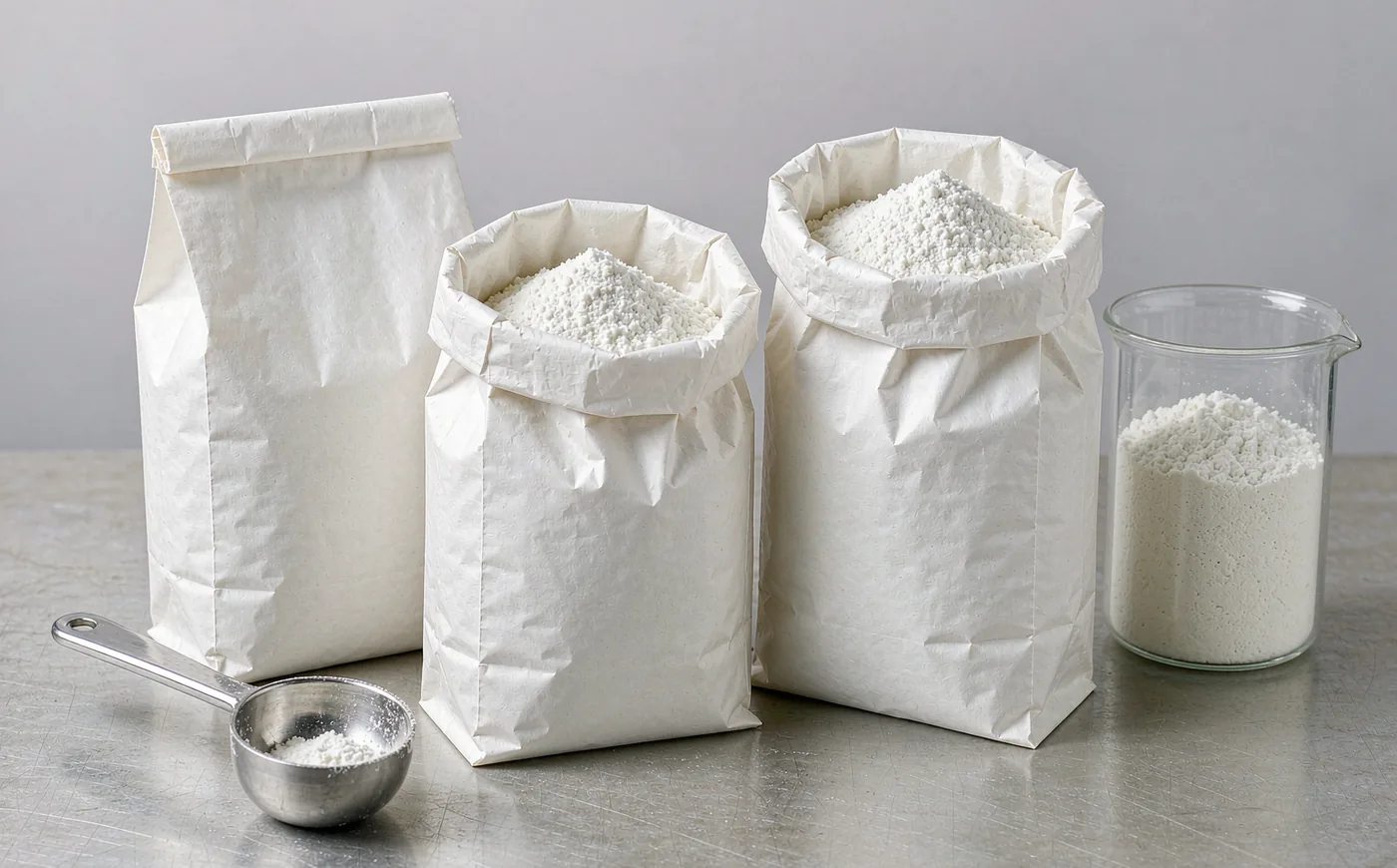
Dose on active matter, not product weight. AOS 92% powder (active matter at or above 92%, CAS 68439-57-6) is the common choice for tower-dried powders: it disperses in the slurry and it is the cheaper kilogram. AOS 95% powder (active matter at or above 95%, bulk density 0.3-0.4 g/cm3) is for concentrates and low-dose sachets where freight per kilogram of active matter dominates. AOS 35% and AOS 38% liquids belong to liquid lines, not towers. Where the powder also wants a sulfate-ester foam booster, SLS 92% and SLS 95% are the usual partners in the surfactant package; start at 2-4% of the package and adjust against foam readings on hard water (illustrative). If you are weighing powder against liquid for the same molecule, the powder versus liquid detergent guide sets out the trade-offs.
Key takeaways
- Cost per wash: LAS is the cheaper sulfonate per kilogram of active matter; AOS costs more and buys hard-water tolerance and foam.
- Surfactant share: about 1.0 to 1.4 US cents of a 60 g wash at illustrative prices; builders carry the rest of the formula.
- Dose by hardness: about 4.0 g of active matter per wash in soft water, 7.2 g at 25 dH.
- Hard-water penalty: above roughly 250 mg/kg CaCO3, LAS needs heavier polymer and carbonate loads; AOS holds its builder load flatter.
- Grade choice: AOS 92% for standard powders, AOS 95% for concentrates, liquids for liquid lines.
Frequently asked questions
Can AOS fully replace LAS in a phosphate-free powder?
Yes. Many phosphate-free powders sold in hard-water markets are built on AOS alone as the anionic surfactant. The formula still needs its builder system; AOS replaces the surfactant, not the zeolite and carbonate. Run foam and detergency trials on your own water before locking the formula.
Is AOS more expensive per wash than LAS?
At equal loading, yes. Illustrative pricing puts AOS 95% at about 2.00 USD per kg of active matter against 1.46 USD for LAS 96%, which is roughly 0.3 US cents more per wash at a 12% loading. Builder savings in hard water offset part of that gap, and foam performance is part of what you are paying for.
What water hardness should I design for?
Measure at the point of use, not at the plant gate. Tap water across much of India, Pakistan and Iran commonly runs between 5 and 25 dH (about 90 to 445 mg/kg CaCO3), and seasonal variation can double the winter figure. Design for the high end and let the formula run rich in soft months.
Does AOS 95% need a different dosage than AOS 92%?
Only a small adjustment. Dose on active matter: a formula calling for 10 g of AOS 92% powder delivers 9.2 g of active, which needs about 9.7 g of AOS 95% powder. The remaining difference is water and minor impurities that come out of the slurry balance.
Can I keep LAS as the base and add AOS for foam?
That is a common pattern. Start with AOS at 3-5% of the total surfactant and adjust against foam readings on hard water. Keep the builder system as it is for the first trial so the foam effect is not masked by a chemistry change.
Request a quote or a sample
For bulk pricing, MOQ and lead time on AOS 92% or AOS 95%, request a quote with your destination port and annual volume. If you are switching from LAS for the first time, request a sample of both AOS grades and run a spray-drying trial side by side. You can request the COA and MSDS for either grade before you commit, or contact our team with your water hardness and powder dose and we will check the per-wash arithmetic against your formula.
Written and reviewed by the ORID Chem technical team. Last updated: 11 November 2026. Prices, builder levels and dose figures in this article are illustrative working numbers, not quotations. Confirm current specifications on the product TDS and lot COA before ordering.