Short answer: For a contactless car wash foam, SLS 92% powder gives the highest foam volume per kilogram of active at the lowest material cost, while AOS 38% liquid holds foam longer in hard borehole water and needs no dissolving step. At 1.0% active, illustrative cost is 19.6 USD per 1,000 L against 44.7 USD. Pick on water hardness and equipment.
This comparison is for formulators and buyers making snow foam or touchless pre-wash concentrates in India, Pakistan, Iran, Russia and Southeast Asia, where wash water often runs above 250 mg/kg CaCO3 and foam has to cling to a vertical panel for several minutes. We supply SLS 92%, AOS 38% and the other grades below. All foam, price and cost figures in this article are illustrative working numbers for the arithmetic, not quotations or test certificates.
How much active matter does a car wash foam actually need?
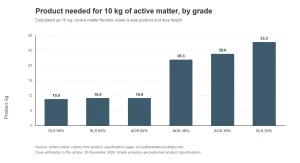
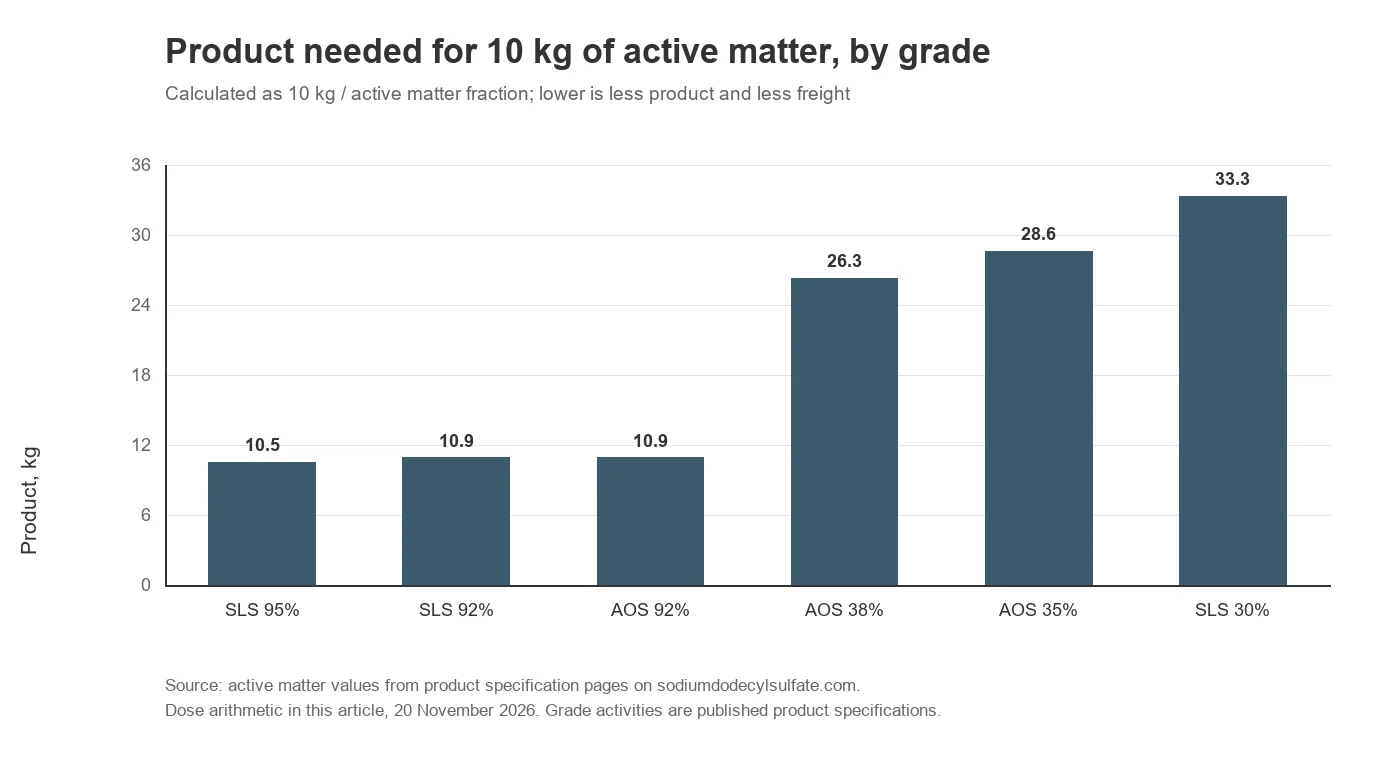
A touchless pre-wash concentrate is diluted at the lance or in a dosing tank, typically 1:50 to 1:200. The diluted liquid that hits the panel carries 0.5 to 1.5% active anionic surfactant. Take 1.0% active as the mid-point. For 1,000 L of diluted foam solution, that is 10 kg of active matter. The product weight depends only on the activity of the grade you buy.
| Grade | Active matter (product spec) | Product needed for 10 kg active | Water carried into the tank |
|---|---|---|---|
| SLS 92% powder | ≥92% | 10.9 kg | 0.9 kg |
| SLS 95% powder | ≥95% | 10.5 kg | 0.5 kg |
| AOS 92% powder | ≥92% | 10.9 kg | 0.9 kg |
| AOS 38% liquid | ≥38% | 26.3 kg | 16.3 kg |
| AOS 35% liquid | 35±1% | 28.6 kg | 18.6 kg |
| SLS 30% liquid | 30% | 33.3 kg | 23.3 kg |
The arithmetic is a division: product kilograms = target active kilograms / activity fraction. A buyer comparing a powder quote with a liquid quote should do this before looking at the price per tonne. Our cost per kilogram of active matter worked example walks through the same conversion with freight included.
What does one 1,000 L tank cost in surfactant?
Illustrative prices for the arithmetic: SLS 92% at 1,800 USD per tonne, SLS 95% at 1,950 USD, AOS 92% at 1,900 USD, AOS 38% at 1,700 USD, AOS 35% at 1,600 USD, SLS 30% at 1,100 USD. Multiply product kilograms by price per kilogram.
| Grade at 1.0% active | Product per 1,000 L | Surfactant cost per 1,000 L | Cost per 100 L of diluted foam |
|---|---|---|---|
| SLS 92% | 10.9 kg | 19.6 USD | 1.96 USD |
| SLS 95% | 10.5 kg | 20.5 USD | 2.05 USD |
| AOS 92% | 10.9 kg | 20.7 USD | 2.07 USD |
| AOS 38% | 26.3 kg | 44.7 USD | 4.47 USD |
| AOS 35% | 28.6 kg | 45.8 USD | 4.58 USD |
| SLS 30% | 33.3 kg | 36.6 USD | 3.66 USD |
Powder wins on material cost because you are not shipping water. The gap is smaller than the table suggests once dissolving labour, heated water and dust handling are counted, and it reverses in some plants. A site that blends liquids by pump and has no powder dosing hopper will usually pay the extra for AOS 35% or AOS 38%. Our liquid versus powder freight comparison covers the container-level version of this trade-off.
Does hard water change which surfactant holds foam longer?
The screen below is illustrative: 1.0% active, 25°C, foam generated in a 500 mL column and read on a vertical painted steel panel at two water hardness levels. Dwell time is the point at which the foam layer breaks into visible channels.
| Grade | Initial foam, 100 mg/kg | Initial foam, 300 mg/kg | Dwell time, 100 mg/kg | Dwell time, 300 mg/kg |
|---|---|---|---|---|
| SLS 92% | 430 mL | 310 mL | 240 s | 140 s |
| AOS 38% | 350 mL | 320 mL | 255 s | 215 s |
| AOS 92% | 355 mL | 325 mL | 260 s | 220 s |
| SLS 92% + AOS 38%, 7:3 on active | 410 mL | 335 mL | 255 s | 195 s |
SLS produces more foam in soft water and loses about 28% of it at 300 mg/kg CaCO3. AOS loses about 9% and keeps roughly three quarters of its dwell time. Calcium binds linear alkyl sulfates into less soluble salts; the olefin sulfonate tolerates the same hardness better. If the wash site uses borehole water and the operator cannot soften it, a 7:3 SLS to AOS blend on active matter recovers most of the foam height and most of the dwell time for a smaller cost increase than switching to 100% AOS. Our AOS versus LAS hard water comparison shows the same pattern in a laundry formula, and the foam height versus concentration data gives the dose response from 0.25% to 2.0%.
What should the concentrate spec ask for?
Three numbers matter more than the product name. First, active matter, because the lance dilution is calculated on it. Second, unsulfated matter and inorganic salt, because both depress foam at low temperature; check the lot COA before you set the dose. Third, dissolution behaviour of the powder grade. SLS 92% needles disperse faster than compacted SLS powder in cold water, and SLS 95% carries less salt per kilogram of active. Coloured SLS colour needles are used where the wash operator wants a visible tint in the foam tank, which is a marketing choice, not a performance one. For plants making a liquid concentrate, SLS 30% solution removes the dissolving step entirely at the cost of shipping 23 kg of water per 10 kg of active.
Key takeaways
- Dose on active matter: 1.0% active in 1,000 L means 10.9 kg of SLS 92% or 26.3 kg of AOS 38%.
- Material cost favors powder: 19.6 USD per 1,000 L for SLS 92% against 44.7 USD for AOS 38%, illustrative prices.
- Hard water favors AOS: foam dwell time at 300 mg/kg CaCO3 is 215 s for AOS 38% against 140 s for SLS 92%, illustrative.
- The blend is the usual answer: 7:3 SLS to AOS on active matter keeps most of the foam height and recovers dwell time.
- Check the equipment first: no powder hopper means a liquid grade is cheaper in practice even if the table says otherwise.
Frequently asked questions
Can I use SLS 92% alone for a touchless car wash foam?
Yes on soft or treated water. On borehole water above about 250 mg/kg CaCO3 the foam thins early, so either soften the water or blend 20 to 30% of the active matter as AOS. Run the panel test at your own hardness before fixing the ratio.
Why does my snow foam collapse before the dwell timer finishes?
Three common causes: water hardness, too little active matter after dilution, and a concentrate that has picked up salt or unsulfated alcohol. Check the lance dilution with a conductivity or titration measurement, ask for the lot COA, and compare initial foam at 100 and 300 mg/kg CaCO3 side by side.
How do I convert an AOS 38% dose to AOS 35%?
Multiply product weight by 38/35, about 1.086. A tank calling for 26.3 kg of AOS 38% needs roughly 28.6 kg of AOS 35% for the same active matter. The extra 2.3 kg is water that comes out of the batch water phase.
Is SLS 95% worth the extra cost in a foam concentrate?
Only when low salt matters to your cold-temperature foam or your formula is dosed close to a solubility limit. At 1.0% active the arithmetic above puts SLS 95% about 0.9 USD per 1,000 L above SLS 92%, illustrative. Most car wash foams do not see a return on that difference.
What should I send a supplier when asking for a car wash foam grade?
Target active matter in the diluted liquid, worst-case water hardness in mg/kg CaCO3, minimum dwell time on a vertical panel, the dilution ratio your lance runs, and whether you have powder dosing equipment. Ask for the COA and a sample at your own hardness, not a generic foam photo.
Request a quote or a sample
For bulk pricing, MOQ and lead time on SLS 92%, AOS 38% or SLS 30% for a car wash foam concentrate, request a quote with your destination port and annual volume. If you are reformulating for hard borehole water, request a sample of both grades and run the panel dwell test at 300 mg/kg CaCO3. You can request the COA and MSDS before committing, or contact our team with your lance dilution ratio and water hardness and we will check the per-1,000 L arithmetic against your formula.
Written and reviewed by the ORID Chem technical team. Last updated: 20 November 2026. Prices, dose figures, foam volumes and dwell times in this article are illustrative working numbers, not quotations or measured test results. Confirm current specifications on the product TDS and lot COA before ordering.