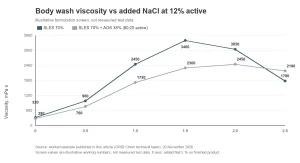
Short answer: In a 12% active SLES 70% body wash, viscosity peaks near 1.5% added NaCl and falls away above about 2.0%. Blending 10 to 20% of the active matter as SLS 92% moves the peak down to roughly 1.2% salt, while AOS 38% flattens the curve. Salt is cheap; an over-salted batch is not. Measure the curve on your own base.
This is written for formulators making shower gels and body washes in India, Pakistan, Iran, Russia and Southeast Asia, where a product has to stay thick through a hot warehouse and still pour at a cool morning temperature. We supply SLES 70%, SLS 92% and the other grades below. Every viscosity, salt and price figure here is an illustrative working number, not a measured curve or a quotation.
Why does salt thicken an SLES formula at all?
SLES micelles are charged and repel each other in dilute solution. Adding sodium chloride screens the charge, so the micelles grow from small spheres into long worm-like structures that entangle and raise viscosity. Past the peak, the screening goes too far: the micelles shorten again, the electrolyte starts to compete for water, and the batch thins and can throw a haze in cold storage. The shape of that curve is what a formulator needs, not a single viscosity number.
What does the salt curve look like at 12% active?
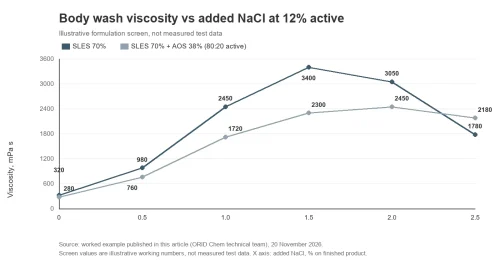
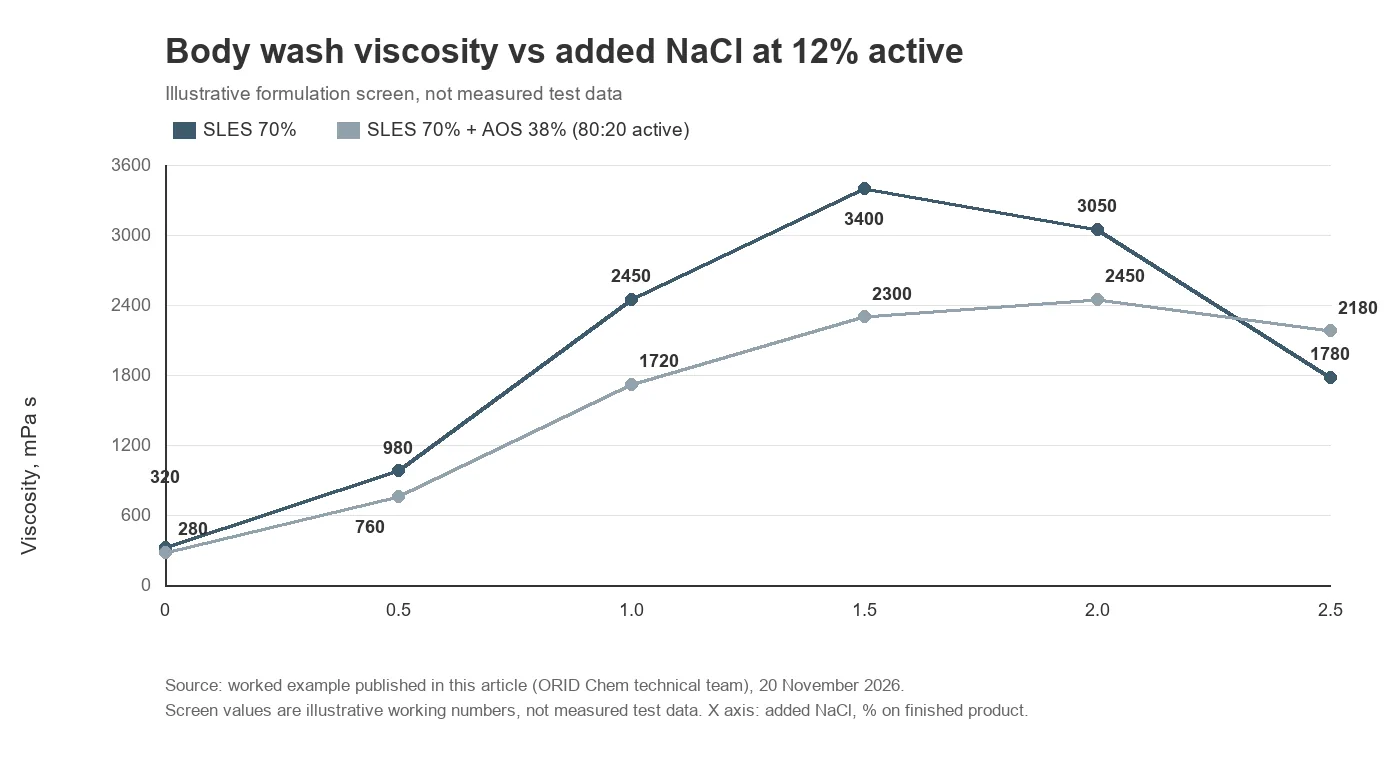
Illustrative screen: 12% active anionic surfactant, 25°C, viscosity read at 20 rpm after 24 hours of de-aeration. Salt is expressed as percent NaCl on the finished product weight.
| Added NaCl, % | SLES 70% viscosity, mPa·s | SLES+SLS 85:15 viscosity, mPa·s | SLES+AOS 80:20 viscosity, mPa·s |
|---|---|---|---|
| 0 | 320 | 410 | 280 |
| 0.5 | 980 | 1,340 | 760 |
| 1.0 | 2,450 | 3,100 | 1,720 |
| 1.5 | 3,400 | 2,980 | 2,300 |
| 2.0 | 3,050 | 2,150 | 2,450 |
| 2.5 | 1,780 | 1,260 | 2,180 |
The straight SLES base peaks at 1.5% salt and loses about 48% of its peak viscosity by 2.5%. Adding SLS 92% at 15% of the active matter raises the low-salt viscosity and pulls the peak back to about 1.0 to 1.2%, but the descending side is steeper. Adding AOS 38% at 20% of active matter gives a flatter, lower peak that tolerates salt dosing errors better. Plants dosing salt by scoop rather than by meter usually prefer the flatter curve. Our AOS versus SLES shampoo comparison reports the same salt effect in a hair wash base, and the dishwashing liquid dilution comparison gives the activity conversion for both grades.
How much salt goes into a 1,000 kg batch?
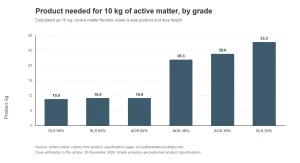
The calculation is a multiplication. For a 1,000 kg batch at 1.5% NaCl, add 15 kg of salt. For 1.2%, add 12 kg. The surfactant part of the same batch at 12% active is 120 kg of active matter, so the product weights are:
| Grade | Active matter (product spec) | Product for 120 kg active | Product at 85:15 with SLS 92% |
|---|---|---|---|
| SLES 70% paste | 70% | 171 kg | 146 kg SLES + 20 kg SLS 92% |
| AOS 38% liquid at 20% of active | ≥38% | 63 kg for 24 kg active | 137 kg SLES + 63 kg AOS 38% |
| SLS 92% powder at 15% of active | ≥92% | 19.6 kg for 18 kg active | as above |
Check the water phase when you switch to a liquid grade. AOS 38% brings about 39 kg of water into a 63 kg dose, so the batch water has to be reduced by the same amount or the finished activity lands below 12%. The SLS 30% solution carries even more water per kilogram of active and is rarely the right tool for a high-active body wash. Our active matter cost worked example shows how to compare these quotes on the same basis.
What does the salt curve cost?
Illustrative prices for the arithmetic: SLES 70% at 1,500 USD per tonne, SLS 92% at 1,800 USD, AOS 38% at 1,700 USD, NaCl at 120 USD per tonne. Surfactant and salt cost for a 1,000 kg batch at 12% active, each at its own peak salt dose:
| Base | Surfactant cost per 1,000 kg | Salt dose | Salt cost | Combined |
|---|---|---|---|---|
| 100% SLES 70% | 257 USD | 15 kg | 1.8 USD | 259 USD |
| SLES+SLS 85:15 | 255 USD | 12 kg | 1.4 USD | 256 USD |
| SLES+AOS 80:20 | 313 USD | 20 kg | 2.4 USD | 315 USD |
Salt itself is almost free in this arithmetic. The cost that matters is a rejected batch. An over-salted straight SLES base can drop below a 2,000 mPa·s specification, and reworking it means dilution, re-dosing and another QC hold. The AOS blend costs about 56 USD more per 1,000 kg in this illustrative example and buys a wider dosing window. Whether that is worth paying depends on how precisely your plant doses salt. The older salt thickening troubleshooting note describes the failure modes without the numeric curve.
Which grade fits the mixing tank?
Powder grades need a dissolving step and dust handling; liquid grades pump straight from the drum. SLS 95% carries less inorganic salt than SLS 92%, which shifts the salt curve slightly because the base electrolyte is lower, so re-run the curve if you switch lots. AOS 35% behaves like AOS 38% at a 9% higher dose on active matter. AOS 92% powder gives the same molecule without the water load, at the cost of a dissolving tank. Ask for the COA on each lot before locking a salt dose; unsulfated matter and salt content move the peak by a few tenths of a percent.
Key takeaways
- Peak at about 1.5% NaCl for a 12% active SLES 70% base, illustrative; viscosity falls roughly 48% by 2.5% salt.
- SLS 92% at 15% of active moves the peak down to 1.0 to 1.2% salt and steepens the descending side.
- AOS 38% at 20% of active flattens the curve and widens the dosing window at a higher material cost.
- Salt cost is minor: about 1.4 to 2.4 USD per 1,000 kg batch. Rework cost is the real item.
- Reduce batch water when dosing a liquid grade, or the finished activity drifts low.
Frequently asked questions
Why did my body wash get thinner after I added more salt?
You crossed the viscosity peak. In the illustrative curve above, a straight SLES base falls from 3,400 mPa·s at 1.5% NaCl to 1,780 mPa·s at 2.5%. Check the actual salt addition against the batch mass, then rebuild a short salt curve from 0.5% to 2.0% on your own base rather than adding more thickener.
Can I thicken an SLES-free AOS body wash with salt the same way?
Not to the same viscosity. AOS responds to electrolyte but the micellar growth is weaker than with SLES, so a 100% AOS base usually needs a polymer thickener or a betaine co-surfactant to reach a gel viscosity. Use AOS as part of the active package, not as a drop-in replacement for the whole SLES fraction.
How do I convert a 12% active SLES dose to SLES 70% paste weight?
Divide 120 kg of active by 0.70. That gives 171 kg of paste per 1,000 kg of finished product. Start from the active target every time; the paste weight changes with the grade activity on the COA.
Does water hardness shift the salt curve?
Yes. Calcium and magnesium act as additional electrolyte, so a batch made with hard plant water can behave as if extra salt had been added and may peak earlier. Run the curve with the water your plant actually uses, and record hardness in mg/kg CaCO3 on the batch sheet.
What should I test before approving a new SLES lot?
Activity by titration, unsulfated matter, 1,4-dioxane on the supplier COA, pH of a 5% solution, and a three-point salt curve at 1.0%, 1.5% and 2.0% NaCl. Compare the new lot against the incumbent at equal active matter, not equal paste weight.
Request a quote or a sample
For bulk pricing, MOQ and lead time on SLES 70%, SLS 92% or AOS 38% for a body wash base, request a quote with your destination port and annual volume. If you are rebuilding a salt curve after a thin batch, request a sample of the SLES and SLS grades and run the 0.5% to 2.5% NaCl screen at your own water hardness. You can request the COA and MSDS before committing, or contact our team with your target active level and salt dosing method and we will check the per-1,000 kg arithmetic against your formula.
Written and reviewed by the ORID Chem technical team. Last updated: 20 November 2026. Prices, viscosity values, salt doses and cost figures in this article are illustrative working numbers, not quotations or measured test results. Confirm current specifications on the product TDS and lot COA before ordering.