Short answer: At a 200-fold dilution in 300 mg/kg CaCO3 water, an AOS 38% wetting package holds an agrochemical EC emulsion longer than SLS 92%, while SLES 70% lasts longest but needs heated storage. Dose on the dilution water, not on the concentrate. Illustrative screen: 26 min versus 11 min to first oil separation.
This is for formulators making emulsifiable concentrates and tank-mix wetters for markets in India, Pakistan, Iran, Russia and Southeast Asia, where spray water often comes from a borehole and the operator dilutes by volume in an open tank. We supply AOS 38%, SLS 92% and SLES 70%. Dilution, emulsion stability and cost figures below are illustrative working numbers, not field trial results or quotations.
How much surfactant reaches the spray tank?
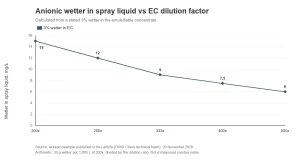
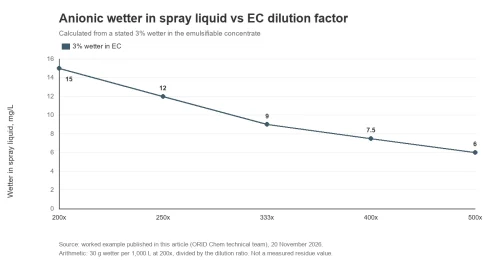
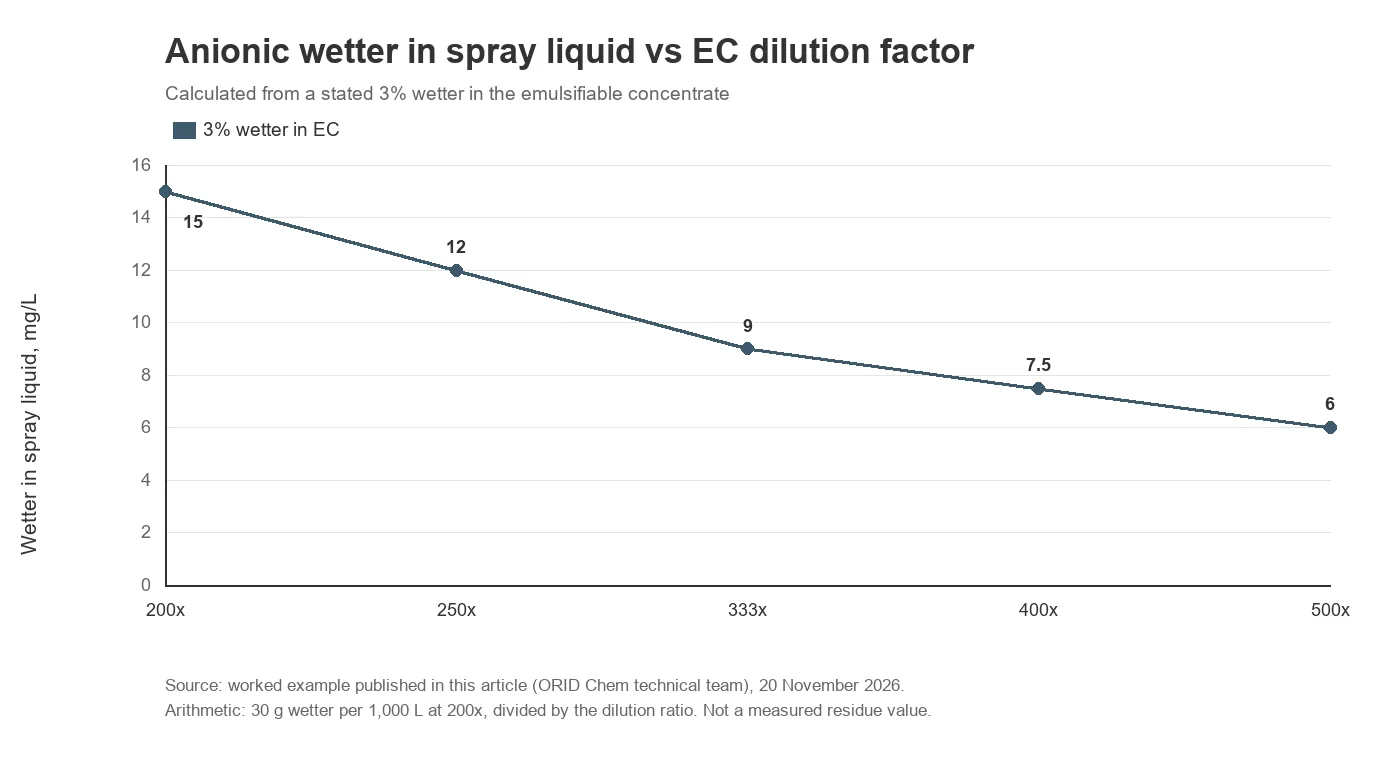
An EC is diluted 200 to 500 times before spraying. If the concentrate carries 3% anionic wetter and the farmer dilutes 1 L into 200 L of water, the spray liquid carries 3 g of wetter per 200 L, or 15 mg/L. That is the concentration the emulsion has to survive. At 500-fold dilution it falls to 6 mg/L, which is close to the point where a marginal package stops holding the oil droplets.
| Dilution | Concentrate per 200 L tank | Wetter at 3% in the EC | Wetter in spray liquid |
|---|---|---|---|
| 200x | 1.0 L | 30 g | 15 mg/L |
| 333x | 0.6 L | 18 g | 9 mg/L |
| 500x | 0.4 L | 12 g | 6 mg/L |
The arithmetic is a division by the dilution factor. A package tuned at 200x can fail at 500x without any change in the concentrate. Our wettable powder wetting agent dose guide runs the same calculation for a solid formulation, where the wetter is dosed on powder weight instead of concentrate volume.
What happens to the emulsion in hard water?
Illustrative bench screen: 3% anionic wetter in the EC, 200x dilution, 25°C, three water hardness levels, emulsion read in a 100 mL graduated cylinder. Time to first visible oil separation and the volume of the cream layer at 30 minutes are recorded.
| Wetter in EC | First oil at 100 mg/kg | First oil at 300 mg/kg | First oil at 500 mg/kg | Cream layer at 30 min, 300 mg/kg |
|---|---|---|---|---|
| SLS 92% | 18 min | 11 min | 6 min | 12 mL |
| AOS 38% | 31 min | 26 min | 19 min | 4 mL |
| AOS 92% | 30 min | 25 min | 18 min | 4 mL |
| SLES 70% | 34 min | 29 min | 22 min | 3 mL |
| SLS 92% + AOS 38%, 1:1 active | 27 min | 21 min | 15 min | 6 mL |
Calcium and magnesium compress the electrical double layer around the oil droplets and convert part of a linear alkyl sulfate into a poorly soluble calcium salt. The sulfonate and the ether sulfate tolerate the same hardness better, which shows up as a longer time to first oil. SLES 70% holds longest in the illustrative screen, but it is a paste that needs heated storage below about 15°C and costs more per kilogram of active in this market. A 1:1 SLS to AOS blend recovers most of the hard-water margin at a lower material cost. The AOS versus LAS hard water comparison reports the same calcium effect on foam and detergency in a detergent base.
What does the wetter cost per hectare?
Take a spray volume of 200 L/ha and a 200x dilution, so 1 L of EC per hectare with 30 g of wetter. Illustrative prices: SLS 92% at 1,800 USD/t, AOS 38% at 1,700 USD/t, AOS 92% at 1,900 USD/t, SLES 70% at 1,500 USD/t. Wetter cost per hectare is 30 g times price per kilogram.
| Wetter | Active in 30 g of product | Wetter cost per ha | Cost per kg of active |
|---|---|---|---|
| SLS 92% | 27.6 g | 0.054 USD | 1.96 USD |
| AOS 38% | 11.4 g | 0.051 USD | 4.47 USD |
| AOS 92% | 27.6 g | 0.057 USD | 2.07 USD |
| SLES 70% | 21.0 g | 0.045 USD | 2.14 USD |
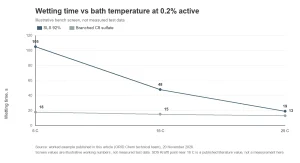
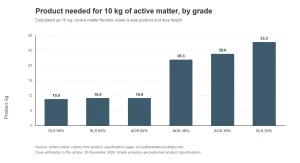
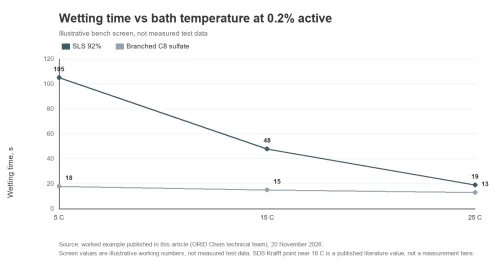
At 30 g of product per hectare, the wetter is a rounding error in the spray budget. The decision is not the 0.01 USD between grades; it is whether a tank of emulsion separates before the operator finishes the row. That is why the cost per kilogram of active column matters more than the cost per hectare column: to hold the same active dose with AOS 38%, you need 2.4 times the product weight, which changes the EC formulation balance and the solvent demand. Our surfactant wetting time comparison gives the Draves numbers for the same three molecules at equal active matter.
Which grade fits which concentrate?
Powder grades suit dry WP and WDG formulations and any EC where the wetter is pre-dissolved into the solvent phase. SLS 92% is the cheapest active kilogram here; AOS 92% and AOS 95% suit concentrates where hard-water stability is specified. Liquid plants take AOS 35% or AOS 38% by metering pump. Where fast wetting of a waxy leaf or a hydrophobic powder matters more than emulsion life, the short-chain sulfates wet faster and drain sooner: sodium 2-ethylhexyl sulfate, sodium decyl sulfate and SLS 30% solution are the grades to trial. Ask for the COA on unsulfated matter and inorganic salt before setting the EC dose; both shift the emulsion result at 500x dilution.
Key takeaways
- Dilution sets the dose: 3% wetter in the EC at 200x gives 15 mg/L in the spray tank; at 500x only 6 mg/L.
- Hard water separates emulsions: illustrative first-oil time at 300 mg/kg CaCO3 is 11 min for SLS 92% and 26 min for AOS 38%.
- SLES holds longest, AOS blends cheapest: 29 min for SLES 70% against 21 min for a 1:1 SLS to AOS blend, illustrative.
- Cost per hectare is minor: about 0.045 to 0.057 USD; cost per kilogram of active decides the formulation balance.
- Test at your worst dilution water, not at the 200x soft-water bench condition.
Frequently asked questions
Why does my EC break in the tank but pass the lab emulsion test?
The lab almost always uses soft water and a 200x dilution. Field tanks use borehole water and often a 500x dilution. Repeat the emulsion stability test at your worst-case mg/kg CaCO3 and at the highest dilution on the label, then check whether the wetter dose still reaches 6 mg/L.
Can AOS 38% replace SLS 92% one for one in an EC?
Not by product weight. AOS 38% carries about 41% of the active matter of SLS 92%, so 30 g of SLS 92% needs roughly 73 g of AOS 38% for the same active. That much extra water and liquid volume usually has to be reformulated into the solvent phase rather than simply swapped.
How do I read an emulsion stability result?
Record time to first visible oil, cream layer volume at 30 minutes, and whether the emulsion redisperses after a standard inversion. A result that redisperses fully is a different case from one that throws free oil. Ask the lab for the water hardness and dilution factor on the report.
Does SLES 70% justify the heated storage?
Only if the extra hard-water emulsion life changes a field failure rate. In the illustrative screen it adds about 3 minutes over AOS 38% at 300 mg/kg CaCO3. Plants without jacketed tanks usually take the AOS grade and spend the difference on a co-emulsifier.
What should I request before changing the wetter supplier?
A sample from the same production lot as the COA, active matter, unsulfated matter, inorganic salt, pH of a 5% solution, MOQ and lead time. Run the incumbent and candidate side by side at equal active matter in your worst-case dilution water.
Request a quote or a sample
For bulk pricing, MOQ and lead time on AOS 38%, SLS 92% or AOS 92% for an EC or WP formulation, request a quote with your destination port and annual volume. If you are reformulating for hard borehole water, request a sample of both the powder and liquid grades and run the 500x emulsion test at your own hardness. You can request the COA and MSDS before committing, or contact our team with your dilution factor and spray volume and we will check the wetter arithmetic against your concentrate.
Written and reviewed by the ORID Chem technical team. Last updated: 20 November 2026. Dilution figures, emulsion separation times, prices and cost figures in this article are illustrative working numbers, not quotations or measured field trial results. Confirm current specifications on the product TDS and lot COA before ordering.