| Item | Value |
|---|---|
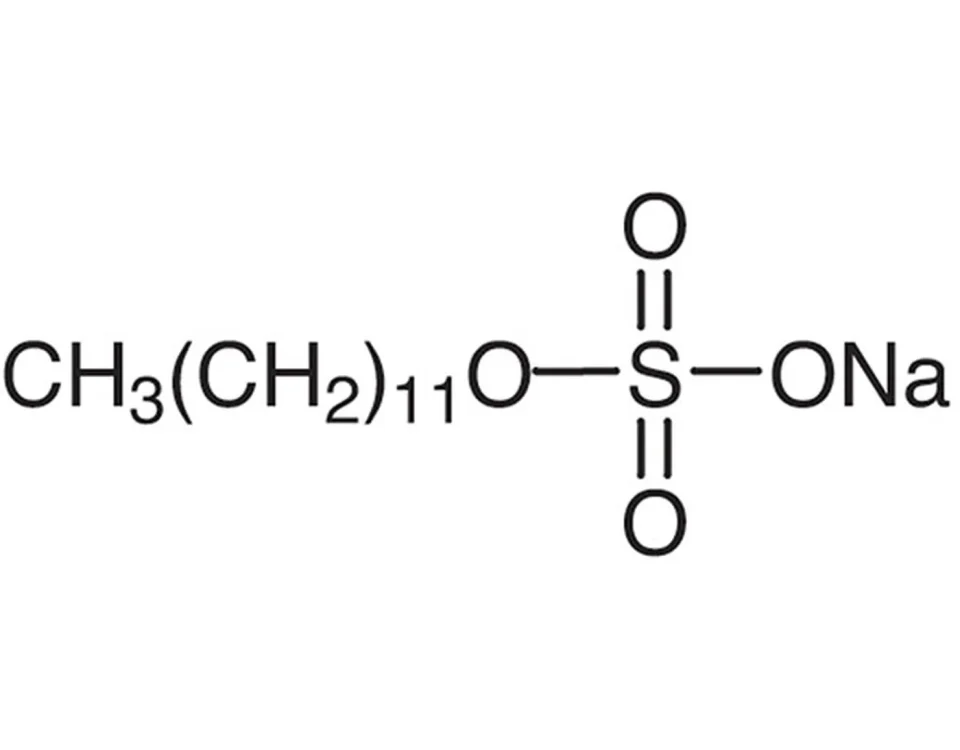
| Structural formula | CH3(CH2)11OSO3Na |
| Tail | Linear C12, no branching |
| Head group | Sulfate ester via C-O-S bridge |
| Counterion | Na+ |
| Molar mass / CAS | 288.38 g/mol / 151-21-3 |
For the structural formula, TDS and bulk pricing, request a quote with your assay target, or request a sample for structural checks.
Short answer: The structure is CH3(CH2)11OSO3Na: a straight twelve-carbon alkyl tail, an oxygen bridge, a sulfate ester head and a sodium counterion. The tail is hydrophobic, the head is anionic and hydrophilic. That split explains the foaming, wetting and protein-binding behaviour of SDS, CAS 151-21-3, molar mass 288.38 g/mol.
Key takeaways
- CH3(CH2)11OSO3Na is a linear C12 tail joined through oxygen to a sulfate ester head.
- Tail length sets the balance of wetting, foam and Krafft point.
- The C-O-S bridge distinguishes a sulfate ester from a direct C-S sulfonate.
- Replacing sodium with lithium changes low-temperature behaviour, not the tail.
- Request the structural formula alongside the lot COA when qualifying a grade.
Reading the structural diagram from left to right
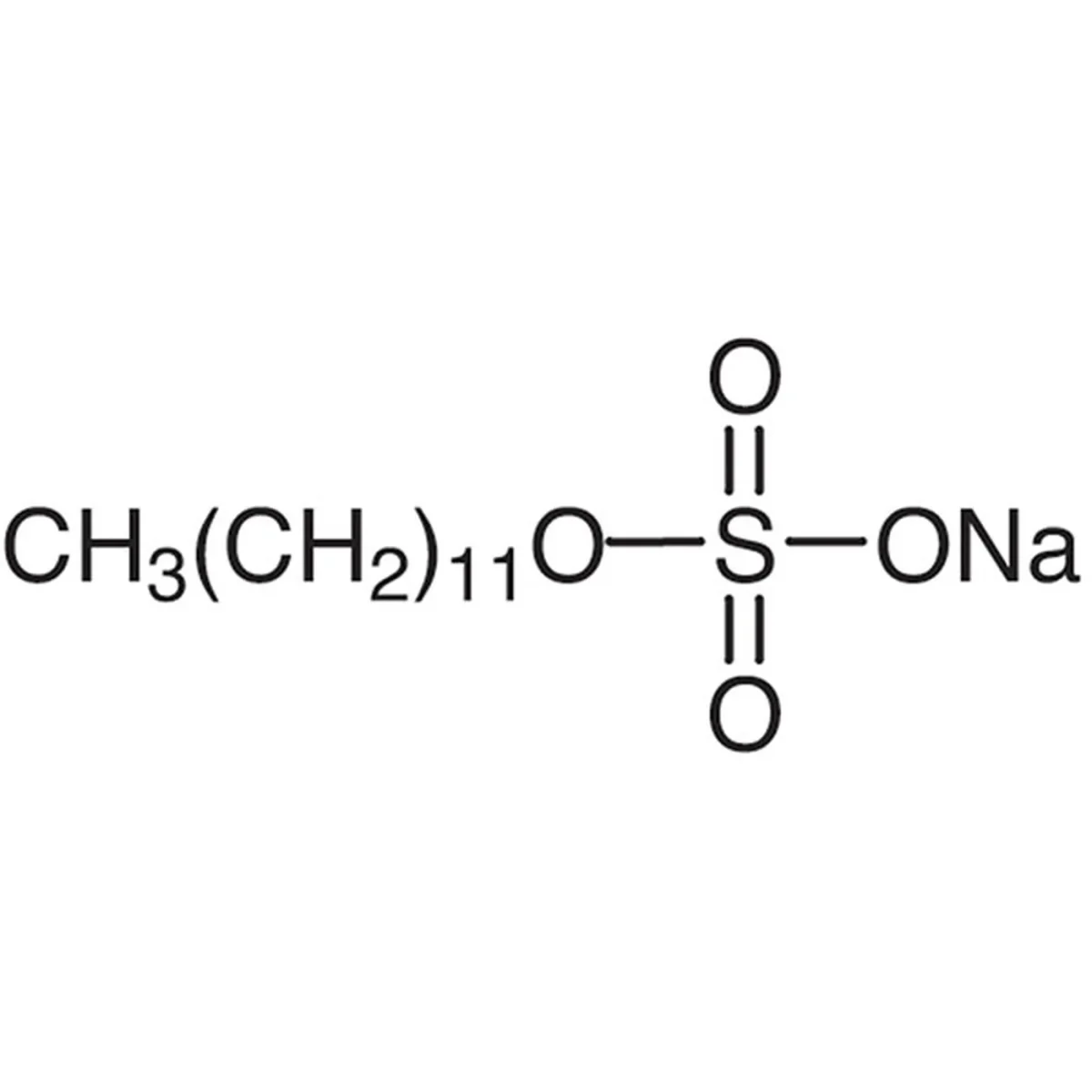
Start at CH3, the terminal methyl group. Eleven CH2 units follow, giving a linear C12 chain with no branching. The twelfth carbon connects to an oxygen, which connects to sulfur carrying three further oxygens. One of those oxygens balances a sodium ion. The drawing above shows this arrangement; no ring, no ethoxylate units and no branching appear anywhere in the molecule.
What the C12 tail controls
Chain length sets the balance between water solubility and surface activity. Shorten it to C8 or C10 and wetting improves while foam drops; lengthen it and the Krafft point rises, so cold-water dissolution becomes harder. A branched chain changes packing at the interface. Our wetting time comparison puts C8, C12 and C14-16 behaviour side by side, and the shorter-chain sulfate is a useful counterexample.
| Chain | Example | Behaviour shift |
|---|---|---|
| C8 | Sodium octyl sulfate | Fast wetting, less foam |
| C10 | Sodium decyl sulfate | Intermediate |
| C12 | SDS 99% | Dense foam, general detergency |
| C14-16 | AOS | Hard-water detergency, sulfonate head |
The sulfate ester head and the sodium counterion
The C-O-S bridge is the part that distinguishes a sulfate ester from a sulfonate. It carries a -1 charge in water and holds the sodium ion loosely. Swap sodium for lithium and the low-temperature solubility changes without changing the tail. Lithium dodecyl sulfate is the usual example; our emulsifier comparison covers how that choice plays out in polymerisation work.
Structure compared with three related surfactants
Structural differences are easier to audit than marketing descriptions. Ethoxylation inserts repeating ether units before the sulfate head, a sulfonate removes one oxygen and bonds sulfur directly to carbon, and a lithium salt changes only the counterion.
| Product | Structural change from SDS | CAS |
|---|---|---|
| Sodium dodecyl sulfate | Reference structure | 151-21-3 |
| SLES | Adds (CH2CH2O)n units | 68585-34-2 |
| AOS 95% | C-S bond, C14-16 chain | 68439-57-6 |
| LDS | Na replaced by Li | 2044-56-6 |
How the structure drives foam, wetting and solubility
The charged head stays in water while the C12 tail adsorbs at air-water and oil-water interfaces. Above the critical micelle concentration the molecules assemble into micelles with a negatively charged surface. Salt screens that charge and changes viscosity. Below the Krafft point the structure crystallises out instead, which is why a warm tank stays clear and a cold one turns cloudy. Our CMC and Krafft point note gives the formulation context.
Structure information to request with a sample
Ask for the structural formula, molecular formula, molar mass and CAS on the TDS, then check that the analytical method on the COA matches the structure. A chain-length distribution matters when the grade is made from a natural fatty alcohol feedstock. Contact our team for the current TDS and a sample from SDS 97% or SLS 92% for your own structural and assay checks.
Linear versus branched C12
The standard structure drawn here is linear. Branching changes interfacial packing and biodegradation behaviour, so confirm the chain description on the TDS if your application is sensitive to it.
Frequently asked questions
Is SDS a branched or a linear molecule?
The standard substance is linear n-dodecyl sulfate. If your process depends on branching, ask the supplier to state the chain description on the TDS rather than assuming it.
How many carbons are in the SDS tail?
Twelve. CH3(CH2)11 gives one terminal methyl plus eleven methylene units. That C12 length is the reason the molar mass is 288.38 g/mol.
What is the difference between the SDS structure and SLES?
SLES has ethylene oxide repeat units inserted between the C12 tail and the sulfate head. The structure is longer, the molar mass varies with n, and mildness and salt response change.
Does the sodium ion appear in the structural drawing?
Yes, as Na+ beside the negatively charged sulfate oxygen. In water the two dissociate, which is why the surfactant behaves as an anion.
Which structure should a detergent formulator compare first?
Compare C12 sulfate with AOS and SLES side by side. The head-group difference predicts hard-water behaviour and foam better than a product name does.
Request a quote or a sample
For bulk pricing, MOQ and lead time on CAS 151-21-3 structural grades, request a quote with your target assay. Request a sample for structural and QC checks and request the COA/MSDS before the first shipment.
Written and reviewed by the ORID Chem technical team. Last updated: 20 November 2026. Figures marked illustrative are working values, not quotations. Confirm current specifications on the product TDS and lot COA before ordering.