Short answer: SLS 92% at 0.5 to 1.5% of a wettable powder usually brings Draves wetting time under 60 seconds in standard hard water, and the cost is small: about 9 to 27 USD per tonne of finished WP. SLS 95% dissolves faster in cold tank water; AOS 92% is the fallback when the spray tank runs on hard borehole water.
This article is for formulators and QC staff building or re-sourcing wettable powders (WP) for herbicides, fungicides and insecticides sold into India, Pakistan, Iran, Russia and Southeast Asia. We sell SLS 92%, SLS 95% and AOS 92%. Dose, wetting-time and price figures below are illustrative working numbers, not quotations.
What does a wettable powder need from its wetting agent?
A WP has to do three things in the spray tank: sink instead of floating, wet the powder mass so water can get in, and let the dispersant break the primary particles apart. The wetting agent handles the second job. Without it, a powder with a contact angle above 90 degrees sits on the surface in a raft and the tank reads lumpy even when the dispersant is good. Typical WP formulas carry 0.5 to 2% wetting agent on the finished product, with the higher end for hydrophobic actives and light carriers.
How much SLS does a wettable powder need?
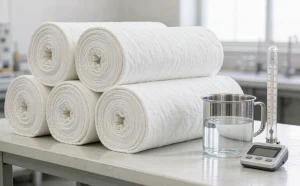
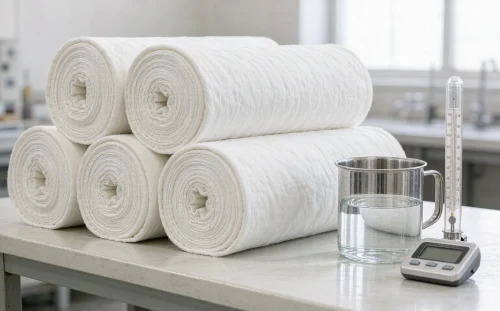
The Draves test is the working screen: a cotton skein or disc under a weight sinks in the surfactant solution, and the time to sink is the wetting time. The table below is illustrative, run at 25°C in standard hard water (342 mg/kg CaCO3) with SLS 92% added to an 80% a.i. WP base.
| SLS 92% in the WP | Wetting time at 25°C, 342 mg/kg | Suspension rate after 30 min | Foam in the spray tank | SLS cost per tonne of WP |
|---|---|---|---|---|
| 0% (no wetting agent) | Over 300 s | 62% | Low | 0 USD |
| 0.25% | 140 s | 71% | Low | 4.5 USD |
| 0.5% | 55 s | 78% | Moderate | 9.0 USD |
| 1.0% | 28 s | 83% | Moderate | 18.0 USD |
| 1.5% | 22 s | 84% | High | 27.0 USD |
| 2.0% | 20 s | 84% | High | 36.0 USD |
The curve flattens past about 1.5%. Wetting time improves by 2 seconds between 1.5% and 2.0% while foam climbs, and foam in the tank is a nuisance for the spray operator: it displaces product in the tank and makes the calibration mark hard to read. For most WPs the sweet spot is 0.5 to 1.0%, which is also where the cost per tonne stays under 20 USD at illustrative prices of 1,800 USD per tonne for SLS 92%.
SLS 92 vs SLS 95: when does the higher grade pay?
Both are white needles of the same molecule (CAS 151-21-3). SLS 93% and SLS 94% sit between them on active matter and salt, and most WP lines never need them; the gap between 92% and 95% is already small. SLS 92% carries petroleum ether soluble substances at or below 1.5% and inorganic salts at or below 4.0%; SLS 95% cuts sodium sulfate to 2.0% and water to 4.0% or less. Less salt and less water means faster dissolution in cold water, and that is the whole case for the higher grade.
Cold tank water is the trigger. SLS dissolution slows sharply below roughly 20°C, and a WP dosed at 0.75% with a 30-second target will miss it in a 12°C borehole tank when the SLS runs at 92%. At an illustrative 1,950 USD per tonne against 1,800 for SLS 92%, the extra 150 USD per tonne is 1.1 USD per tonne of WP at a 0.75% dose. That is a rounding error against a failed wetting screen, so choose SLS 95% when the tank water runs cold and SLS 92% when it does not. Our worked cost-per-kg example runs the same arithmetic for full-grade surfactants.
What happens in hard borehole water?
Hard water attacks the wetting agent directly: calcium and magnesium form the corresponding dodecyl sulfate salts, which are poorly soluble and precipitate out of the spray tank instead of wetting the powder. The Draves number above already includes that penalty, since the test ran at 342 mg/kg CaCO3. In really hard water, above 500 mg/kg, SLS wetting time roughly doubles and foam drops with it.
AOS 92% (active matter at or above 92%, CAS 68439-57-6) holds wetting far better in the same water because the alpha-olefin sulfonate does not form the same insoluble calcium salts. The trade is price and foam: AOS 92% costs more per kilogram and foams higher in the tank, and AOS 95% powder is the higher-grade option where freight per kilogram of active dominates. A practical split for hard-water regions is 0.5% SLS 95% plus 0.3% AOS 92% on the WP, which keeps wetting near 30 seconds and foam moderate. Keep the dispersant system separate; wetting agents and dispersants do different jobs, and the SVS versus SSS monomer comparison covers the polyelectrolyte dispersants that usually sit alongside it.
What does the wetting agent cost in a real formula?
Worked example, illustrative. An 80% a.i. WP with 1.0% SLS 92% and 3% dispersant system: the SLS line is 10 kg per tonne at 1,800 USD per tonne, which is 18 USD per tonne of WP. If the WP sells at 3,200 USD per tonne, the wetting agent is 0.56% of product cost. Switching from SLS 92% to SLS 95% adds 1.5 USD per tonne. Dropping from 1.0% to 0.5% saves 9 USD per tonne and costs 27 seconds of wetting time, which most label claims do not tolerate. The arithmetic rarely justifies going below 0.5% unless the active is already hydrophilic and the carrier is clay.
Key takeaways
- Working dose: 0.5 to 1.5% SLS 92% on the WP; wetting time flattens past 1.5% and foam keeps climbing.
- Cost per tonne of WP: 9 USD at 0.5% and 27 USD at 1.5% at an illustrative 1,800 USD per tonne.
- Choose SLS 95% for cold tank water below roughly 20°C; the extra cost is about 1.1 USD per tonne of WP at a 0.75% dose.
- Hard water above 500 mg/kg CaCO3: blend with AOS 92%, for example 0.5% SLS 95% plus 0.3% AOS 92%.
- Watch foam: 2.0% SLS wets 2 seconds faster than 1.5% and annoys the spray operator.
Frequently asked questions
Can AOS 92% replace SLS as the wetting agent?
In hard water, yes, and it performs better on wetting time. The penalties are cost per kilogram and foam in the spray tank. In soft water SLS is the cheaper wetting agent and AOS buys nothing the Draves test can show, so most formulators keep SLS for soft-water markets and switch only where hardness exceeds about 500 mg/kg CaCO3.
Does the wetting agent affect suspension rate?
Indirectly. A powder that wets fast breaks apart fast, so the dispersant has smaller agglomerates to work on, and the 30-minute suspension rate rises with it. The wetting agent is not a dispersant, though: if the suspension rate is the failing number, fix the dispersant system first, then re-check the wetting dose.
Will SLS foam ruin the spray operation?
Above about 1.5% on the WP it can, especially in tank-and-agitation systems where the operator judges volume by the liquid line. Keep the dose at or below 1.0% for high-foam actives, and remember that hard water suppresses foam while soft water amplifies it, so a formula tuned in a hard-water lab can foam over at a soft-water farm.
How should SLS be added during WP production?
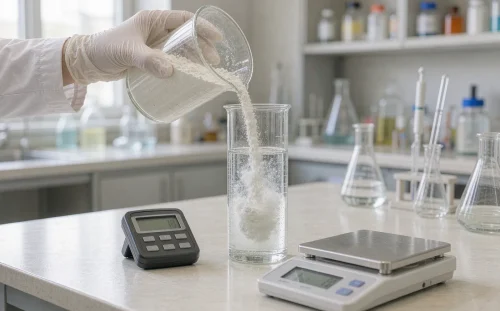
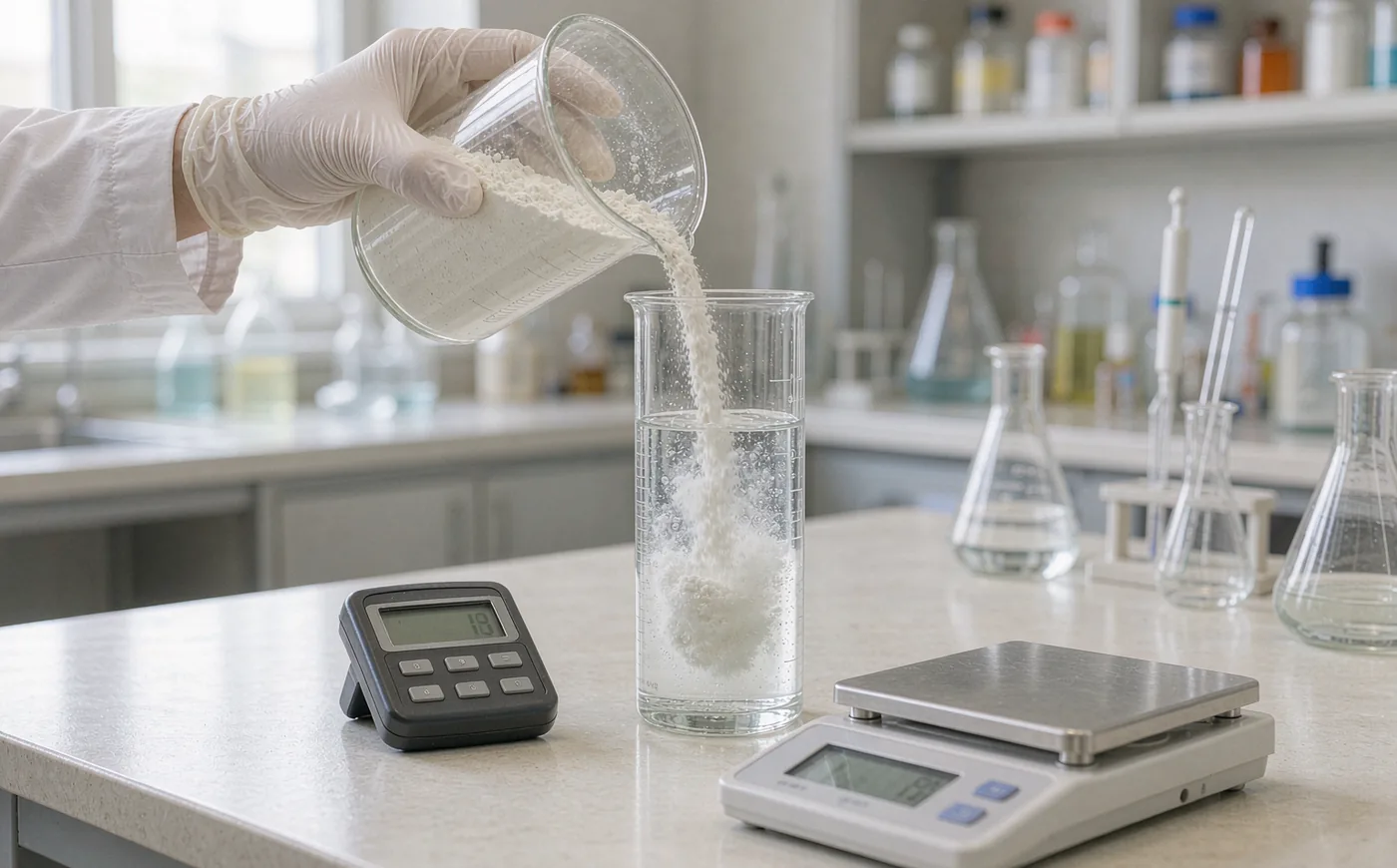
Dry blend it with the carrier and dispersant before the active is charged, or dissolve it in the water phase if the line runs a wet process followed by drying. Two practical points: SLS 92% holds water at 5% or less and SLS 95% at 4% or less, so store both sealed; and screen every incoming lot for wetting time, because needle form versus powder form changes dissolution speed. The needles versus powder note covers the form effect.
What documents should I ask for before ordering?
Lot COA with active matter, petroleum ether soluble substances, inorganic salts, water, pH of a 1% solution and color, plus the MSDS. If your registration file needs the wetting agent named, the COA should state the analysis method used for active matter; our two-phase versus direct titration comparison explains why that line matters.
Request a quote or a sample
For bulk pricing, MOQ and lead time on SLS 92%, SLS 95% or AOS 92%, request a quote with your destination port and annual volume. If you are qualifying a new wetting agent, request a sample and run the Draves screen against your incumbent lot. You can request the COA and MSDS for either grade, or contact our team with your active ingredient, carrier and tank water hardness and we will suggest a starting dose.
Written and reviewed by the ORID Chem technical team. Last updated: 15 November 2026. Prices, dose figures and test values in this article are illustrative working numbers, not quotations. Confirm current specifications on the product TDS and lot COA before ordering.